
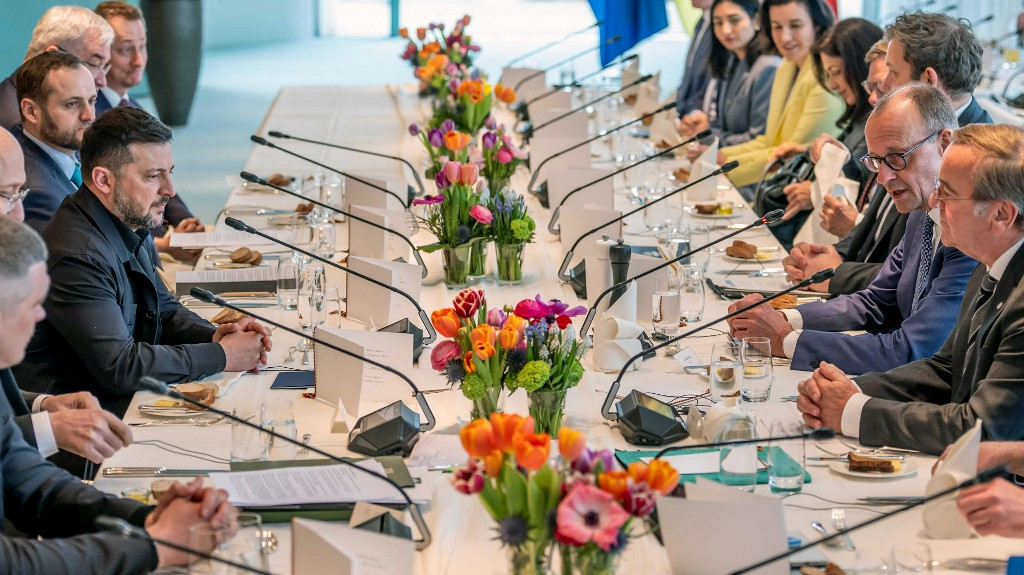
Ukraine and Germany agreed on a €4 billion ($4.7 billion) defense cooperation package covering Patriot missiles, 36 IRIS-T launchers, €300 million in long-range strike investments, and joint production of 5,000 AI-enabled drones. The deal boosts Ukraine’s air defense and domestic weapons capacity while deepening Berlin’s military support amid the war with Russia. The announcement is likely sector-relevant for defense suppliers and signals continued European security spending.
The important read-through is not the headline spend, but the signaling that Germany is moving from ad hoc support to quasi-industrial co-production with Ukraine. That shifts value from one-time munitions demand toward a multi-year procurement and capacity-build cycle, which is materially better for European defense primes, propulsion/electronics suppliers, and any small-cap drone/autonomy vendors with exportable software stacks. The market may be underestimating the second-order effect that battlefield data becomes a monetizable asset: German firms that can absorb Ukrainian combat feedback into product iteration should gain share in NATO procurement over the next 12-24 months.
For Ukraine, the near-term benefit is survivability, but the medium-term equity story is industrialization of warfighting. Joint drone production and domestic long-range weapon funding imply local assembly, testing, and software integration demand that can create a de facto defense manufacturing base despite the war, which is bullish for logistics, comms, and component supply chains outside the front line. The constraint is execution risk: Patriot and IRIS-T deliveries are bottlenecked by inventory, not capital, so the operational benefit may arrive in waves over quarters rather than immediately, leaving headline optimism ahead of actual battlefield improvement.
The contrarian angle is that this may be more inflationary for defense input chains than bullish for the combatant’s near-term security. If Germany prioritizes replenishment and co-production, the winners are likely not the obvious launch-system names but the deeper supply chain: sensors, semiconductors, guidance, and secure communications. The biggest risk to the thesis is a diplomatic thaw or US supply reprioritization that changes European urgency; absent that, the setup supports a sustained re-rating in European air-defense and drone-exposed names over 6-18 months.
AI-powered research, real-time alerts, and portfolio analytics for institutional investors.
Request TrialOverall Sentiment
mildly positive
Sentiment Score
0.20
Ticker Sentiment
