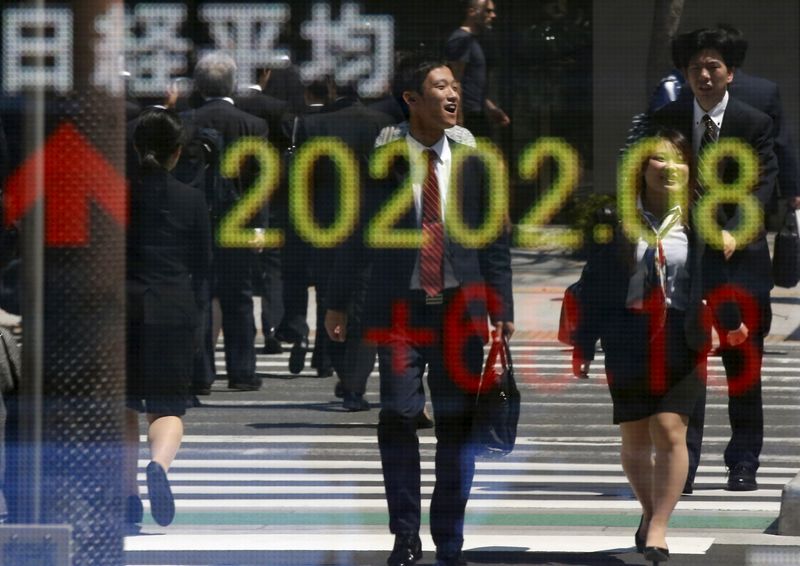
Asian equities surged on a preliminary U.S.-Iran peace deal, with South Korea's KOSPI up 5.6%, Japan's Nikkei 225 up 5.4% and both Nikkei and TOPIX at record highs. The agreement to reopen the Strait of Hormuz helped push oil prices lower, supporting import-dependent economies such as India, Japan and South Korea. Markets are also focused on this week's BOJ meeting, where a 25 bp rate hike is widely expected, alongside a likely unchanged RBA decision and the Fed later in the week.
The immediate market beneficiary is not just Asia beta; it is the entire imported-energy complex in Japan, Korea, India, and parts of Southeast Asia. Lower front-end oil and freight costs should show up first in airlines, chemicals, utilities, and consumer discretionary, while the second-order loser is the inflation trade: breakevens, energy miners, and any market pricing a sticky policy path on the assumption that oil stays elevated. The most underappreciated effect is on current-account sensitivity in import-heavy economies, which can mechanically support local FX and reduce the probability of policy tightening driven by imported inflation.
The bigger setup is that a relief rally in geopolitical risk often compresses volatility faster than fundamentals improve. If the Strait reopens smoothly, there is room for a multi-week unwind in hedges, but the market is vulnerable to headline reversals because the agreement still appears conditional and revocable on nuclear negotiations. That means the cleanest expression is not an outright directional macro bet, but a relative-value trade favoring beneficiaries of lower energy and lower rates versus sectors that were bid purely as geopolitical hedges.
For Japan, the policy implication is asymmetric: a softer oil tape reduces pressure on the BOJ to sound aggressively hawkish even if it still hikes. Equity investors may be over-interpreting the near-term rate move as a growth-positive signal, when in reality a stronger yen and tighter policy can quickly cap the rally unless domestic nominal growth keeps improving. In other words, the rally is strongest if oil keeps falling and the BOJ stays incrementally hawkish but not disruptive; if either condition breaks, the trade reverses sharply.
Consensus may be underpricing how much of this move is a short-covering squeeze rather than a durable re-rating. The risk/reward shifts after the first 3-5 sessions: if oil stabilizes and central banks deliver no surprises, the easy money in cyclicals fades, but if talks stall or there is any attack-triggered disruption, the market reprices from relief to tail-risk in hours, not weeks. That makes options and pairs more attractive than cash equities here.
AI-powered research, real-time alerts, and portfolio analytics for institutional investors.
Request DemoOverall Sentiment
strongly positive
Sentiment Score
0.72
