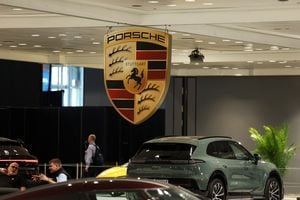
Porsche unveiled an all-electric Cayenne Coupe lineup starting at $113,800, with the top Turbo variant priced at $168,000 and producing up to 1,139 hp. The SUV is built on an 800-volt platform, supports up to 400 kW charging, and is expected to deliver about 360 miles of range under early real-world testing. The launch reinforces Porsche's EV transition while keeping the Cayenne line multi-powertrain through beyond 2030.
This is less a Porsche-specific headline than a validation of the premium EV playbook: performance, charging speed, and brand halo are still powerful enough to pull buyers into a higher-ASP segment despite broader EV demand fatigue. The second-order winner is Tesla’s charging ecosystem, because another marquee OEM standardizing on NACS reduces switching friction for affluent buyers and reinforces Tesla’s role as the default DC fast-charging interface, even when the vehicle itself is not Tesla-branded. That matters more over 12-24 months than the launch itself, because every new NACS adoption raises the odds of network utilization and adjacent charging-services monetization.
The more important competitive signal is to legacy premium OEMs: Porsche is showing that the luxury SUV buyer will pay for acceleration and software-adjacent features, but only if the product avoids the ‘compromise’ stigma that hurt early EVs. That should pressure BMW, Mercedes, and Audi to accelerate their own high-end EV refreshes, especially in markets where lease economics and charging convenience are decisive. The flip side is that this launch does not necessarily broaden the EV addressable market; it likely cannibalizes internal Porsche mix while expanding the total luxury EV pie only incrementally.
For TSLA, the stock-level impact is modest in the near term, but the narrative tailwind is durable: if a prestige rival is willing to publicly validate NACS and ultra-fast charging, Tesla’s charging standard becomes harder to displace. The contrarian view is that the market may be overpricing this as a demand win for EVs generally; in reality, it is a premium-segment substitution effect, and the mass-market adoption problem remains unresolved. The key risk is that luxury EV pricing stays too high versus ICE/hybrid alternatives, limiting volume and making the launch more of a brand statement than a profit engine.
AI-powered research, real-time alerts, and portfolio analytics for institutional investors.
Request TrialOverall Sentiment
mildly positive
Sentiment Score
0.35
Ticker Sentiment
