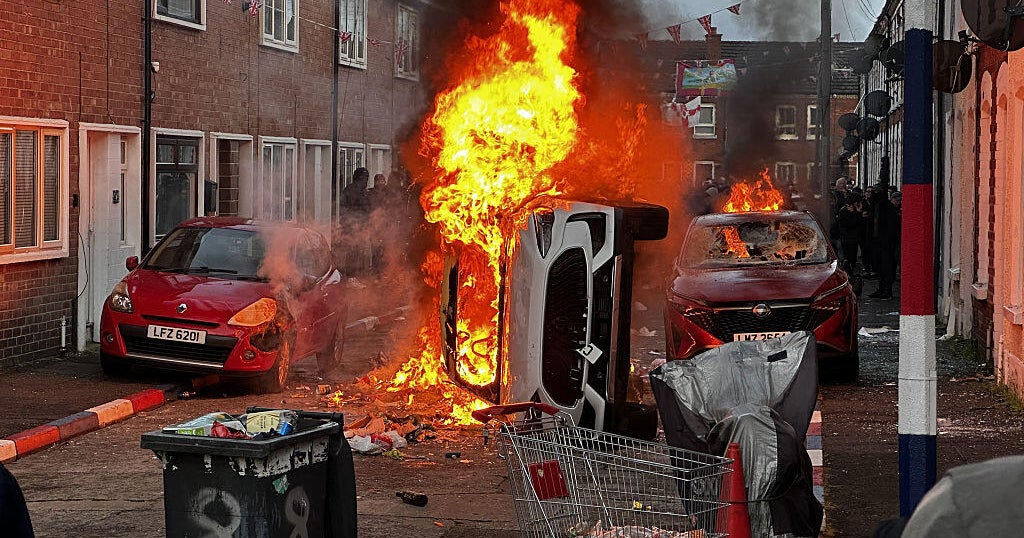
Violent anti-immigration unrest erupted in Belfast after a stabbing attack, with masked protesters reportedly burning buses, cars, trash cans, and homes; police said they responded to 62 incidents between 7pm and midnight. A Sudanese man was charged with attempted murder and related offenses, while officials including Northern Ireland's first minister and U.K. Prime Minister Keir Starmer condemned the violence. The article centers on public disorder, immigration tensions, and political fallout rather than direct market-moving economic data.
This is less a one-off public-order shock than a signal that immigration remains a high-beta political variable across the UK and Ireland. The immediate market read-through is not on direct revenue exposure, but on policy risk premia: anything tied to housing, local services, prisons, border administration, and private security can see a second-order bid as authorities respond with tighter enforcement, more visible policing, and potentially faster asylum processing. The clearest beneficiaries are likely firms with domestic government contracts and crowd-control/security exposure, while retailers, transport operators, and insurers with concentrated Belfast/Northern Ireland footprints face a short-lived but real disruption over the next several sessions.
The more important catalyst horizon is months, not days: sustained unrest raises the odds that immigration becomes a central issue in UK and Northern Ireland elections, which can widen spreads on sterling-sensitive domestic cyclicals and deepen discount rates on public-service dependent assets. If the story persists online, the feedback loop is dangerous because social amplification can outlast the original incident and travel to other cities, creating asymmetric downside for urban commercial property, hospitality, and transit operators with weak insurance terms or high footfall reliance. Watch for policy responses that are harsher on enforcement than on integration; those tend to support security, surveillance, and detention capacity while doing little for overall stability.
The consensus may be overestimating the duration of the street violence but underestimating the political permanence of the issue. In the near term, these episodes often mean-revert in markets once arrests and visible policing restore order, yet the reputational damage to incumbents and the anti-immigration narrative can linger into polling cycles. That makes this better expressed as a relative-value trade than a broad macro short: own the beneficiaries of security spending and short the most exposed domestic consumer/real-estate proxies into strength.
AI-powered research, real-time alerts, and portfolio analytics for institutional investors.
Request DemoOverall Sentiment
strongly negative
Sentiment Score
-0.80
