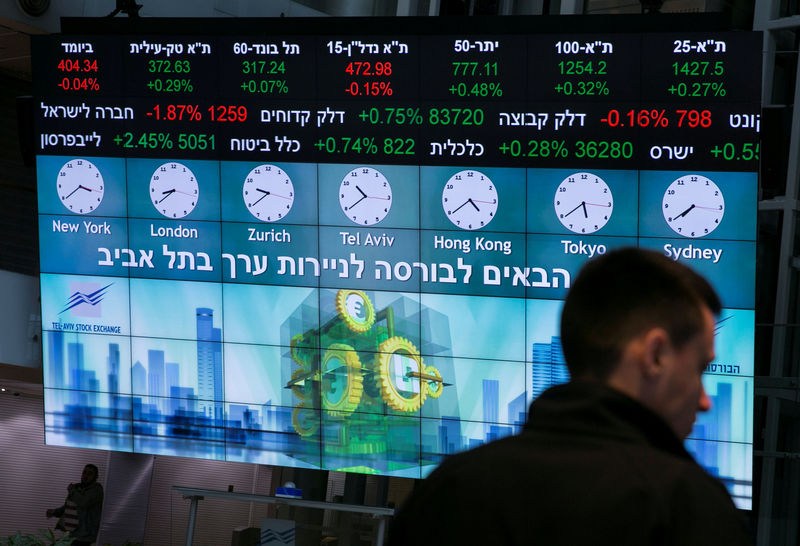
Israel's TA 35 rose 0.48% to a new all-time high, led by Migdal Insurance (+6.55%), Amot Investments (+6.39%), and Camtek (+4.47%), while NICE (-3.30%) and Israel Discount Bank (-2.32%) lagged. In commodities, crude oil fell 4.27% to $101.88, Brent dropped 2.96% to $111.05, and gold futures rose 1.24% to $4,589.51. USD/ILS weakened 0.64% to 2.94 and EUR/ILS fell 0.53% to 3.44; the headline on Strait of Hormuz adds geopolitical context but the body is primarily a market wrap.
The market is still pricing this as a contained geopolitical premium unwind, but the bigger signal is cross-asset regime drift: lower oil, firmer local equities, and a stronger shekel point to a short-term de-escalation trade rather than a durable resolution. That matters because the immediate beneficiaries are not just energy consumers; they are duration-sensitive domestic asset classes whose discount rates fall when imported inflation fears fade. In Israel, that favors insurers and real estate more than cyclicals because their liabilities and valuation multiples are most sensitive to rate and FX normalization.
The weak spot is quality growth and capital-light exporters tied to domestic slowdown risk. NICE looks less like a geopolitics victim and more like a crowding/valuation casualty: when local risk appetite rotates into financials and property, software names with slower near-term acceleration tend to get de-rated despite solid fundamentals. ENLT is also vulnerable because lower power-price anxiety can reduce the urgency premium embedded in renewable assets; if oil keeps bleeding over the next 2-6 weeks, the market may keep taking out the inflation hedge bid before the long-duration cash-flow story reasserts.
The contrarian read is that this move is probably underestimating follow-through risk in energy prices while overestimating the permanence of FX relief. A 3-5% additional drop in Brent from here would likely compress inflation expectations enough to help Israeli domestic multiples, but any renewed shipping disruption would quickly reverse the shekel strength and reprice the entire curve. The right framing is to trade the next 1-3 weeks as a mean-reversion window, not a structural thesis on geopolitics; that argues for using strength in lower-beta beneficiaries to fund shorts in names whose recent weakness is driven by style rotation rather than fundamentals.
AI-powered research, real-time alerts, and portfolio analytics for institutional investors.
Request DemoOverall Sentiment
neutral
Sentiment Score
0.10
Ticker Sentiment
