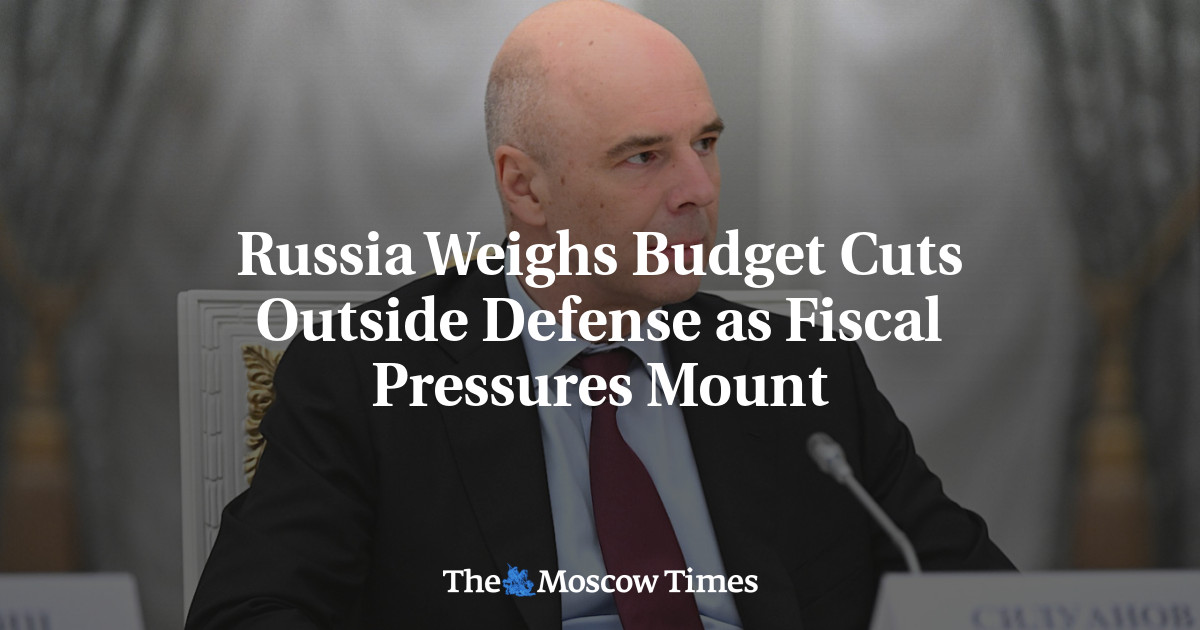
Russia's Finance Ministry is reviewing this year's budget and may cut non-defense, non-social spending as the 2025 deficit widens and growth slows to 0.4% from 1.2%. The January-April federal deficit reached 5.8 trillion rubles, more than double a year earlier and 1.6x the full-year target, while liquid NWF assets of 3.63 trillion rubles already fall short of the shortfall. Analysts warn the government may need 300-700 billion rubles of spending optimization this year or new revenue measures, including potential taxes, which would add pressure to an already weakening economy.
The key market implication is not the headline deficit itself, but the tightening feedback loop between slower nominal growth and a more tax-heavy funding model. In a system already suppressing private-sector confidence, any incremental revenue mobilization will likely hit the marginal ruble of corporate cash flow harder than the state’s arithmetic would suggest, because balance sheets no longer have much slack. That means the fiscal fix is increasingly self-defeating: higher levies or forced balance-sheet extraction would reduce investment, weaken collections further, and push the burden into 2026-2027 rather than close it cleanly this year.
The second-order winner is the domestic “priority” complex—defense-linked contractors, state banks, and politically favored firms—at the expense of everything discretionary, import-reliant, or capex-sensitive. The more interesting loser set is not just small business, but the broader industrial ecosystem that supplies it: logistics, machinery maintenance, commercial real estate, and consumer-credit dependent sectors should all see a slower payment cycle and more counterparty stress. If spending is cut where it is most efficient rather than where it is most protected, the immediate macro hit could be larger than the fiscal saving because those outlays have the highest multiplier.
Duration matters. Over the next 1-3 months, this is primarily a budget-execution story and can remain market-neutral if oil stabilizes or the state leans harder on one-off measures. Over 6-18 months, the risk is an adverse sovereign-credit spiral: weaker growth lowers tax intake, which increases reliance on domestic financing, which lifts debt-service costs and crowds out non-priority activity. The main reversal would be a meaningful oil-price rebound or a larger-than-expected tax/levy package that front-loads revenue, but both would likely worsen medium-term growth rather than restore quality.
Consensus is probably underestimating how hard it is to cut non-interest spending without breaking politically sensitive supply chains. The visible line item compression may look manageable, but the hidden cost is delayed payments, arrears, and deferred maintenance, which eventually show up in lower productivity and higher inflation friction. That argues for treating any ‘fiscal discipline’ headline as bearish for domestically oriented cyclicals and only conditionally supportive for sovereign risk, because the adjustment path itself is recessionary.
AI-powered research, real-time alerts, and portfolio analytics for institutional investors.
Request DemoOverall Sentiment
strongly negative
Sentiment Score
-0.68
