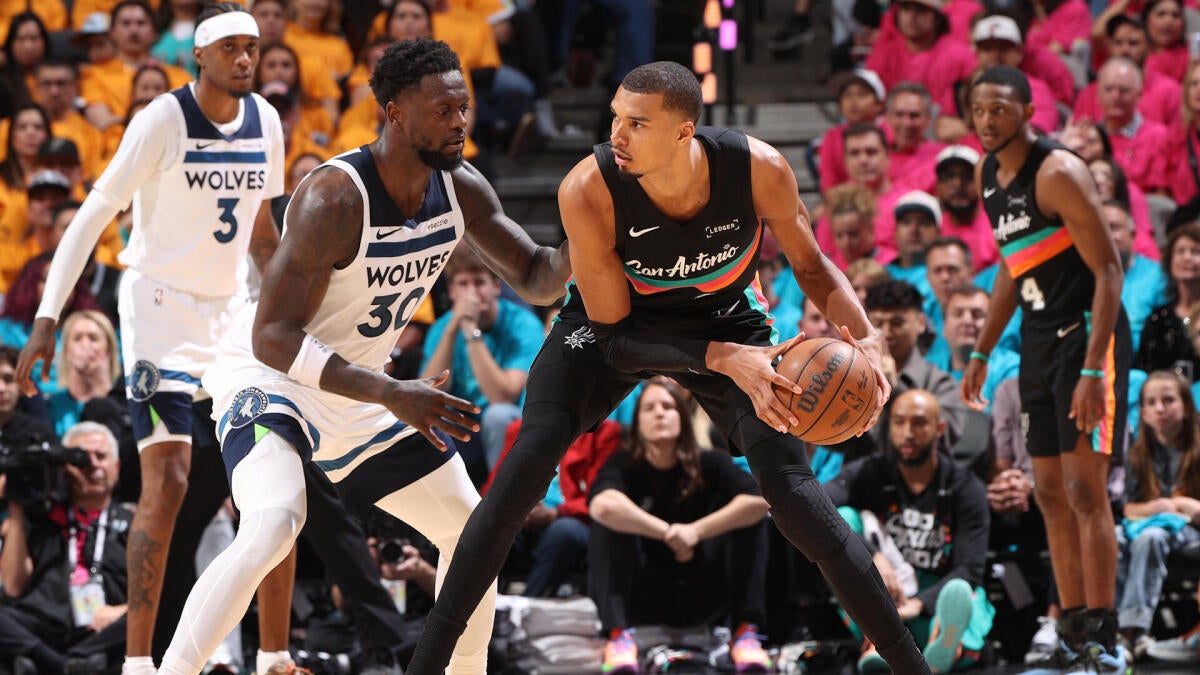
The Spurs shifted from roughly -3000 pre-series to -200 after a 104-102 Game 1 upset by the Timberwolves, while Minnesota moved from about +1200 to +160. The article argues the move is an overreaction and recommends backing San Antonio to win the series in six, citing Anthony Edwards' limited health and Minnesota's thin depth. A second-round Timberwolves upset at +1000 or greater would be a rare NBA playoff outlier.
The setup here is less about basketball and more about how a binary event got repriced after one game, creating a classic volatility-arbitrage window. In series markets, the first loss after a large favorite is often where implied probability overshoots because public money extrapolates a short sample into a full-state change; that tends to be most acute when the favorite still retains home-court and the better underlying season-long profile. The key second-order effect is that the underdog’s Game 1 win likely tightens in-game and series prices across the next 1-2 games, but the favorite’s cheaper series line can actually become more attractive if the market is over-penalizing one result relative to the remaining game distribution.
The market is also underweighting the fatigue and rotation constraints that show up only after the first upset. Underdogs that win with a thin rotation frequently face diminishing returns in Games 2-4 because defensive intensity, foul trouble, and shooting variance become less replicable when the favorite adjusts to the specific actions that worked once. That creates a path where the underdog can remain live in the near term while the favorite’s long-run series edge reasserts itself, which is why the most attractive entry is usually after the first emotional reaction, not before it.
The contrarian read is that the consensus is correctly identifying upset risk but mispricing the magnitude: a single-game upset does not justify treating the series as near coin-flip unless the favorite has a structural injury or matchup break that persists. Here, the better framing is not "back the favorite because they're better," but "buy the favorite only when the market grants enough margin for two more losses before the thesis breaks." That implies the edge is in timing and structure, not directional conviction.
Tail risk remains that the underdog’s star availability becomes closer to full strength and the favorite’s offense fails to solve the defensive scheme, in which case the new price is still too low. But the base case over the next 3-5 days is mean reversion in the series line as the market recognizes that one upset does not eliminate a talent gap; if the favorite wins Game 2, the pricing reset could be swift and violent.
AI-powered research, real-time alerts, and portfolio analytics for institutional investors.
Request DemoOverall Sentiment
neutral
Sentiment Score
0.10
