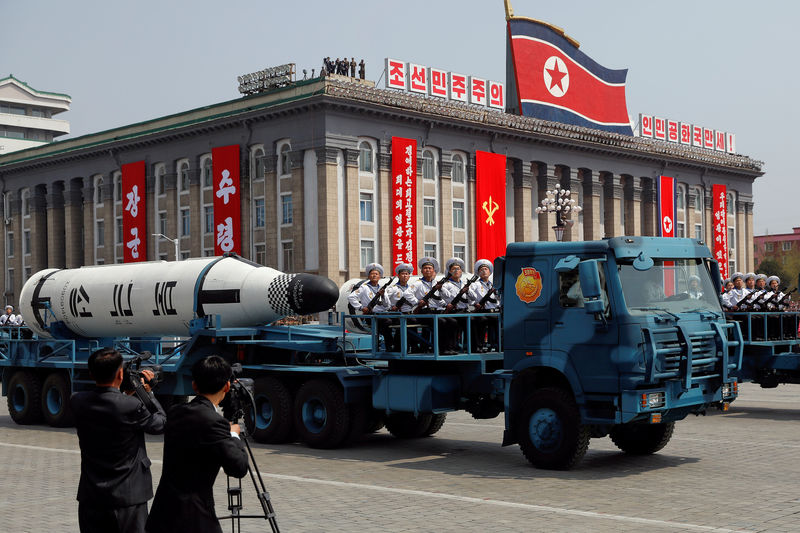
North Korea launched an unidentified ballistic missile on Saturday, adding to a recent pattern of missile tests and escalating geopolitical tensions. The article ties the launch to heightened U.S.-Iran conflict dynamics and the Strait of Hormuz energy-chokepoint risk, which could worsen supply chain disruptions and keep energy markets volatile. Broader market sentiment is likely risk-off given the multi-front security backdrop.
The market is trading two linked but distinct geopolitical channels: near-term energy disruption risk and medium-term defense budget reallocation. The immediate effect is not on the headline target names but on second-order beneficiaries of maritime hardening, ISR, missile defense, and base security equipment; those cash flows can re-rate quickly when risk committees extend duration on “containment” trade baskets. If the Middle East stays unstable, defense spend tied to ship defense, radar, and interceptors should see a higher probability of incremental procurement over the next 1-2 quarters, even if top-line budgets are unchanged.
For NOC specifically, the setup is less about the event itself and more about the probability of follow-on orders across naval systems, command-and-control, and replenishment chains. The stock typically reacts first to narrative, but the fundamental lift comes later through backlog quality and mix shift toward higher-margin sustainment and sensor content. The risk is that the market is already pricing a generic geopolitics premium; without a clear contract catalyst, beta can fade once headlines stabilize.
The larger second-order loser is the industrial and transport complex if energy volatility persists and shipping insurance/rerouting costs stay elevated. That creates a delayed margin squeeze over 1-2 quarters via freight, inventory buffers, and working capital, even if oil itself mean-reverts. A ceasefire failure would likely steepen the dispersion trade: long defense, short cyclicals/exposed shippers, with the strongest alpha coming from names whose input costs and delivery times are most sensitive to chokepoints rather than from broad market hedges.
AI-powered research, real-time alerts, and portfolio analytics for institutional investors.
Request DemoOverall Sentiment
moderately negative
Sentiment Score
-0.35
Ticker Sentiment
