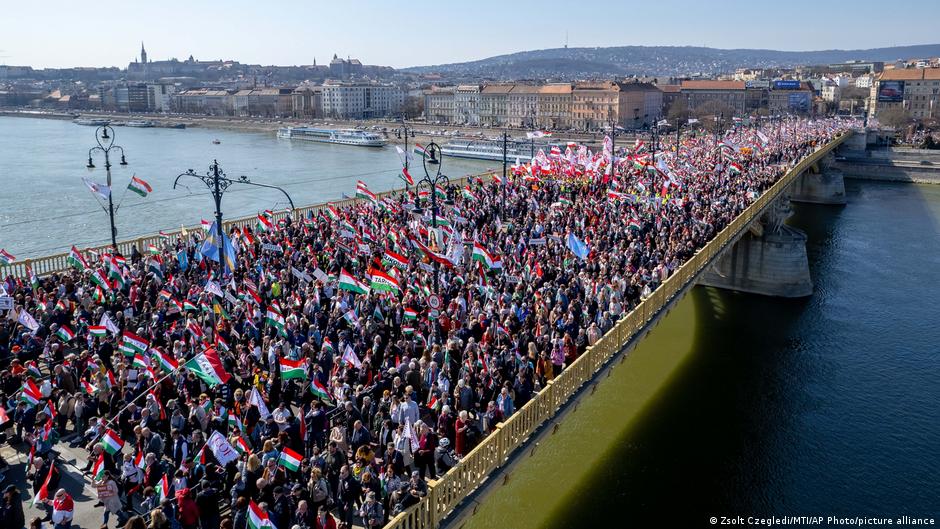
April 12, 2026 national election: rival rallies in Budapest saw Prime Minister Viktor Orban and his Fidesz supporters stage a large 'peace march' while opposition leader Peter Magyar drew at least 100,000 at Heroes' Square. The campaign highlights a stark choice over Hungary’s foreign alignment—Orban maintaining a pro-Kremlin stance and criticizing Ukraine, while Magyar vows to firmly re-align with the EU and NATO; recent frictions include Ukraine blocking Russian oil deliveries to Hungary and Hungarian authorities detaining a Ukrainian cash shipment. The outcome will affect regional geopolitical risk and could influence energy transit and EU relations, but this report alone is informational and unlikely to move markets materially in the near term.
The election is a binary political-volatility event with asymmetric economic channels: a pro-EU outcome would likely unlock stalled EU transfers and lower political risk premia, compressing Hungary sovereign spreads and appreciating HUF by mid-single digits within 1–6 months; the opposite outcome would keep access to EU capital restricted and raise the probability of targeted EU measures, pushing spreads wider and HUF weaker by a similar magnitude. Energy flows are the clearest transmission mechanism to markets — any further friction over Russian oil transit or Ukrainian interdiction raises tactical supply risk for regional refiners and logistics, creating idiosyncratic winners (companies with diversified crude sourcing) and losers (those reliant on contested routes).
Expect event-driven volatility to spike in the 10 trading days bracketing April 12 and to reprice structurally over the following 3–12 months as fiscal transfers and regulatory stances crystallize; short-term market moves will be driven more by position-squaring and FX funding flows than by fundamentals. A key second-order effect is bank funding: domestic banks’ foreign-currency liabilities and FX liquidity lines are exposed to HUF moves — a widening in 1Y FX swaps and cross-currency basis could force deleveraging in local credit, amplifying price moves in equities and sovereign bonds.
Consensus appears to underweight path dependency — even a narrow opposition win will not immediately reverse 16 years of regulatory legacy or restore full capital flows; materially lower political risk requires both election victory and multimonth institutional changes. Conversely, the market may be underpricing the tail where sustained Hungarian-EU rupture triggers sector-specific sanctions (energy, banking) that would disproportionately damage local incumbents and create relocation opportunities for competitors elsewhere in the EU.
AI-powered research, real-time alerts, and portfolio analytics for institutional investors.
Request DemoOverall Sentiment
neutral
Sentiment Score
0.00
