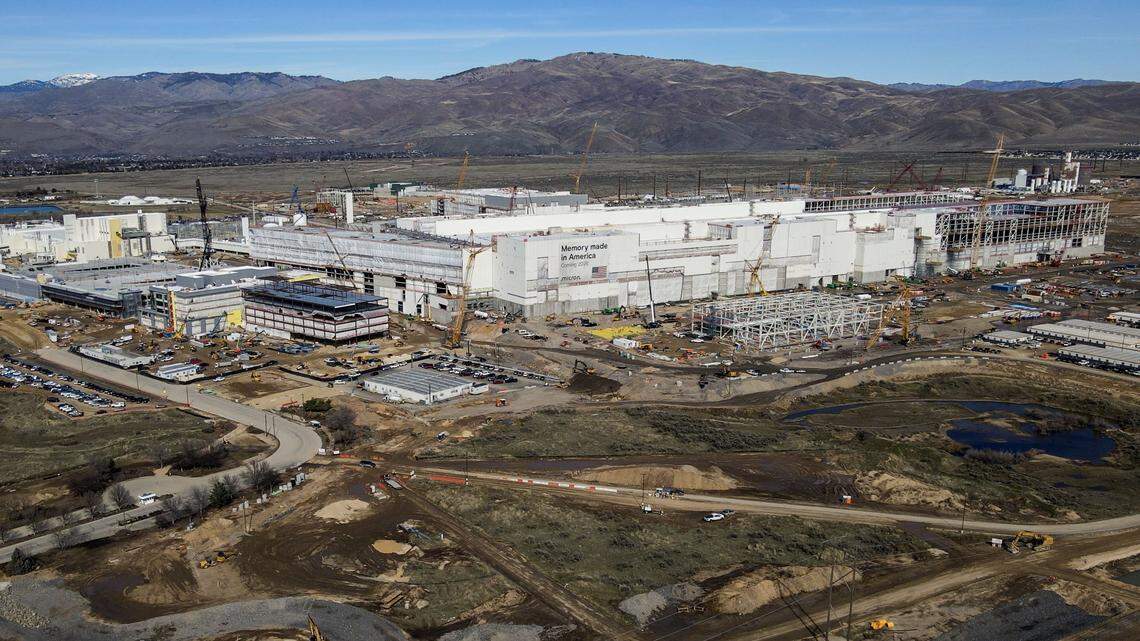
Micron plans roughly $200 billion in domestic investment to expand DRAM/HBM capacity and aims to produce 40% of U.S. DRAM, driving sector supply responses. The company reported record quarterly revenue of $13.6B (up from $11.3B prior quarter), has HBM sold out for the year, expects ~ $18.78B revenue in the next release, and its stock has rallied over 300% to a high of $437.80. The capex push includes two $25B Idaho fabs, multiple U.S. fabs (Clay, NY), and major international fabs (Japan $9.6B, Singapore $24B, India assembly/test ~$2.8B), with sizable local employment and real-estate spillovers.
The headline expansion masks a two-speed cash flow cycle: equipment vendors see near-term pull-through (orders booked, design wins, longer lead times) while wafer-level supply only meaningfully increases once fabs start production in 2026–2028. That timing mismatch creates a 12–36 month window where capital-equipment OEMs can re-rate independently of memory OEM margins, because orders convert to revenue well before wafer output hits the market and pressures selling prices.
Second-order winners are not just front-end toolmakers but specialty subcontractors (clean-room integrators, utility upgrades, cryogenics/thermal management) and regional construction/engineering firms that capture lumpy, high-margin revenue during buildouts; losers could be spot DRAM/HBM sellers and smaller memory pure-plays if supply growth overshoots AI demand or if hyperscalers vertically integrate. Geopolitics is a structural amplifier: CHIPS-era subsidies lower project financing risk but also concentrate capacity in friendly jurisdictions, raising strategic barriers for Chinese fabs and increasing premium pricing power for U.S.-based suppliers — until geopolitical détente or technological substitution alters demand.
Downside catalysts that would reverse the trade are clear and serial: (1) large-scale capacity announcements + rapid execution by Samsung/SK within 18–36 months, (2) a demand pullback from hyperscalers if model architectures reduce HBM intensity, or (3) material order deferrals stemming from macro weakness that extend equipment lead times and force rebooking. Time arbitrage matters: capture equipment-cycle rerating in 6–18 months and de-risk before wafer-level inventory normalization around 24–36 months.
AI-powered research, real-time alerts, and portfolio analytics for institutional investors.
Request DemoOverall Sentiment
extremely positive
Sentiment Score
0.90
Ticker Sentiment
