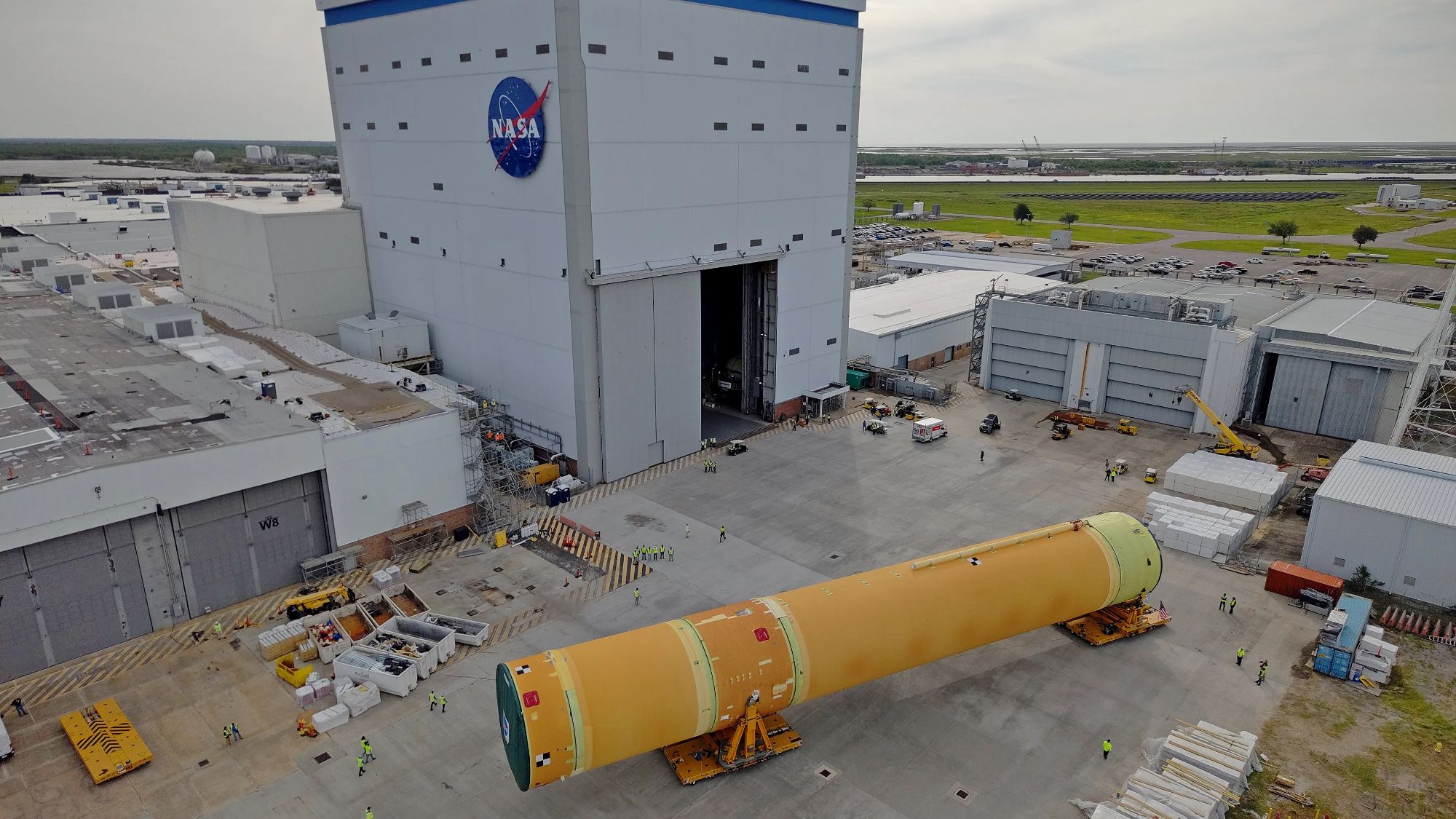
NASA rolled out the Artemis 3 SLS core stage on April 20, a milestone toward the mission’s targeted mid-2027 launch. The 212-foot integrated core stage will be assembled in Florida for final integration, supporting plans for a crewed lunar-orbit test and eventual Artemis 4 landing in late 2028. The article is largely a factual progress update with limited direct market relevance.
This is a credibility and schedule signal more than a near-term revenue event: the program’s biggest hardware moving to the launch site de-risks the political narrative around Artemis, but it does little for cash flow until the broader cadence proves repeatable. The market should think in terms of options value for the supply chain rather than a clean budget winner, because each successful integration step increases the odds that Congress preserves funding while also pulling forward procurement for ground systems, cryogenics, avionics, and launch support.
The second-order beneficiary set is likely better exposed than the obvious primes. A sustained Artemis timeline tends to favor niche high-reliability suppliers and test/electrical integration vendors that sit inside NASA’s long qualification cycle, while the largest prime contractors remain vulnerable to headline-driven scrutiny if the schedule slips again. The key economic implication is that “success” can still be bearish for some names if it reduces schedule slack and exposes bottlenecks in the lander and integration chain over the next 12-24 months.
The real risk is not this hardware move but the next 6-12 quarters of execution: any anomaly in final integration, cryogenic performance, or the Earth-orbit docking demonstration could reset confidence and push the moon landing timeline out by another year or more. That would likely compress expectations for the broader NASA contractor ecosystem and re-open debate over whether the program is becoming a cost sink rather than a durable procurement stream.
Contrarian angle: the consensus may be too focused on the moon-landing headline and underestimating the industrial base buildout. The better trade is not on “space” broadly, but on firms with recurring testing, mission-assurance, and propulsion-adjacent exposure where each delay still means billable engineering hours and contract extensions. In that sense, schedule slippage can be monetized by the pick-and-shovel layer even when it is politically painful for the flagship program.
AI-powered research, real-time alerts, and portfolio analytics for institutional investors.
Request TrialOverall Sentiment
mildly positive
Sentiment Score
0.20
Ticker Sentiment
