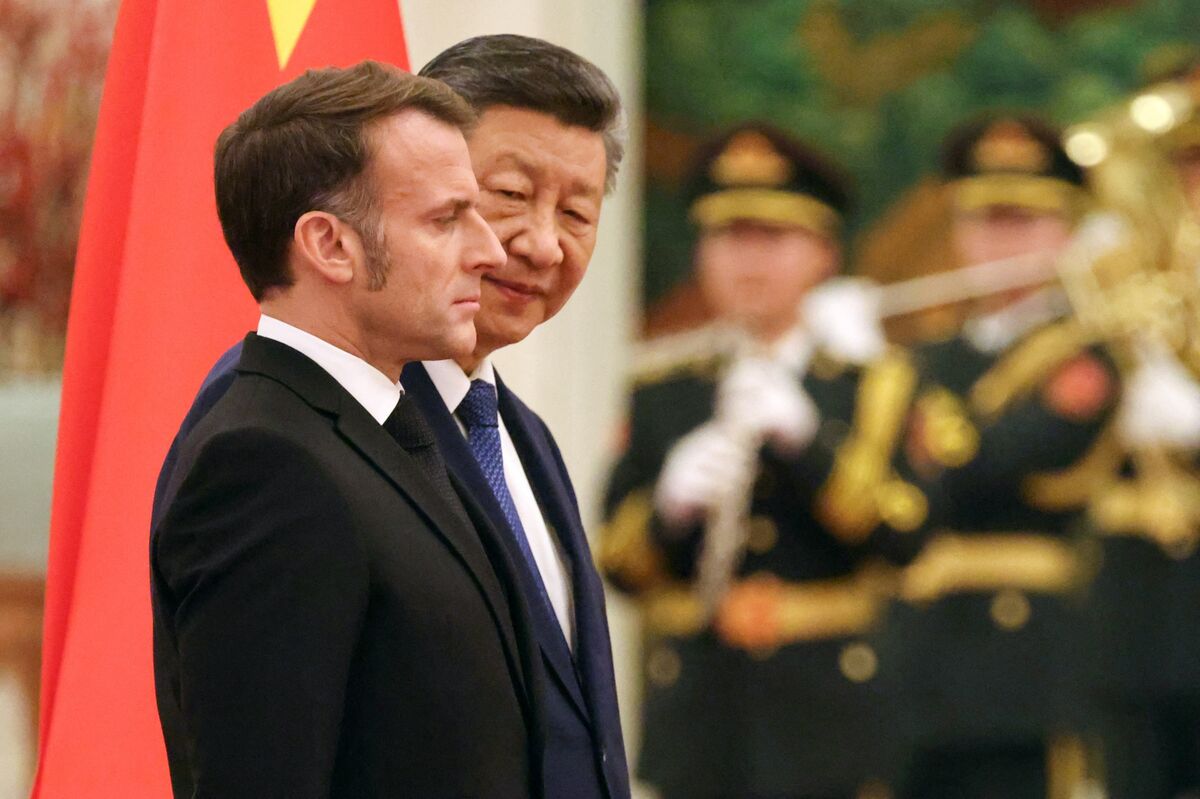
French President Emmanuel Macron met Chinese leader Xi Jinping in Beijing during a three-day state visit to discuss bilateral economic ties, trade tensions, Taiwan and the war in Ukraine. Despite public displays of personal rapport, substantive political differences remain unresolved, leaving open the prospect of future policy shifts on trade and sanctions and maintaining elevated geopolitical risk for European exporters and investors with China exposure.
Market structure: A France-China thaw that produces concrete trade/access agreements would disproportionately benefit French luxury (LVMH/Kering), tourism, and aerospace (Airbus) through pricing power and order flow; expect a 3–6% revenue tailwind within 6–12 months for names with >10% China exposure if MOUs convert to orders. Conversely, defense primes and firms positioned to profit from Sino-Western decoupling (semiconductor import-substitutes, dual-use exporters) lose optionality and political pricing power, pressuring multiples by 5–15% on re-rated geopolitical risk assumptions.
Risk assessment: Tail risks include a Taiwan escalation or renewed export controls (10–20% probability over 12 months) that would invert any short-term gains and spike risk premia; immediate (days) reaction will be headline-driven, short-term (weeks–months) will hinge on signed agreements, long-term (quarters–years) will depend on implementation and EU policy alignment. Hidden dependencies: Chinese stimulus and approval of inward investment are the gating variables—without Beijing’s fiscal impulse, MOUs won’t translate to orders.
Trade implications: Actively favor selective long exposure to French luxury and aerospace while hedging geopolitical premium compression: concentrated, staged long positions (2–3% portfolio) in MC.PA and 1% in AIR.PA via equity or call-spread structures over 3–6 months. Implement relative-value: long MC.PA / short ITA (iShares U.S. Aerospace & Defense ETF) to express a China-normalization view; add a 3–12 month EUR/CNH long forward (size 1–2% risk) as a macro carry if EUR/CNH breaks +0.5% on joint communiqué.
Contrarian angles: The market underestimates the immediacy of deal flow—France can secure discrete industrial deals (EV batteries, aerospace offsets) that re-rate small/mid French industrials by 10–25% if executed, but history shows many summit MOUs fail to convert, so positions must be tranche-sized. Unintended consequence: a short-term influx of Chinese capital could trigger EU political backlash and retroactive restrictions; size trades to tolerate a 15–25% drawdown and use options to cap tail risk.
AI-powered research, real-time alerts, and portfolio analytics for institutional investors.
Request DemoOverall Sentiment
neutral
Sentiment Score
0.00
