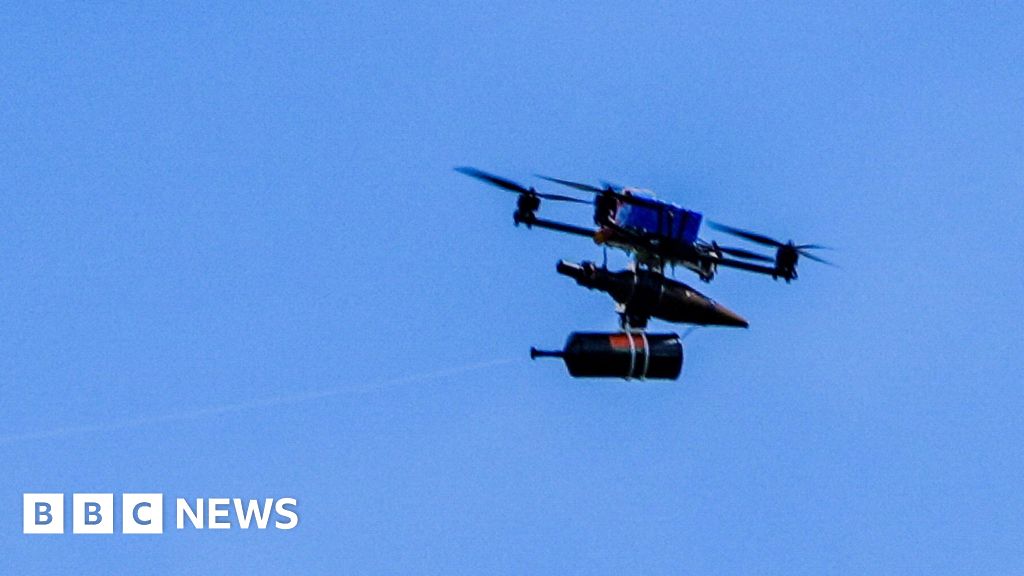
Hezbollah has made fibre-optic FPV drones its primary weapon against Israel, with 8 of 12 Israeli deaths since the ceasefire attributed to these drones and more than 100 attacks on communities inside Israel since April. The article describes escalating cross-border strikes, Israeli evacuation orders in southern Lebanon, and a growing race to develop counter-drone defenses and retaliatory tactics. The conflict is intensifying despite ceasefire constraints and is now a significant regional geopolitical and defense risk.
The key market implication is that low-cost, hard-to-detect FPV/fibre-optic drones are shifting the offense-defense equation from platform-centric to sensor/munition-centric warfare. That favors companies selling electro-optical detection, autonomous fire-control, counter-UAS software, fragmentation rounds, and expendable interceptors, while compressing the moat of legacy air-defense systems that were optimized for rockets, mortars, and larger UAVs. The second-order effect is budget reallocation: every incremental dollar spent on point defense and battlefield awareness is a dollar not spent on heavier platforms, creating a procurement mix shift that should persist for years rather than weeks. The near-term catalyst is escalation pressure, not just tactical adaptation. As drones lower the threshold for cross-border attrition, commanders are incentivized to strike launch crews, storage sites, and deeper command nodes, which raises the probability of a broader Lebanon campaign if a high-casualty drone event hits civilians. That creates a convex risk profile: headline risk can gap higher defense names on each escalation, but the larger macro trade is that persistent border insecurity keeps Israel in elevated mobilization mode, supporting demand for ISR, loitering munitions, hardened communications, and perimeter security. Contrarianly, the market may be underestimating how quickly this becomes a procurement and export opportunity for Israeli defense tech rather than just a geopolitical shock. Ukraine has already validated the tactical problem; the winner is not the first mover in tanks or jets, but the firms able to industrialize cheap countermeasure stacks at scale. The main reversal trigger is a durable ceasefire enforced by external patrons, but absent that, the adaptation cycle should run for multiple quarters and likely expand to other theaters, which broadens the addressable market for counter-drone vendors globally.
AI-powered research, real-time alerts, and portfolio analytics for institutional investors.
Request DemoOverall Sentiment
strongly negative
Sentiment Score
-0.70
