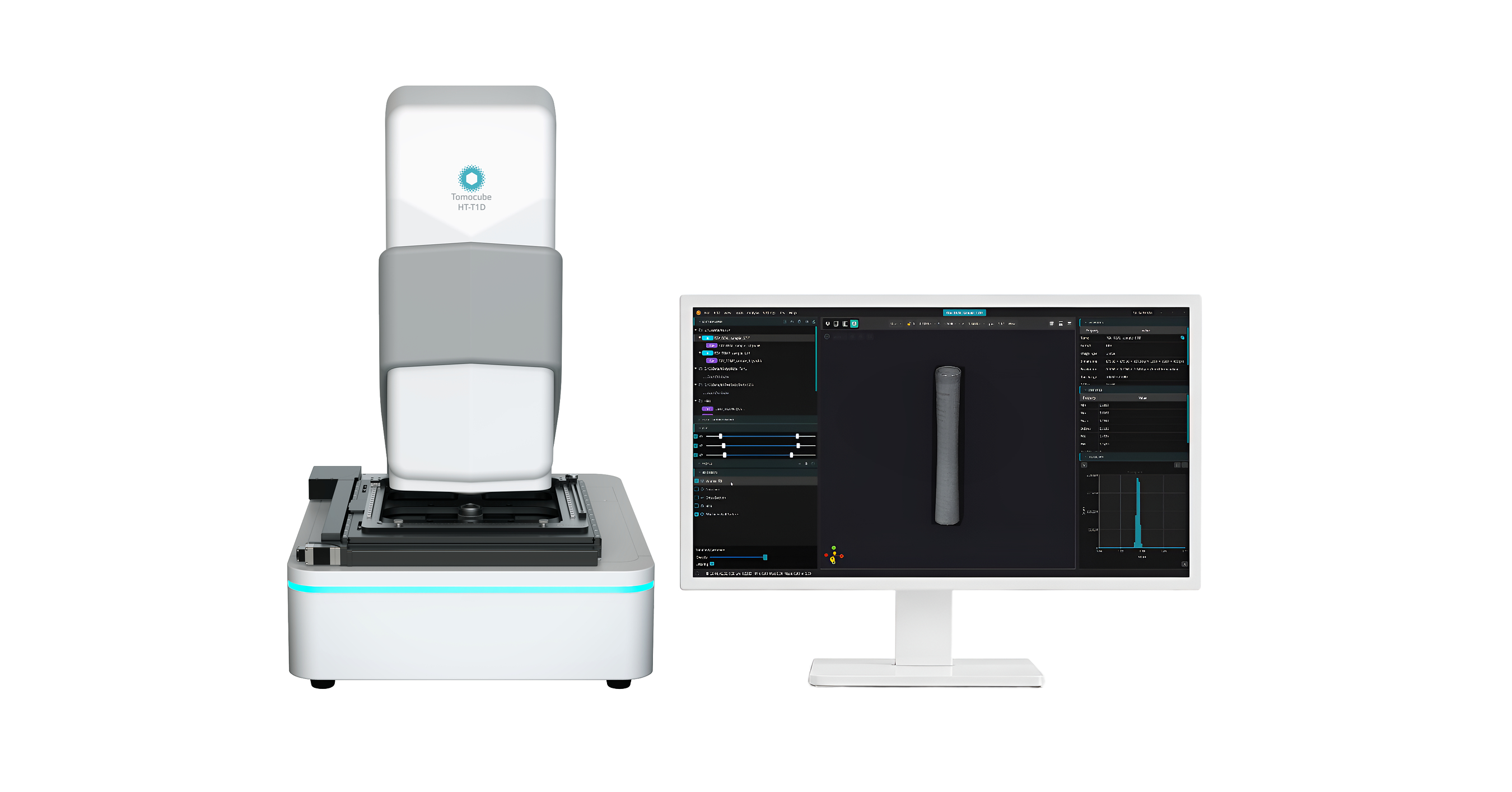
Tomocube launched the HT-T1 Desktop (HT-T1D), a compact holotomography system for non-destructive 3D defect analysis of glass substrates used in next-gen semiconductor advanced packaging. It visualizes 3D refractive-index distributions with reported sensitivity of $10^{-4}$ and is expected to cut destructive failure-analysis cycles from days/weeks to minutes, accelerating yield learning and root-cause identification. The company also introduced TAMI (TomoAnalysis MI) to connect R&D 3D analysis with production-line verification, including compatibility with its planned in-line module HT-T1M.
The investment significance is not the product launch itself, but the signal that glass substrates are moving from R&D novelty to a production-learning problem. That tends to favor the broader metrology/inspection stack first, because every new defect mode in a new packaging medium forces more measurement, data management, and process-control spend before it unlocks meaningful unit volume. In that sense, the near-term winners are equipment vendors with advanced packaging exposure and the substrate ecosystem that can now shorten yield ramps; the first-order loser is any pure destructive FA workflow that loses urgency once non-destructive root-cause tools become good enough.
Second-order, faster yield learning can compress the timeline for glass adoption in AI accelerators and CPO, which is more important than the launch revenue itself. If that happens, it strengthens the case for upstream capex in inspection, laser processing, and panel handling, but also raises the bar for substrate makers: improved visibility tends to expose process drift sooner, which can temporarily increase scrap and rework before it improves yields. The mechanism is classic: better measurement lowers uncertainty, but it also reveals where current process windows are too narrow.
The contrarian view is that the addressable market may still be smaller than the press release implies. If glass substrates remain in pilot or pre-volume phases, this can be a high-value tool in labs without becoming a material line-item in production budgets; the true bottlenecks may sit in materials purity, warpage control, or thermal reliability rather than defect imaging. Time horizon matters: days-to-weeks reaction should be negligible for listed equities, but over 6-18 months this is a mild positive read-through for advanced packaging metrology, not a standalone catalyst.
AI-powered research, real-time alerts, and portfolio analytics for institutional investors.
Request TrialOverall Sentiment
mildly positive
Sentiment Score
0.35
