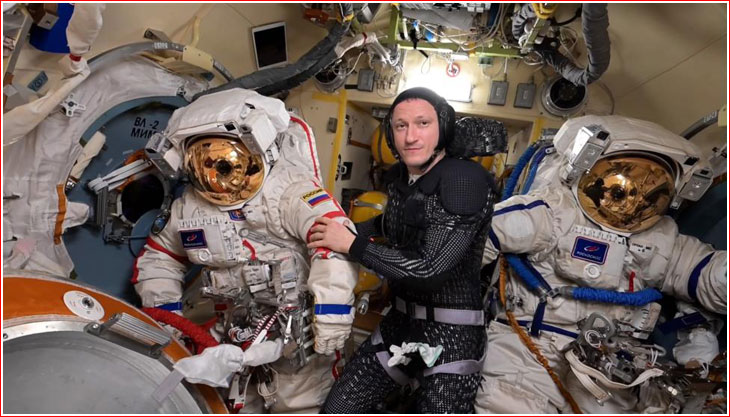
Russian cosmonauts Sergei Kud'-Sverchkov and Sergei Mikaev completed a 6-hour 5-minute spacewalk on May 27, 2026, installing the 50-kilogram Solntse-Teragerts telescope on the ISS and carrying out several external maintenance and experiment-retrieval tasks. The EVA also included work on the Ekran-M and Biorisk experiments and securing a failed Kurs-NA antenna on Progress MS-33. The article is an operational mission update with no direct financial market implications.
This is a small but useful signal that the Russian segment is still capable of executing complex on-orbit integration despite aging hardware and a constrained EVA cadence. The bigger implication is not the science payloads themselves; it is that Roscosmos can still service and reposition external assets with robotic support, which modestly reduces near-term perceived operational risk around the segment and preserves station uptime for the remaining life of ISS-era contracts. The second-order winner is the broader set of suppliers tied to space robotics, EVA tooling, and high-reliability space electronics, because the mission validates a workflow that substitutes robotics for scarce EVA minutes. That matters more than the individual experiments: when crews can offload translations, precise positioning, and object handling to robotic assistance, future external maintenance becomes less labor intensive and potentially cheaper per task. The loser is any assumption that aging station architecture forces near-term mission degradation; instead, the system is showing resilience, which can delay procurement urgency for replacement platforms and keep budget allocation fragmented. The contrarian read is that this is not a commercialization catalyst; it is a proof of operational endurance. Markets often overrate visible “firsts” and underrate how much of space infrastructure demand is still driven by maintenance, integration, and inspection rather than science payloads. The relevant horizon is years, not days: the trade is around who benefits from sustained government spending on robotic servicing, external sensors, and fault-tolerant avionics as legacy stations age out. Key risks are failure of the telescopes/experiments to deliver usable data, or a negative follow-on incident from the undeployed antenna issue that exposes reliability problems in cargo/EVAs. If such anomalies accumulate over the next several months, it would shift the narrative from resilience to decay and could accelerate spending toward next-generation stations and servicing platforms.
AI-powered research, real-time alerts, and portfolio analytics for institutional investors.
Request DemoOverall Sentiment
neutral
Sentiment Score
0.10
