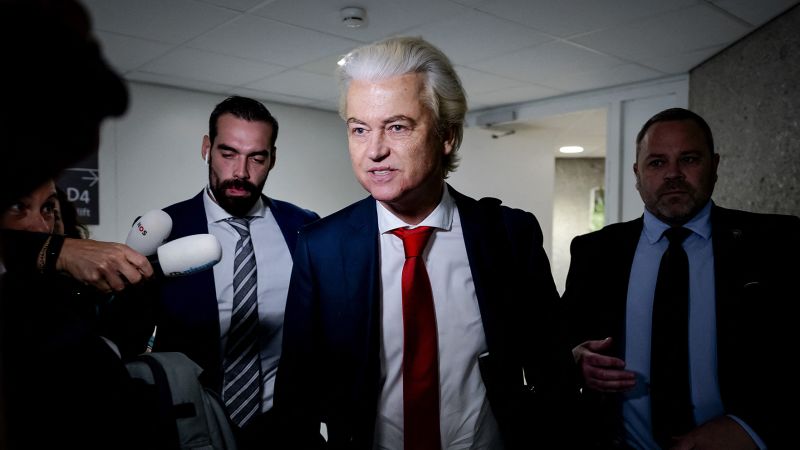
The Dutch government has collapsed after Geert Wilders' Party for Freedom (PVV) withdrew its support over disagreements regarding asylum policy, creating political uncertainty. Wilders stated the coalition refused his proposals for stricter border controls and asylum-seeker policies, leading to the PVV's exit. While polls suggest the PVV would likely remain the largest party if elections were held, its ability to form a new government remains uncertain given the fragmented political landscape.
The collapse of the Dutch governing coalition, triggered by the far-right Party for Freedom's (PVV) withdrawal over irreconcilable differences on asylum policy, has plunged the Netherlands into significant political uncertainty with potential, albeit currently limited, geopolitical reverberations concerning EU immigration stances. PVV leader Geert Wilders attributed the withdrawal to the coalition's refusal to implement his proposed "strictest asylum policy," thereby reducing Prime Minister Dick Schoof's government to a minority of just 51 out of 150 parliamentary seats and leading to calls for snap elections. This development occurs within the context of the PVV having been the clear winner of the November 2023 election, though Wilders did not assume the premier role in the now-fallen coalition, which was described as the most right-leaning in Dutch history. Current polling suggests the PVV might remain the largest party despite potential seat losses, yet the fragmented nature of Dutch politics—where coalition governments are the norm—casts considerable doubt on the ease of forming a new, stable administration. The associated "mildly negative" sentiment (-0.3) and "uncertain" tone, along with a low market impact score of 0.3, reflect this domestic political instability, which could see center-right and center-left parties gain in new elections. This situation primarily highlights heightened domestic political risk and policy ambiguity for the Netherlands, with the asylum debate touching on broader European geopolitical themes.
AI-powered research, real-time alerts, and portfolio analytics for institutional investors.
Request DemoOverall Sentiment
mildly negative
Sentiment Score
-0.30
