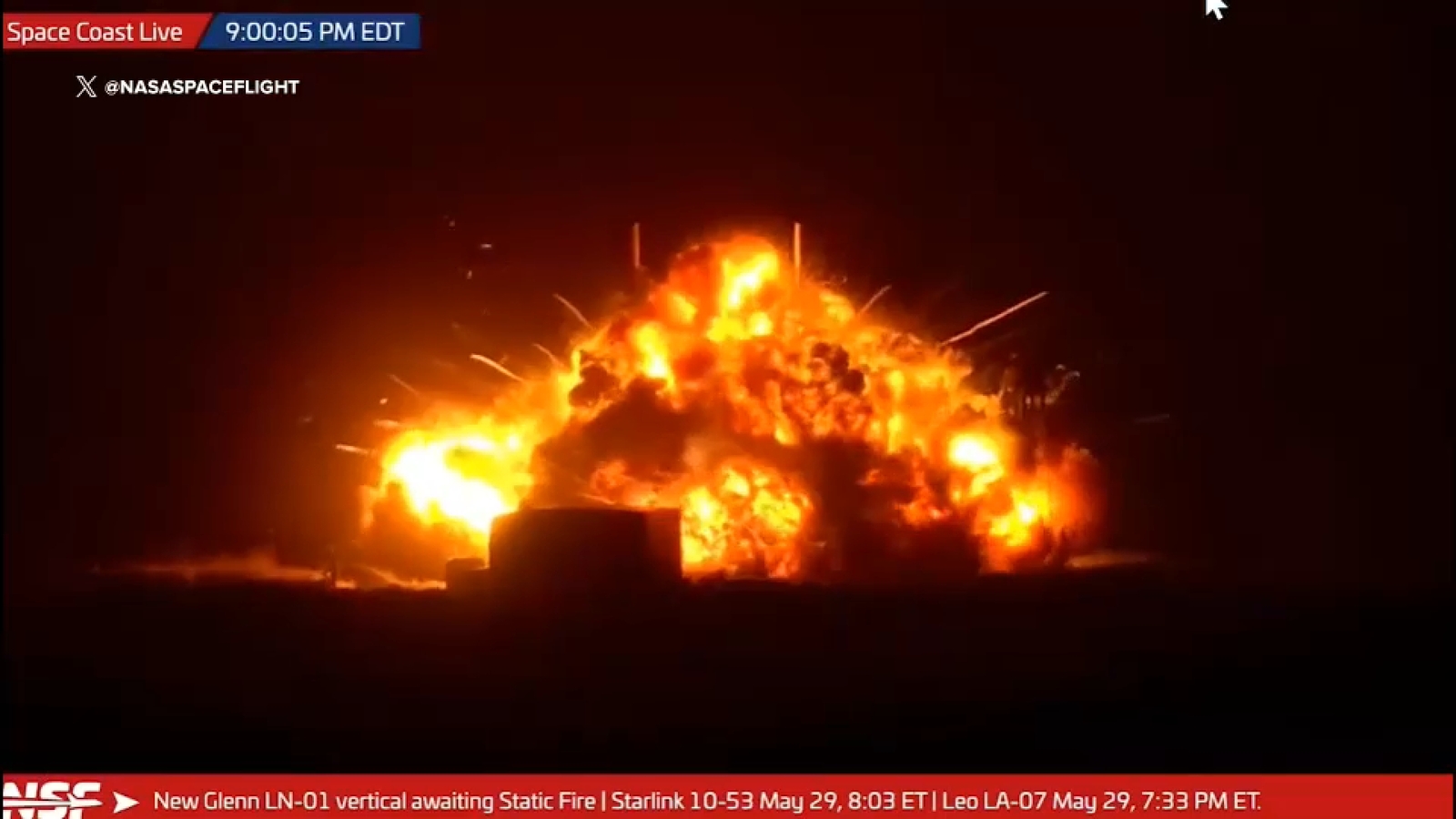
Blue Origin's New Glenn rocket exploded during a static fire test at Cape Canaveral, delaying preparation for a mission intended to send 48 Amazon satellites into low-Earth orbit. The incident is a setback for the company's fourth planned flight and follows an earlier failed mission that missed the intended orbit. NASA said it will assess near-term impacts to the Artemis and Moon Base programs, which rely on Blue Origin's lunar lander and launch capability.
The immediate loser is not just Blue Origin’s launch cadence; it is anyone underwriting the ecosystem assumption that heavy-lift capacity will arrive on schedule. For AMZN, the economic damage is less about one payload delay and more about optionality: every month of slippage pushes out constellation fill, service revenue, and the data-network effects those satellites are meant to unlock. That matters because satellite programs have a convex adoption curve — one missed deployment window can ripple into downstream customer commitments, insurance pricing, and launch manifest bargaining power.
Second-order winners are more likely to be competing launch providers and ground/integration vendors than obvious pure-play space names. A reliability stumble at an early-stage heavy-lift platform can redirect near-term government and commercial missions toward incumbents with higher cost per launch but lower execution risk. Over the next 1-3 quarters, the market should also re-rate the probability of schedule slippage across adjacent Artemis-linked contractors, which tends to compress multiples before any formal contract loss shows up.
The contrarian point: this is not automatically a durable fundamental impairment for the sponsor, because the strategic value of the program is high enough that stakeholders may tolerate repeated resets. If root cause is isolated and fixed quickly, the market may over-discount a single anomaly while underpricing the learning-curve benefit from failure data. The real tail risk is not the explosion itself; it is a multi-quarter certification delay that bleeds into NASA milestone timing and forces customers to re-route payloads, which would be a 6-18 month headwind rather than a one-day headline.
AI-powered research, real-time alerts, and portfolio analytics for institutional investors.
Request DemoOverall Sentiment
strongly negative
Sentiment Score
-0.55
Ticker Sentiment
