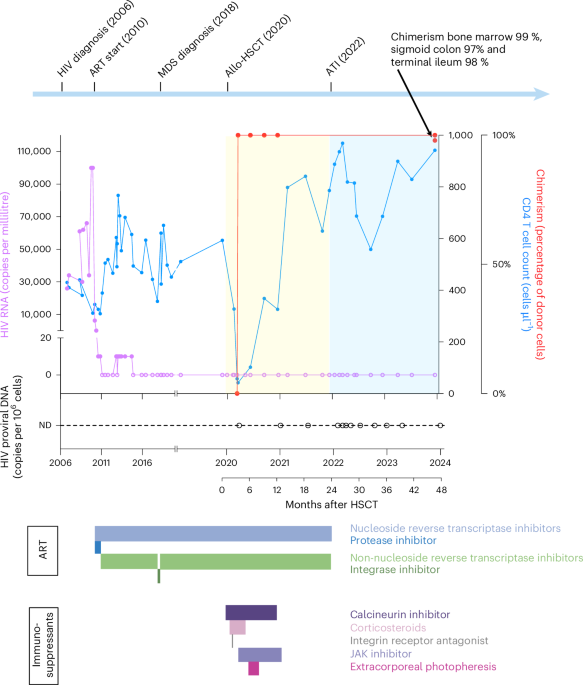
A 63-year-old patient remained in HIV remission 5 years after allogeneic HSCT from a CCR5Δ32/Δ32 sibling donor, with 48 months showing no intact HIV DNA in blood or gut, no replication-competent virus, and no HIV-specific T cell responses. Full donor chimerism was achieved in blood, bone marrow, and gut, including the primary reservoir in the terminal ileum and sigmoid colon. The result strengthens evidence that CCR5Δ32/Δ32 donor transplants can produce durable HIV remission or cure, though the finding is medically important rather than market-moving.
This is not a broad HIV therapeutics read-through; it is a durability signal for the small ecosystem around transplant-based cure infrastructure. The incremental value accrues to assay, cell-processing, and specialized diagnostics vendors that can monetize ultra-low-copy reservoir testing, chimerism workflows, and longitudinal immune monitoring rather than to standard antiviral franchises. The second-order effect is a higher probability that academic centers and reference labs will adopt more centralized, harmonized protocols, which favors scaled molecular diagnostics platforms over bespoke local workflows. The bigger strategic implication is that the market may be underestimating how much value shifts from ‘drug discovery’ to ‘measurement science’ in cure research. If full donor chimerism in gut tissue becomes a meaningful endpoint, then companies with capabilities in low-input ddPCR, FFPE-compatible nucleic acid recovery, multiplex immune profiling, and tissue logistics gain pricing power. That creates a niche but durable consumables/reagent tailwind, especially as more groups try to replicate reservoir-negative findings with more stringent tissue sampling. Contrarian angle: the headline reads as a cure milestone, but the investable takeaway is not a near-term revenue pop; this is a protocol-validation event. The risk is that the field remains low-throughput and heavily academic, so the commercial conversion rate is slow and uneven over 12-36 months. Still, any expansion of centralized HIV reservoir testing or transplant surveillance should incrementally lift utilization for high-complexity lab tools, while the broader biotech cure narrative remains more sentiment-driven than cash-flow relevant.
AI-powered research, real-time alerts, and portfolio analytics for institutional investors.
Overall Sentiment
strongly positive
Sentiment Score
0.85
Ticker Sentiment
