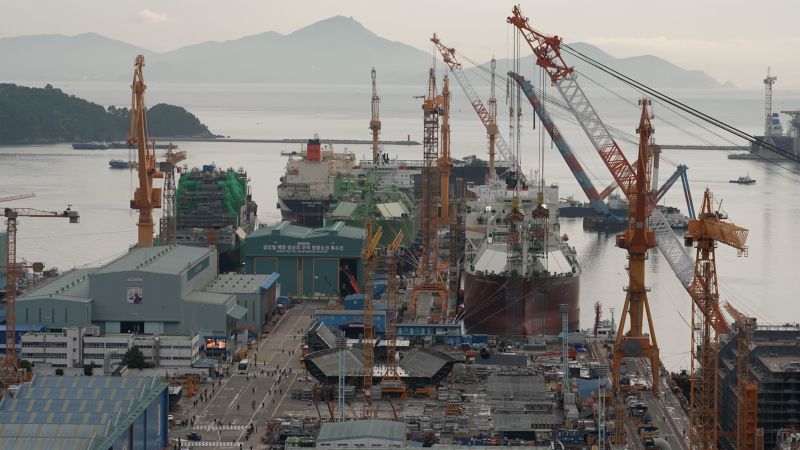
South Korean shipbuilders HD Hyundai Heavy Industries and Hanwha Ocean are offering to assist the US Navy in addressing its significant shipbuilding crisis, marked by chronic delays and budget overruns that impede its ability to counter China's naval expansion. These firms, renowned for their efficient operations, experienced workforces, and integrated commercial-military capabilities, propose sharing technology and expertise to construct advanced warships. While US law currently restricts the Navy from procuring foreign-built vessels, potential collaboration, possibly through Hanwha's acquisition of Philly Shipyard or legislative changes, could offer a strategic solution to the US's defense needs, despite regulatory hurdles.
The US Navy faces a significant shipbuilding crisis, characterized by chronic delays and substantial budget overruns, exemplified by programs running six months late and 57% over budget. This inefficiency hampers its strategic capability against China's growing fleet. South Korean shipbuilders, HD Hyundai Heavy Industries and Hanwha Ocean, are offering their expertise and technology, highlighting their proven track record of delivering top-rated warships on time and within budget.
Korean shipyards attribute their efficiency to a highly experienced workforce, with HD Hyundai Heavy Industries boasting an average tenure of 16 years, and an integrated commercial-military shipbuilding model that ensures consistent work and process innovation. In contrast, inconsistent Pentagon orders discourage US shipyards from investing in automation and new processes. Furthermore, South Korea's localized supply chain, with 90% of parts sourced within 50km for Hanwha's Geoje yard, significantly enhances production efficiency.
Hanwha Ocean's acquisition of Philly Shipyard and its planned $5 billion investment signal a direct entry strategy into the US market, aiming for both commercial and military contracts. However, current US law restricts the Navy from procuring foreign-built ships or building abroad, posing a significant regulatory hurdle for direct collaboration. While the US-Finland Coast Guard icebreaker deal offers a potential template, legislative changes would be required for broader Navy involvement.
Despite regulatory challenges, the "moderately positive" sentiment and "optimistic" tone suggest a potential for strategic shifts, especially given the US's urgent defense needs. The potential for Congress to loosen requirements for commercial or auxiliary vessels, or for a phased approach of initial Korean construction followed by US integration, could be a "game changer" for US shipbuilding capabilities, addressing critical national security infrastructure.
AI-powered research, real-time alerts, and portfolio analytics for institutional investors.
Request DemoOverall Sentiment
moderately positive
Sentiment Score
0.50
