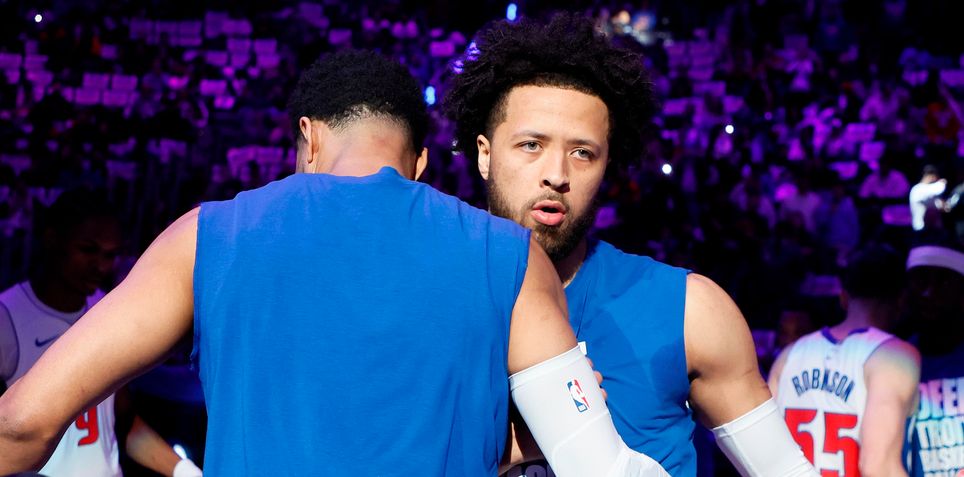
The article highlights two NBA playoff player prop bets: Cade Cunningham over 5.5 first-quarter points (-130) and Donovan Mitchell under 27.5 points (-132). It is a sportsbook wagering preview based on projections and recent form, not company-specific or macroeconomic news. Market impact is minimal and confined to sports betting activity.
This is a classic late-series microstructure setup: the market is likely overreacting to one extreme game and underestimating how quickly coaching adjustments can compress usage distribution in the next outing. In playoff props, the highest edge often comes not from forecasting true talent but from identifying when the prior game forced a tactical response that the betting line has not fully priced. Here, the key second-order effect is that a “go elsewhere” defensive adjustment can create cleaner looks for secondary creators and reduce the alpha in the primary scorer’s volume rather than just his efficiency.
The first-quarter angle is more fragile than the full-game scoring market because it depends on intentional early usage and minute allocation, both of which are highly coach-controllable and therefore more sensitive to game-plan variance. That makes the upside attractive if the player is scripted to initiate, but it also means the line can flip fast on any early foul trouble, a quicker-than-expected rotation, or a deliberately slower pace to start. In other words, the best entry is pre-tip only if the market hasn’t already moved materially off the opening number; once the public piles in, the expected value tends to evaporate.
The under on the star scorer is the better structural trade because playoff opponents rarely allow repeated outlier shot quality for multiple games in a row. The real tail risk is not regression in isolation, but that the game environment stays high-variance enough that a few transition possessions or late free throws keep the ceiling alive despite lower shot efficiency. That suggests the trade works best as a short-dated, game-specific position rather than a broader series thesis.
Contrarian view: the consensus is probably overweighting the most recent scoring eruption and underweighting the possibility that the supporting cast simply regresses harder than the star does. If the defense tilts and the surrounding shooters fail to punish help, the scorer can still get to a respectable number without hitting the inflated ceiling. The more interesting mispricing may be in assist or combo markets on the same player, where a defensive adjustment can create value even while raw points mean-revert.
AI-powered research, real-time alerts, and portfolio analytics for institutional investors.
Request DemoOverall Sentiment
neutral
Sentiment Score
0.05
