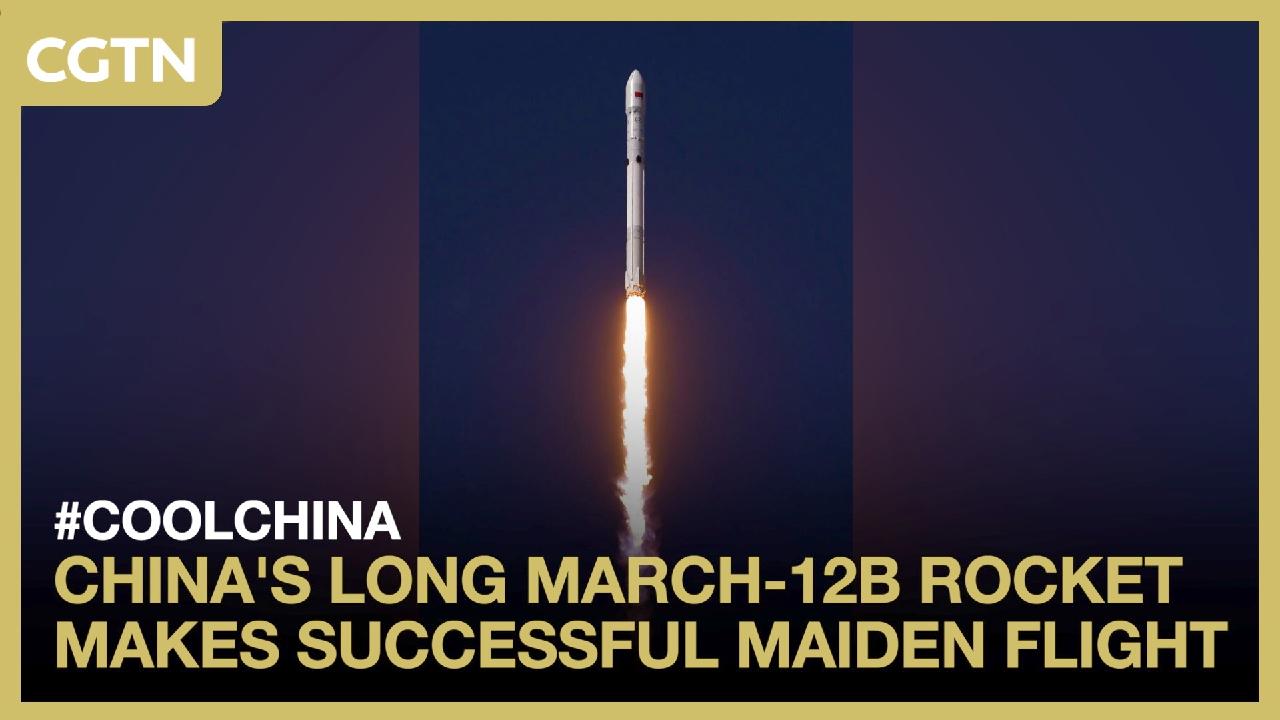
China successfully completed the maiden flight of the Long March-12B Y1 carrier rocket, launching a group of Qianfan (Spacesail) Constellation networking satellites into preset orbits. The mission was declared a complete success and marked the 647th flight of the Long March rocket series. The article is a factual launch update with limited direct market implications.
This launch matters less as a one-off aerospace success and more as evidence that China is moving from launch-capacity constraints toward an increasingly industrialized cadence of orbit deployment. The second-order implication is a lower-friction buildout for sovereign communications, ISR, and maritime tracking networks, which strengthens domestic defense autonomy while also tightening the competitive moat of Chinese launch and satellite OEM ecosystems. That tends to shift value away from pure-play launch providers over time and toward upstream propulsion, composites, guidance, and ground-segment suppliers that can scale with recurring constellation replenishment.
The near-term market impact is likely muted, but the medium-term read-through is important for U.S. and allied space infrastructure names: if China can sustain higher launch frequency with a new heavy-lift platform, capacity oversupply in commercial LEO launches could persist longer than expected, pressuring pricing power in a market that was already fragile. The more subtle winner is the terrestrial network of RF components, phased-array antennas, and cloud/edge processing layers that feed from satellite proliferation; those markets benefit from more satellites in orbit even if launch economics compress.
The contrarian angle is that investors often overestimate the revenue visibility of constellation growth and underestimate the failure rate, spectrum bottlenecks, and coordination costs that show up after the initial deployment burst. In other words, the headline is bullish for strategic capability, but not automatically bullish for the entire space industrial stack. If this becomes a pattern of repeated successful launches over the next 6-12 months, the real signal would be not sentiment but procurement pull-through for domestic chip, materials, and ground-station suppliers.
From a risk perspective, the main reversal would be launch anomalies, export-control friction, or a policy shift that slows constellation commercialization; those are months-to-years risks, not days. The trade setup is therefore better expressed as relative-value rather than outright directional exposure.
AI-powered research, real-time alerts, and portfolio analytics for institutional investors.
Request DemoOverall Sentiment
neutral
Sentiment Score
0.15
