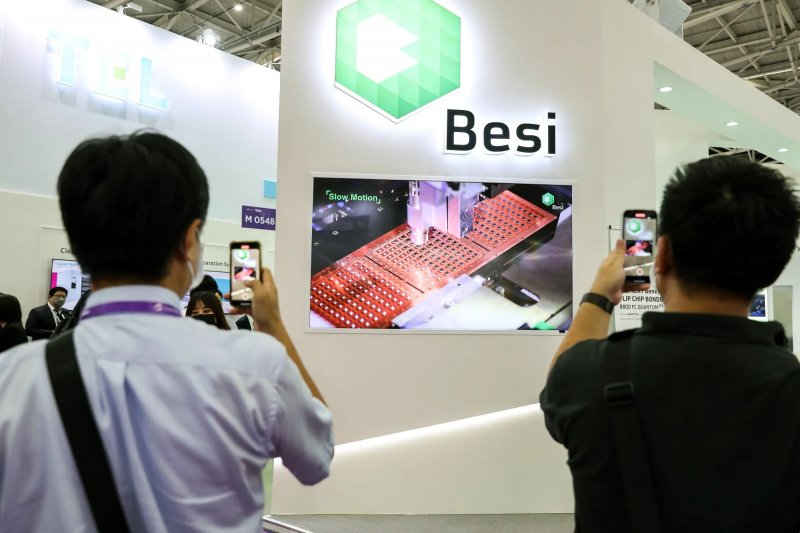
BE Semiconductor Industries (BESI) reported a preliminary jump in fourth-quarter orders to €250 million, up from €174.7 million in Q3 and €128 million in Q2, driven by broad-based bookings from Asian subcontractors for 2.5D data‑center applications and renewed capacity purchases from major photonics customers. As a supplier of chip‑assembly equipment to subcontractors that service chip designers such as NVIDIA and AMD, the order surge points to stronger near‑term demand for assembly capacity and could support upside to BESI’s upcoming revenue and margin outlook.
Market structure: BESI (Euronext: BESI) is a clear near-term winner as its Q4 orders jumping to €250m implies OSATs and photonics assemblers are accelerating 2.5D/advanced‑packaging capex; expect BESI and select OSAT suppliers (ASE: ASX, Amkor: AMKR) to see 2–4 quarters of stronger order visibility and potential 5–15% improvement in pricing power as lead times lengthen. Chip designers (NVDA, AMD) are indirect beneficiaries through more available advanced packaging capacity, but not direct revenue drivers for equipment makers.
Risk assessment: Key tail risks are (1) export-control escalation to China that curbs Asian subcontractor demand, (2) a cloud/AI spending pause that drops bookings >30% QoQ, and (3) supply‑chain component shortages or BESI execution failure that delays shipments by 2+ quarters. Immediate market move is likely within days; validate operational delivery over 1–3 quarters; structurally, advanced packaging adoption is a 2–5 year secular play but will be lumpy.
Trade implications: Favor concentrated, size‑controlled exposure to BESI (equipment) and OSATs (ASX, AMKR) while reducing legacy wafer‑fab cyclicality. Use protective option structures (see decisions) to express directional view while capping downside; expect cross‑asset moves: TWD/KRW upside vs USD on stronger Asian capex, modest risk‑on pressure on European credit spreads.
Contrarian angles: Consensus may overstate sustainability — orders are customer‑concentrated and lumpy; history (post‑2017 packaging spikes) shows risk of overbuild and margin compression within 4–8 quarters. Monitor order cadence and customer diversification; if bookings concentrate >40% with two customers, rerate immediately.
AI-powered research, real-time alerts, and portfolio analytics for institutional investors.
Request DemoOverall Sentiment
moderately positive
Sentiment Score
0.45
Ticker Sentiment
