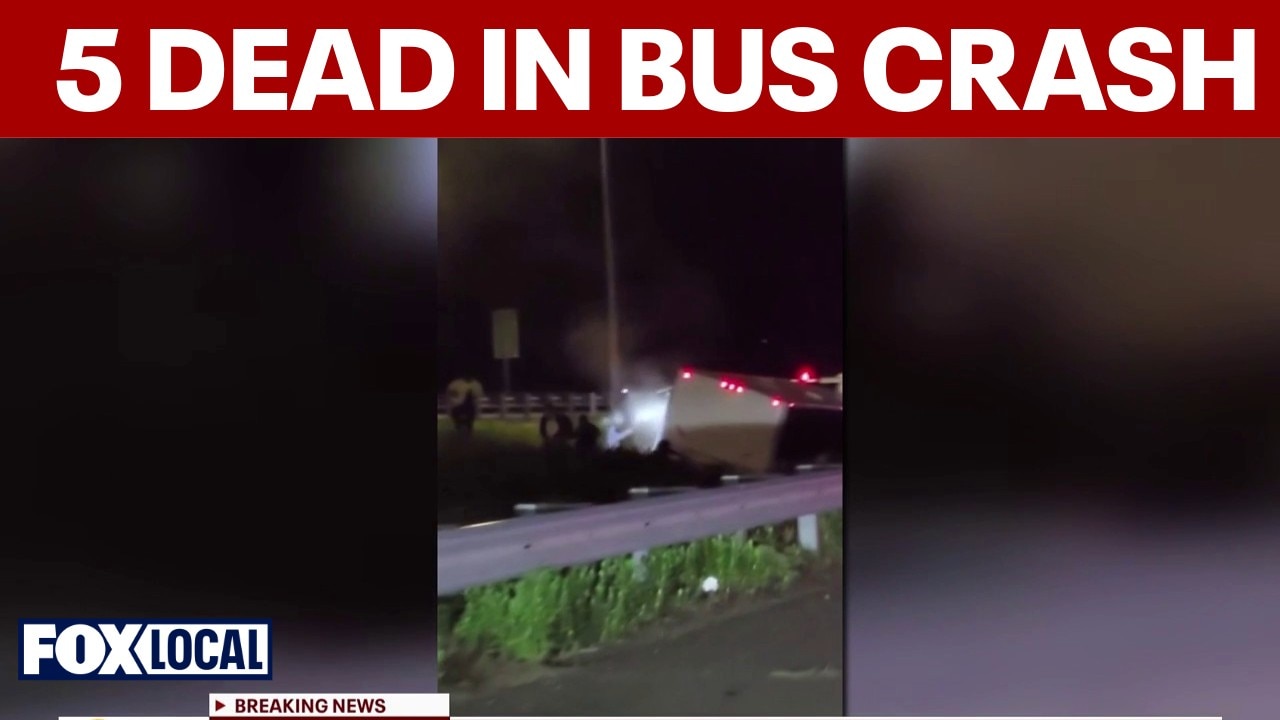
A deadly Interstate 95 bus crash in Stafford County killed 5 people and injured 34 others, including 3 critically, after a bus struck six vehicles near mile marker 146 around 2:35 a.m. Southbound I-95 and Route 1 are expected to face major delays, with congestion likely to worsen during the morning commute. The incident is still under investigation and charges are pending.
The immediate market read-through is not the accident itself, but the forced re-routing of freight and commuter flow along one of the East Coast’s most time-sensitive corridors. Even a one-morning closure can create outsized knock-on costs because trucking networks are optimized for narrow arrival windows; once a few loads miss their dock appointments, the disruption propagates through same-day warehouse labor, temperature-controlled inventory, and last-mile delivery schedules. That makes the near-term beneficiaries less about transportation exposure broadly and more about firms with spare network capacity, inland alternatives, or pricing power in expedited service.
The secondary winners are likely regional toll-road, rail, and parcel operators that can absorb spillover volume, while the losers are operators whose economics depend on predictable highway throughput and just-in-time inventory turns. A multi-hour closure also raises the odds of temporary spike pricing in managed freight, tow/recovery, and emergency response services, though those gains are usually too transient to matter for public equities unless the incident triggers a broader pattern of lane restrictions or work-zone enforcement that lasts weeks. The key question for investors is whether this becomes a one-off traffic shock or a catalyst for more conservative routing and buffer-stock behavior by shippers in the Mid-Atlantic.
The contrarian angle is that these events are often overestimated as macro signals and underestimated as operational catalysts. If this causes even a small subset of shippers to pay up for redundancy over the next 1-2 quarters, the real beneficiaries will be the networks that sell resilience: rail intermodal, regional air cargo, and logistics software that optimizes multi-route dispatch. Conversely, if the closure is resolved quickly, any move in transport-related names should fade fast; the trade is more about short-dated event risk than a durable demand shock.
A bigger second-order risk is regulatory: a fatal crash in a work-zone context can accelerate enforcement, lower speed limits, or tighter truck-bus restrictions on segments like this, which would slightly raise transit times and compliance costs for carriers but improve demand for routing alternatives. That effect would matter over months, not days, and would be most visible in operators with heavy exposure to the corridor rather than the broader market.
AI-powered research, real-time alerts, and portfolio analytics for institutional investors.
Request DemoOverall Sentiment
strongly negative
Sentiment Score
-0.80
