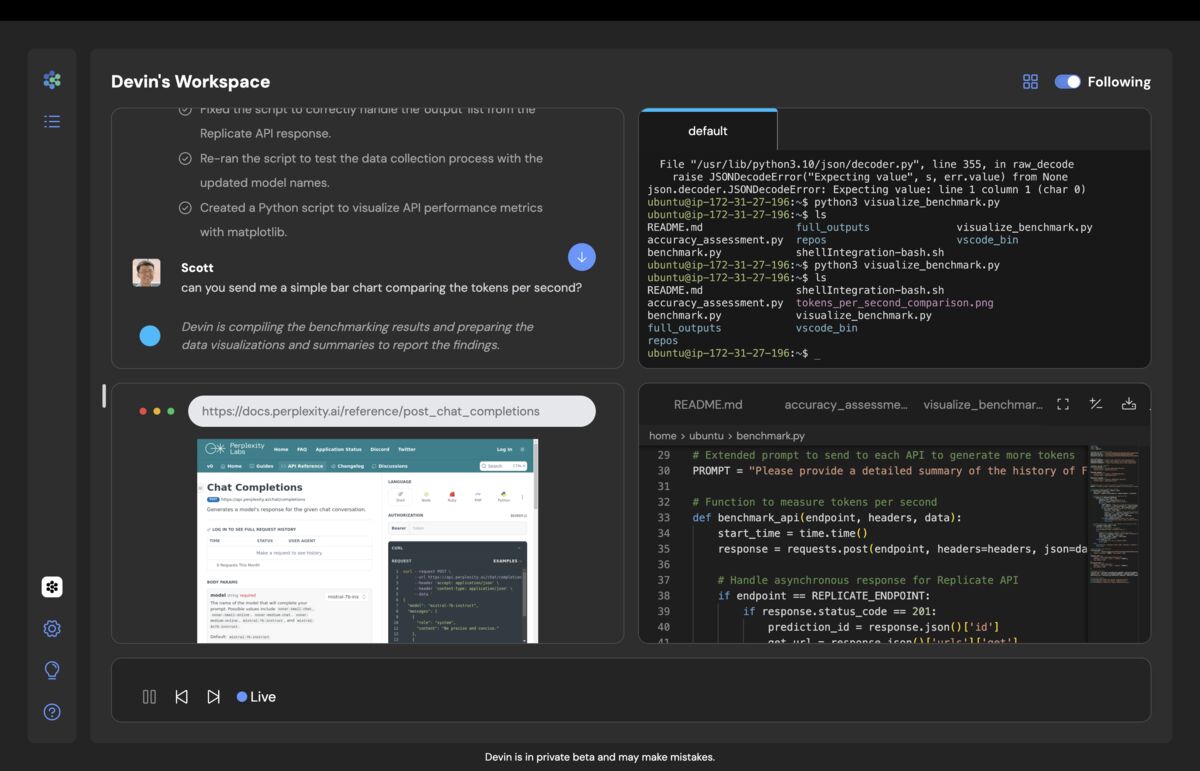
Cognition AI is reportedly in early talks to raise hundreds of millions of dollars or more at a $25 billion valuation, more than doubling its prior value. The funding discussions reflect strong investor demand for AI software development companies, though terms remain subject to change. The news is positive for Cognition and the private AI funding environment, but broad market impact should be limited.
The real signal here is not one company’s mark-up; it’s the repricing of AI software leverage as a scarce strategic asset. If private buyers are willing to underwrite a step-change in valuation for a coding workflow winner, the spillover is a tightening of capital access for adjacent infrastructure, model distribution, and developer-tooling businesses over the next 6-12 months. That tends to favor the picks-and-shovels layer first: compute, data tooling, and cloud credits providers that can monetize the rising arms race without needing a clear path to standalone profitability.
Second-order, this kind of financing pressure can hurt slower incumbents in software services and vertical SaaS that rely on billable engineering labor. The market may be underestimating how quickly AI-assisted development compresses cycle times, which is a margin tailwind for software-heavy buyers but a revenue headwind for IT services and outsourced dev shops over 2-4 quarters. The more important loser is not a named competitor today, but the entire labor-arbitrage model in software delivery.
The key risk is that this is still a private-markets signal, not a public-market cash flow event. If growth multiples compress or fundraising windows tighten, the valuation premium can unwind quickly and drag sentiment across the AI application stack; these reversals usually show up first in late-stage venture marks and only later in public comps. Conversely, if the company raises at the rumored level, it likely resets expectations for exit multiples in AI-native software and extends the duration of the theme rather than changing near-term earnings power.
The contrarian view is that the market may already be over-owned in obvious AI beneficiaries while under-positioned for the second-order short: firms whose moats are human-engineering intensity rather than product differentiation. If AI coding tools continue improving, the value pool shifts from app-layer narratives to distribution, workflow integration, and inference-efficient infrastructure. In other words, the best public-market expression may be less about the startup itself and more about shorting the legacy cost base that gets disrupted by it.
AI-powered research, real-time alerts, and portfolio analytics for institutional investors.
Request TrialOverall Sentiment
moderately positive
Sentiment Score
0.55
