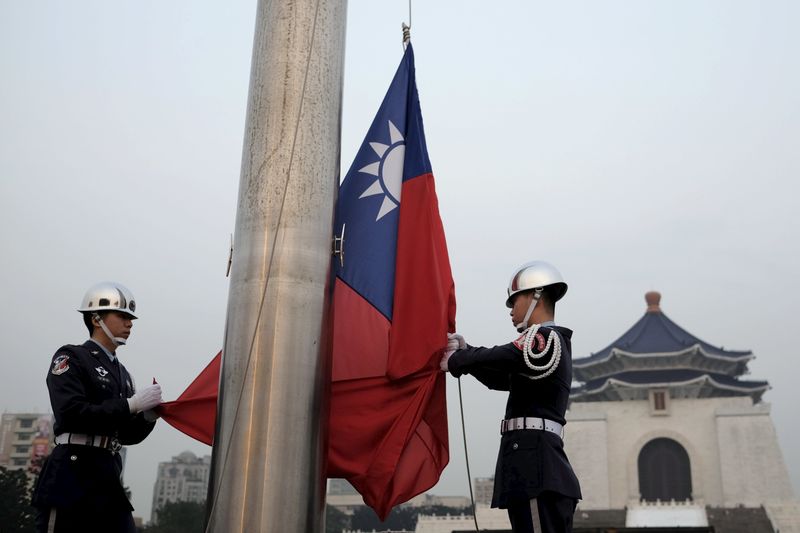
Taiwan President Lai Ching-te completed a high-stakes visit to Eswatini amid reported Chinese pressure on overflight permissions, highlighting elevated geopolitical tensions across East Asian and Indian Ocean routes. Beijing sharply criticized the trip, while Taiwan defended its right to conduct international diplomacy without Chinese approval. The episode is geopolitically meaningful and could add to regional risk premia, though it is not a direct corporate or earnings event.
The direct market read-through is not the diplomatic theater itself, but the increasing probability of a sharper U.S.-China signaling cycle around Taiwan in the next 1-3 months. That tends to create a short-duration volatility bid in defense, cyber, satellites, and selective Asia logistics names, while pressuring firms with concentrated Taiwan manufacturing or China revenue that can’t easily reroute supply. The second-order effect is that every escalation reinforces a “friend-shoring” capex premium: customers pay up for redundancy, inventory buffers, and non-China capacity, which favors infrastructure and defense contractors over pure-play industrials.
The real asymmetry is that most investors underprice tail risk until there is an actual overflight or shipping incident. Even without kinetic conflict, repeated access-denial episodes can incrementally raise insurance costs, charter friction, and working-capital needs across Asian supply chains; that is a slow-burn margin headwind for semis, electronics, and freight-sensitive importers over the next several quarters. In contrast, defense names with backlog visibility and policy support can re-rate quickly because the market tends to pay for budget durability, not immediate revenue acceleration.
BRK.B is largely a macro barometer here rather than a direct trade: the company’s cash pile gives it optionality in a risk-off tape, but the article does not create a catalyst for the shares beyond its existing capital-allocation reputation. The more interesting contrarian angle is that elevated geopolitical noise can be a buy-the-dip setup for high-quality Taiwan-linked equities if supply chains remain intact; the market often extrapolates headline risk faster than earnings risk. That said, if Beijing shifts from rhetorical pressure to repeated transport interference, the market could quickly reprice the probability of non-linear disruption, and the better trade becomes owning protection rather than trying to predict the first missing shipment.
AI-powered research, real-time alerts, and portfolio analytics for institutional investors.
Request DemoOverall Sentiment
mildly negative
Sentiment Score
-0.15
Ticker Sentiment
