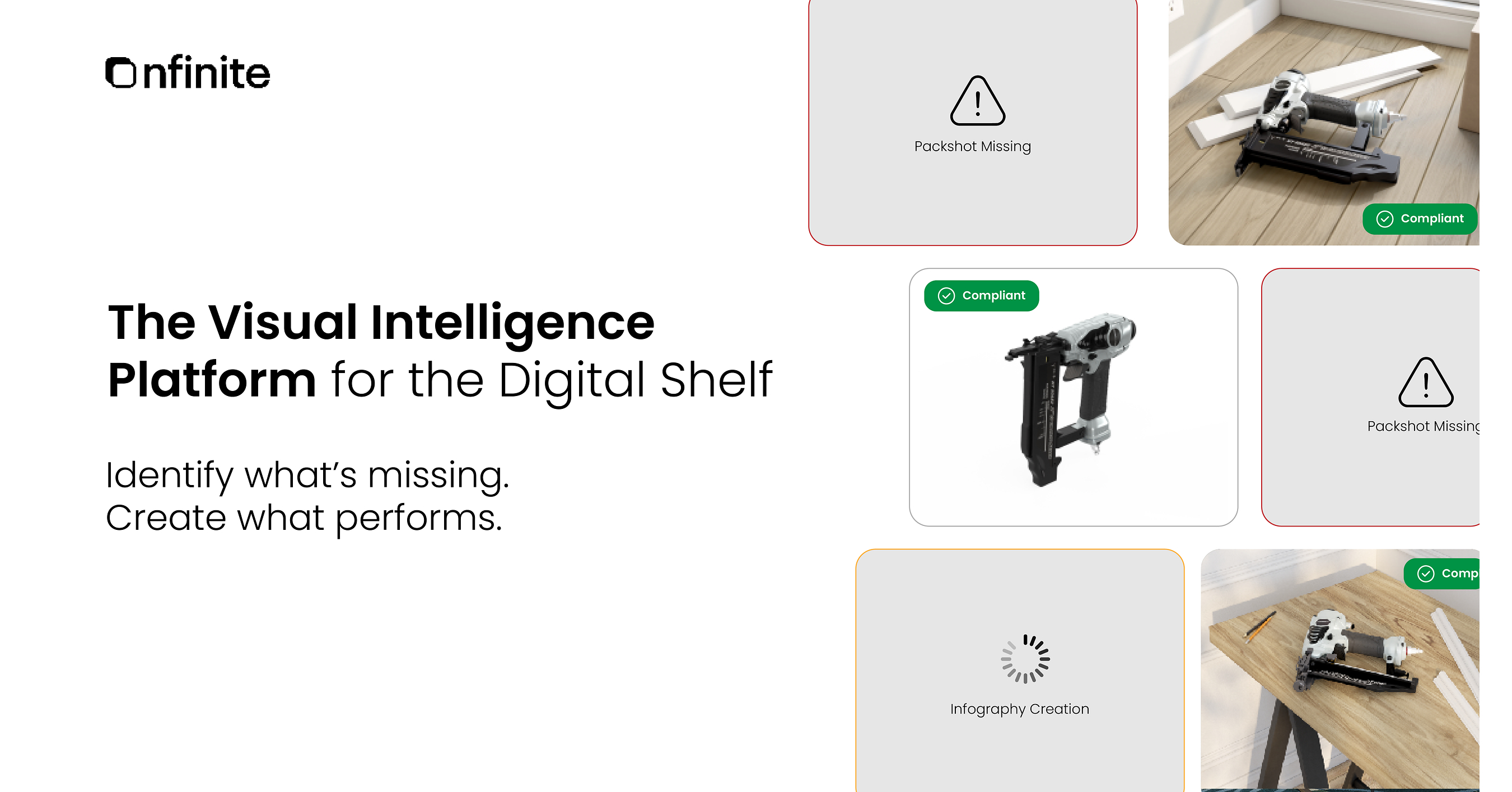
Nfinite launched its “Visual-Intelligence-Plattform für das digitale Regal,” aiming to help brands and retailers monitor and fix visual PDP compliance at scale. The company cites potential revenue impacts of non-compliant product pages of -15% to -25% and notes a pilot finding of 897 content gaps across 7 retail endpoints with a 61% overall compliance score. It also claims generative AI cut content production costs by 70–95% and reduced production timelines from weeks to hours, supporting the case for faster, prioritized visual content creation.
The economic value here is not the content generation itself; it is the conversion leakage the tool can surface and fix. That favors large-SKU, image-sensitive merchants and brands with fragmented catalogs — think AMZN, WMT, HD, LOW, TSCO — because even a small lift in PDP conversion or fewer suppressed listings compounds across millions of visits, while manual operations-based workflows get priced as a tax on growth. The second-order effect is that merchandising, SEO, and retail-media budgets should shift from broad spend to targeted remediation, which makes the best operators more efficient and widens the gap versus laggards.
Near term, this is more of a vendor-validation story than a tradable earnings catalyst: enterprise adoption cycles are long, and the real proof will be in retailer integrations, SKU coverage, and measurable reduction in content-related suppression over the next 1-3 quarters. The main falsifier is if retailers already have enough internal tooling or if the claimed compliance gaps do not show up in conversion/ranking data; in that case, the product becomes a feature, not infrastructure. A structural tailwind remains if genAI keeps lowering content production cost faster than governance can keep up, because the bottleneck shifts to prioritization and monitoring.
Contrarian view: the market may overrate the value of cheaper content creation and understate the value of visibility into where content is actually hurting sales. If Nfinite can prove it improves on-shelf performance, it becomes a budget line item funded by margin recovery, not by incremental marketing spend. If not, the winners are still the large retailers and brands that can internalize the workflow, not necessarily the standalone vendor ecosystem.
AI-powered research, real-time alerts, and portfolio analytics for institutional investors.
Request DemoOverall Sentiment
mildly positive
Sentiment Score
0.25
