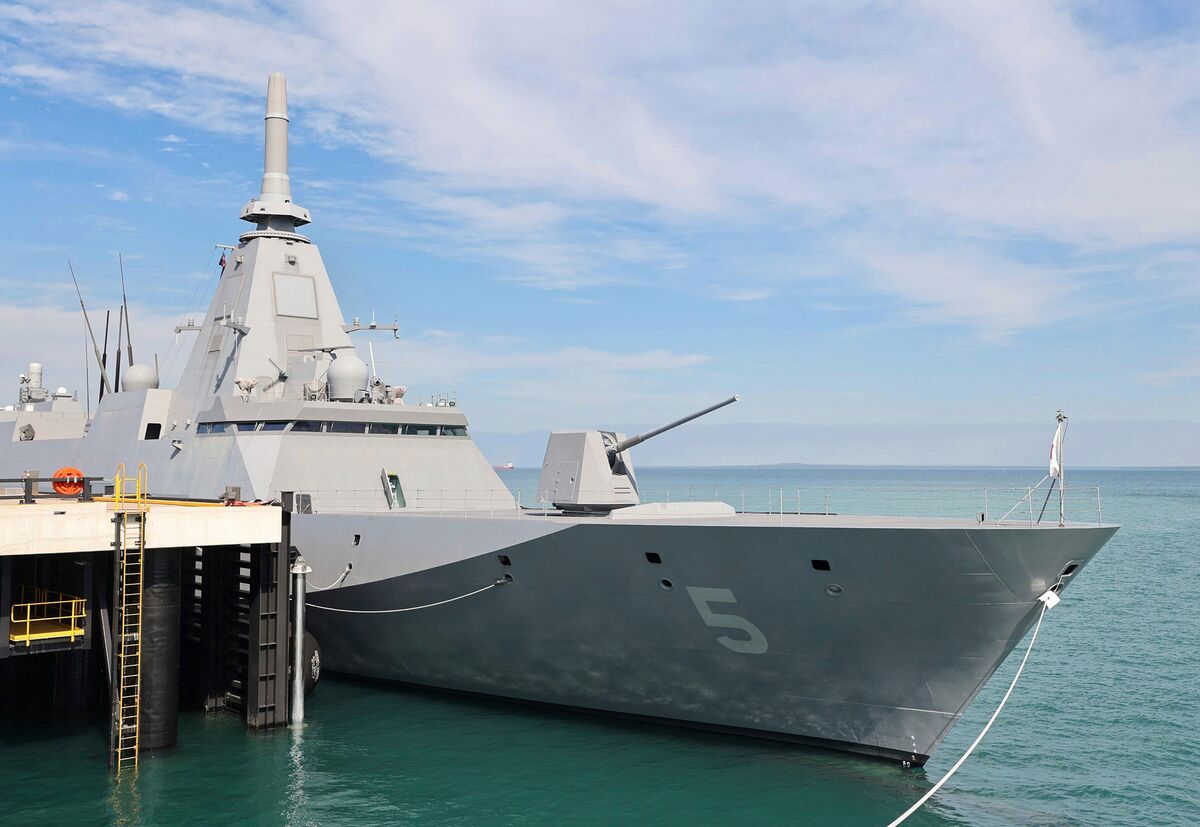
Australia completed a deal for the first three of 11 advanced warships from Japan, marking a landmark defense procurement aimed at strengthening the Royal Australian Navy. The agreement also signals a breakthrough for Japan as it expands into major defense exports. The signing in Melbourne involved Australian Defense Minister Richard Marles and Japanese Defense Minister Shinjiro Koizumi.
This is less about a single ship order and more about the emergence of a Japan-led defense export lane into a trusted allied procurement market. The second-order benefit accrues to Japanese prime contractors and their domestic subcontractor base: export volume improves utilization, amortizes R&D across more hulls, and gradually lowers unit costs, which should matter disproportionately if Tokyo can stack follow-on orders over the next 12-36 months. For Australia, the strategic value is schedule certainty and industrial diversification away from a narrower set of legacy suppliers, which reduces concentration risk in a region where delivery slippage has become a strategic vulnerability.
The bigger competitive implication is that Japan is now competing for share in the same export pool as South Korea and parts of Europe, but with a higher-trust geopolitical brand and increasingly relevant production know-how. If this program executes cleanly, it should create a reference case that improves win rates on adjacent categories: radar, combat systems, electronics, and maintenance support, which are typically higher-margin than hull construction and can persist for decades through spares and upgrades. That creates a long-duration annuity effect rather than a one-off contract bump.
The main risk is execution, not demand: shipbuilding is notoriously schedule-sensitive, and any cost overrun or integration issue would quickly weaken the export narrative and re-open the “buy local” political argument in Australia. Time horizon matters here—near-term upside is mostly sentiment-driven over weeks, but the real re-rating for Japanese defense suppliers would take multiple clean deliveries over 1-3 years. A secondary tail risk is policy reversal if regional diplomacy stabilizes faster than expected, which could soften urgency for follow-on orders and compress the strategic premium.
Consensus likely underestimates how much this deal can spill over into supply-chain normalization and export financing innovation inside Japan. The market may focus on headline defense spend, but the more investable edge is the combination of recurring aftermarket revenue, higher factory utilization, and a precedent for Japanese primes becoming repeat exporters rather than occasional bidders. If that path holds, the sector re-rates on quality of earnings, not just geopolitics.
AI-powered research, real-time alerts, and portfolio analytics for institutional investors.
Request TrialOverall Sentiment
mildly positive
Sentiment Score
0.35
