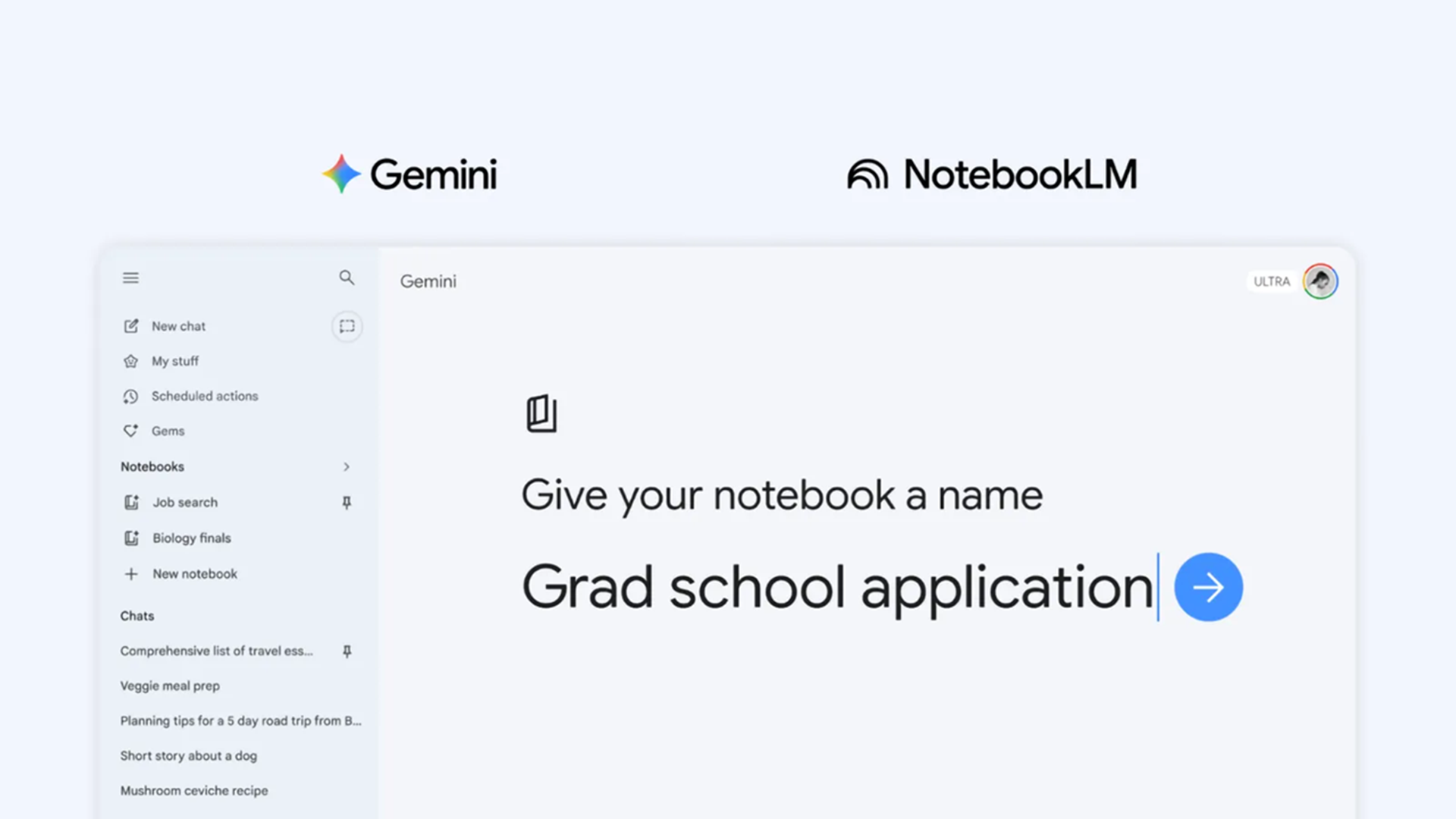
Google has made Gemini’s Notebook feature free for all users, a product enhancement aimed at improving continuity by letting chats, files, and instructions persist together. The article outlines five practical use cases—task management, shared memory, note cleanup, tone setting, and notebook segmentation—that position the feature as a more personalized AI workflow tool. The news is positive for Gemini adoption but appears to be a modest product update with limited near-term market impact.
The strategic significance is not the feature itself but the behavioral lock-in it creates. Free persistent context lowers the friction of repeated use, which should increase session depth and switching costs for casual users; that favors GOOGL in the near term because the value accrues through higher retention rather than obvious monetization. The second-order winner is Google Cloud/Workspace by association: if consumers get used to stateful AI workflows, that normalizes enterprise demand for memory, retrieval, and instruction-layer tooling, a more durable spend category than model tokens alone.
The competitive read-through is that this is a productization of memory, not intelligence. That is a subtle but important shift because it attacks one of the few UX advantages rivals can still easily explain to users: “the model remembers me.” If adoption scales, the moat comes from workflow embedding and accumulated user data, which could pressure smaller AI assistants more than incumbent search or OS players. The likely loser is any consumer AI app whose value proposition is generic chat plus light personalization; those products become easier to substitute once users experience persistent context in a free tier.
The main risk is that consumer enthusiasm converts poorly into paid revenue if the feature becomes a utility rather than a premium capability. Over the next 1-3 months, the key catalyst is engagement data: if notebook-style usage materially lifts daily active time or repeat queries, the market will re-rate the product as an ecosystem enhancer; if not, this fades into another low-cost feature launch. A contrarian view is that the market may be underestimating the cost side: persistent context increases storage, retrieval, and safety overhead, so unit economics could worsen before any monetization benefit shows up.
For DELL and AAPL, the near-term impact is indirect but constructive if persistent-AI workflows increase perceived need for better local hardware and hybrid cloud setups. However, the move is too small to justify a hardware beta trade on its own; the better expression is through GOOGL versus other AI-platform names. If this becomes a standard interaction model, the real monetization opportunity shifts from model quality to workflow control and device distribution, which is where AAPL could benefit over a 6-12 month horizon if AI memory features become a key iPhone/macOS differentiator.
AI-powered research, real-time alerts, and portfolio analytics for institutional investors.
Request DemoOverall Sentiment
mildly positive
Sentiment Score
0.20
Ticker Sentiment
