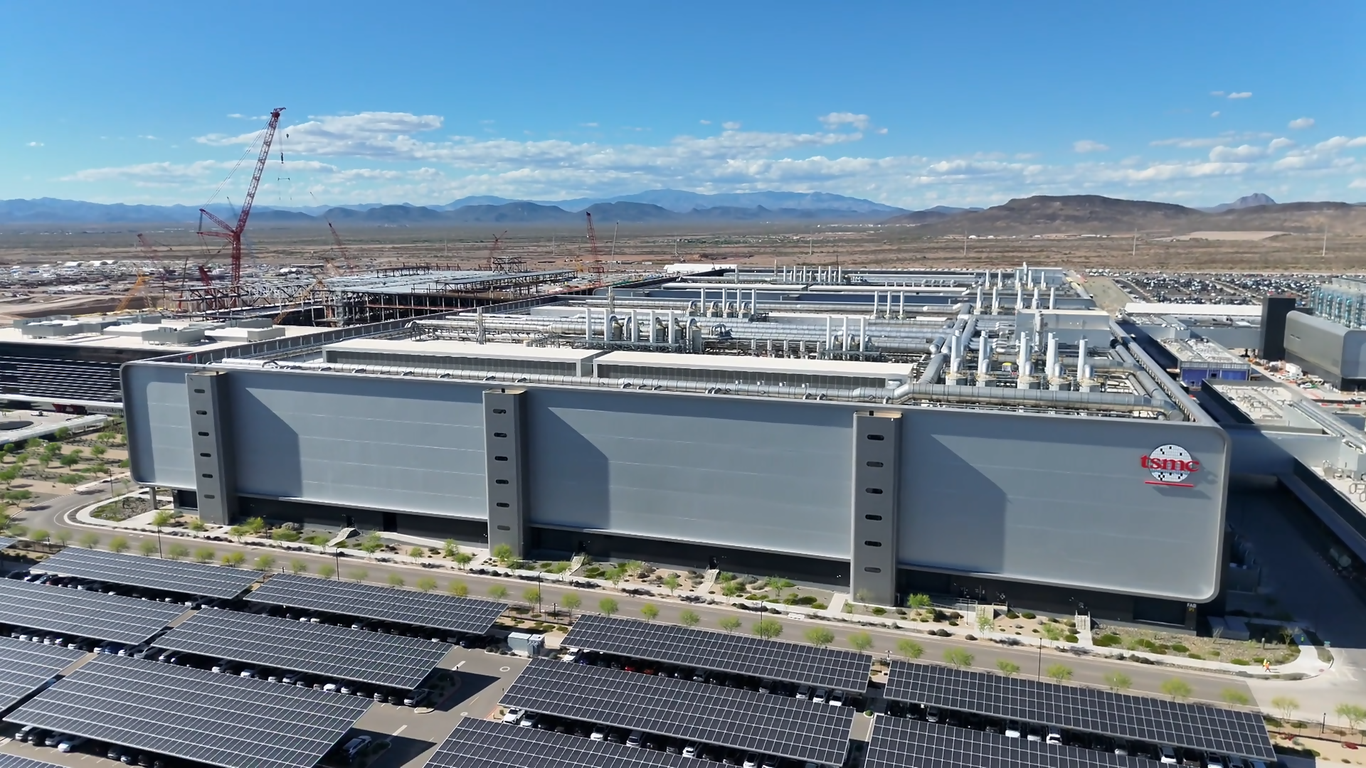
TSMC posted nearly $36 billion in first-quarter revenue, up 40.6% year over year, with AI demand driving the surge. CEO CC Wei said customers do not expect the growth to taper soon and confirmed the second Phoenix fab remains on track to open next year. The article also highlights Halo Vista, the 2,300-acre development intended to support TSMC's U.S. expansion, reinforcing the long-term growth backdrop.
TSM’s print is less about one quarter and more about extending the duration of the AI capex super-cycle. The key second-order effect is that strong foundry utilization de-risks the entire advanced-node ecosystem: EUV toolmakers, wafer suppliers, packaging/testing, and upstream specialty chemicals all gain bargaining power as capacity remains tight. If AI demand is still rising this late in the cycle, the market should keep paying up for names tied to capacity expansion rather than just end-demand exposure.
The Phoenix buildout matters because it reduces the most persistent objection to U.S.-based leading-edge manufacturing: execution slippage. Each incremental milestone lowers the probability that customers re-route strategic orders to Korea or keep more of the mix in Asia, which is a subtle negative for domestic re-shoring skeptics and a positive for U.S. industrial real estate, power infrastructure, and labor-linked beneficiaries. The real economic spillover is not just jobs; it is a multi-year capital stack around housing, transmission, water, and supplier localization.
The main risk is not a near-term demand miss but an AI capex digestion phase 6-12 months out if hyperscalers slow order growth or tighten ROI hurdles. That would hit TSM less than equipment and cyclical semiconductor adjacencies first, because the market will re-rate the supply chain ahead of any actual revenue deceleration. A second risk is policy/geo friction around subsidies, water, or labor, which could add cost and delay without changing the long-term thesis.
Consensus is probably underestimating how much of this story is already embedded in TSM and overestimating how quickly Arizona-driven benefits accrue to local beneficiaries. The better asymmetry may be in the second derivative trades: firms that supply the fabs, utilities, and infrastructure can rerate before the fabs fully ramp, but they also have more downside if AI order growth pauses. In other words, the strongest trade is not simply owning TSM on the quarter; it is expressing the buildout through the ecosystem while the market still assigns option value to capacity growth.
AI-powered research, real-time alerts, and portfolio analytics for institutional investors.
Request TrialOverall Sentiment
moderately positive
Sentiment Score
0.58
Ticker Sentiment
