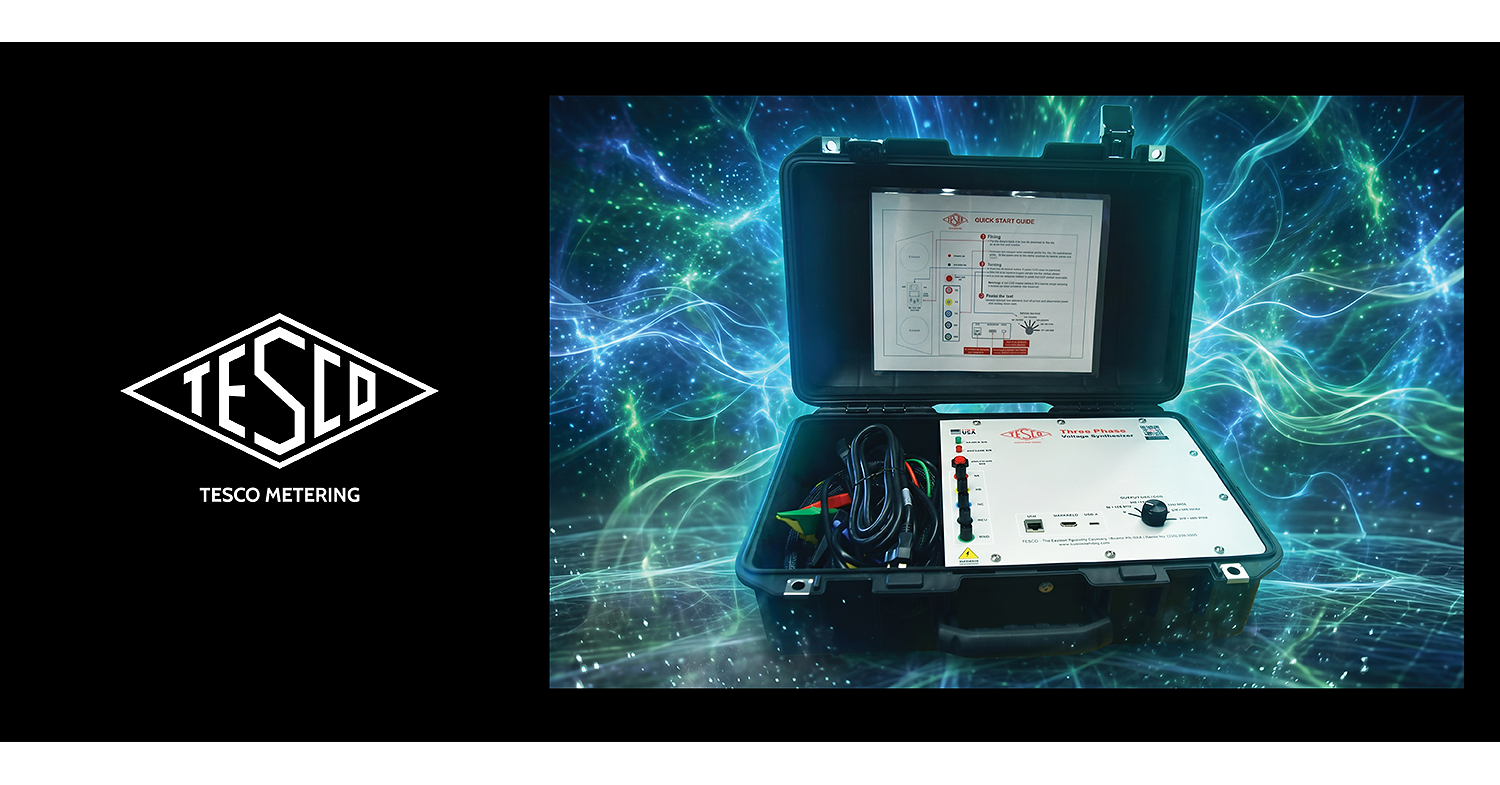
TESCO Metering announced the Model 6440 Three-Phase Voltage Synthesizer, expanding its portable meter testing platform anchored by the TESCO 6330 Meter Site Analyzer. The Model 6440 outputs 69 to 480 VAC (50/60 Hz) with ±0.5% voltage setting accuracy and <3% THD, enabling modular, portable revenue meter commissioning and validation. The news is a product launch that should improve field testing efficiency and safety for AMI/DER/EV-infrastructure use cases, but it is unlikely to move markets broadly.
This reads more like confirmation of a slow-burn replacement cycle than a discrete demand shock. The economic value is in utilities increasingly needing revenue-grade verification as DERs, EV chargers, and bidirectional loads make billing disputes and commissioning errors more expensive; that supports a niche supplier with standards credibility and field-service depth. The bigger winner over time is whichever vendor can bundle training, calibration, and workflow software around the hardware, because the purchase decision will be driven by uptime and compliance, not feature count.
Near term, the launch itself is unlikely to move fundamentals; utility procurement is bureaucratic and budgeted, so any revenue benefit likely shows up over 2-4 quarters, not days. The risk is that this becomes a nice product announcement but not an order inflection: cash-constrained utilities may keep using existing test rigs longer than the press release implies. If that happens, the market will quickly treat it as maintenance of share rather than incremental growth.
Contrarian view: consensus may be underestimating how much grid complexity increases the frequency of field validation, but also overestimating the TAM. This is still a narrow capex/ops-ex spend bucket, so upside to public comps should be modest unless there is evidence of backlog conversion, repeat orders, or gross-margin leverage from the modular platform. For TSCDY, the thesis is more about durability of a niche moat than a step-change in earnings power; for EML, the read-through appears negligible unless it has hidden exposure to metering test equipment or utility workflow software.
AI-powered research, real-time alerts, and portfolio analytics for institutional investors.
Request DemoOverall Sentiment
mildly positive
Sentiment Score
0.12
Ticker Sentiment
