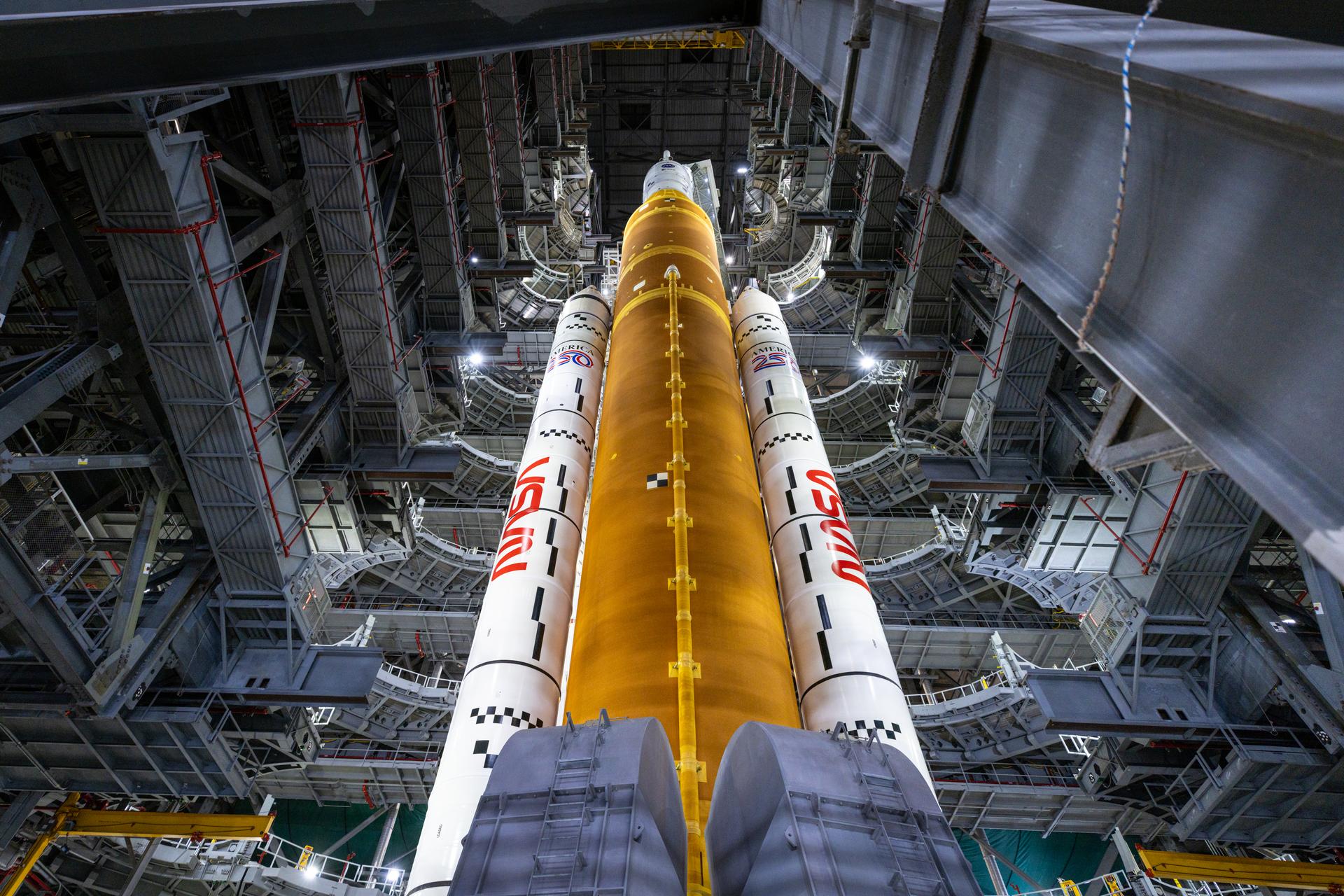
Artemis II's SLS rocket and Orion spacecraft began rolling to Launch Pad 39B at 12:20 a.m. EDT on March 20, a roughly 4-mile, up-to-12-hour transfer to the pad. After a Feb. 21 wet dress rehearsal revealed a helium-flow issue, teams repaired the upper-stage feed and refreshed systems—replacing and charging multiple batteries and a core-stage LOX feed-line seal—before returning to rollout. The mission will carry four astronauts (Reid Wiseman, Victor Glover, Christina Koch, Jeremy Hansen) on an approximately 10-day crewed lunar flyby, marking the Artemis program's first crewed flight.
This rollout is a catalyst for a multi-year, cost-plus revenue stream that disproportionately benefits systems integrators and specialty component suppliers rather than consumer-facing “NewSpace” launchers. Expect follow-on demand for high-reliability batteries, cryogenic seals, and mission-assurance testing services to be lumpy but high-margin; these are items where incumbents with flight heritage capture pricing power and recurring sustainment work over the next 3–7 years.
Second-order supply-chain winners include industrial cryogenics and avionics firms whose products become certified flight hardware — certification creates a high barrier to entry and stickier revenues versus one-off launch services. Conversely, contractors exposed to fixed-price commercial launch work (smaller systems integrators and some launch startups) face crowding and margin compression if NASA shifts more sustainment and integration work to established primes under heightened oversight.
Near-term risks that could reset valuation expectations are schedule slips from component-level failures (batteries, valves, seals) and political budget pressure; a single significant anomaly on Artemis II would materially increase NASA’s testing regimen and push multi-quarter contract delays. Positive catalysts that would re-rate suppliers are a clean mission and a follow-on manifested cadence (Artemis III+ schedule or civil-commercial partnerships) within 12–24 months that convert one-off program revenues into multi-year sustainment contracts.
The market narrative will likely overweight the PR of a crewed lunar flight and underweight which firms actually capture recurring cash flows. That creates asymmetric trade opportunities: selectively long mission-assurance and cryogenics suppliers while avoiding or shorting smaller commercial launch-equipment vendors that lack NASA heritage and face contracting headwinds.
AI-powered research, real-time alerts, and portfolio analytics for institutional investors.
Request DemoOverall Sentiment
neutral
Sentiment Score
0.00
