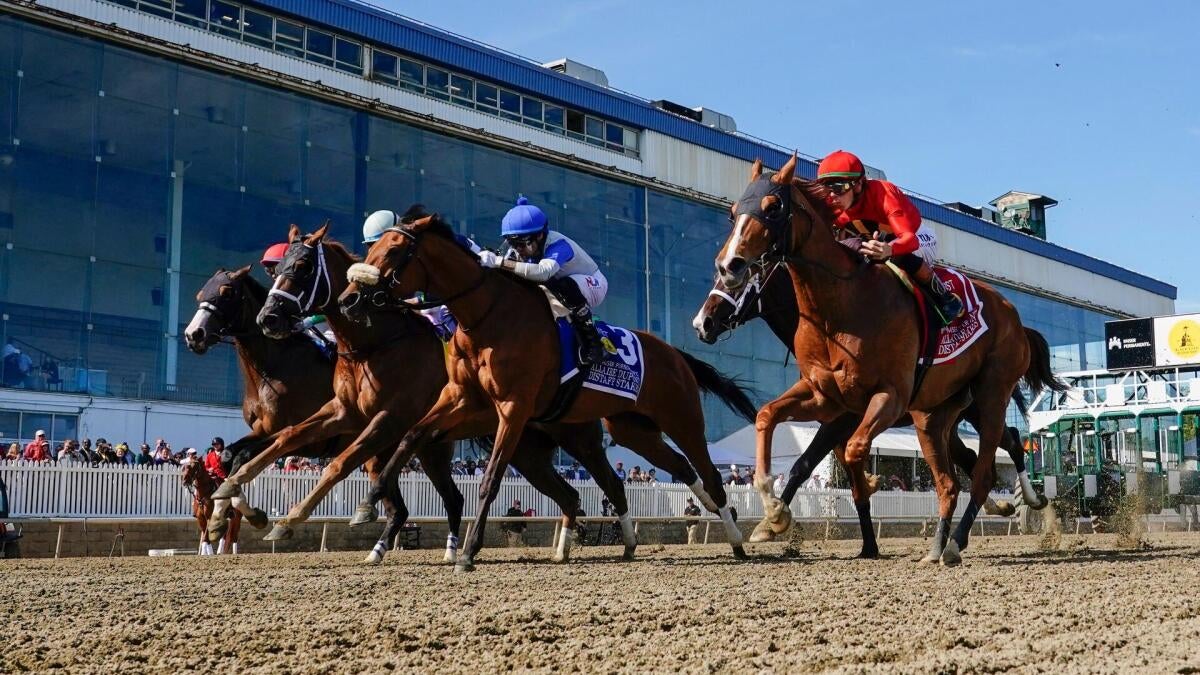
The article previews the 2026 Preakness Stakes at Laurel Park on May 16, with Iron Honor the 9-2 favorite and a 14-horse field featuring Chip Honcho, Incredibolt, and Taj Mahal at 5-1, plus Ocelli at 6-1 and Napoleon Solo at 8-1. It is primarily handicapping commentary, highlighting expert Gene Menez fading the favorite and favoring longshots like The Hell We Did at 15-1. The piece is sports-focused and has minimal direct market impact.
This is a classic micro-event with macro-relevant read-throughs for discretionary consumer behavior: the market is being asked to price a low-liquidity, high-variance spectacle where the favorite is vulnerable and the field is compressed enough that tote-board swings can materially alter late money. In those setups, the real edge is usually not picking the “best horse” but identifying which narratives are overbet by public money and which are underbet because they lack brand recognition or recent headline momentum. That dynamic tends to favor contrarian positioning in the final 30-60 minutes before post time, when recreational flows are most concentrated.
The second-order effect is on the sports-betting / gaming ecosystem rather than the race itself. A nationally televised, short-window event drives same-day handle, promotional spend, and acquisition efficiency for books and affiliates; the winners are the operators with the lowest CAC and strongest parlay ecosystem, while the losers are smaller platforms forced to over-subsidize promos to compete. If the favorite underperforms, that typically improves hold rates for books because public favorites are the most common anchor leg in parlays and round-robins, creating a positive convexity tail for operators into the evening slate.
The contrarian angle is that the “favorite fading” narrative can become crowded very quickly. Once the market latches onto one or two longshots with plausible form cycles, odds on those names can compress faster than their true win probability improves, especially in a race with a shallow field and limited remaining information. The better edge is often to express the thesis through exotic structures and related-event exposure rather than taking outright win risk on the most talked-about longshot.
From a risk perspective, this is a one-day catalyst, not a multi-week fundamental story, so timing matters more than conviction. The key reversal is a clean break from public narrative: if the market starts showing strong support for the favorite late, that usually signals sharper confidence and reduces the payoff to a fade. The asymmetry is best harvested in tickets that benefit from chaos rather than needing a single exact winner.
AI-powered research, real-time alerts, and portfolio analytics for institutional investors.
Request DemoOverall Sentiment
neutral
Sentiment Score
0.05
