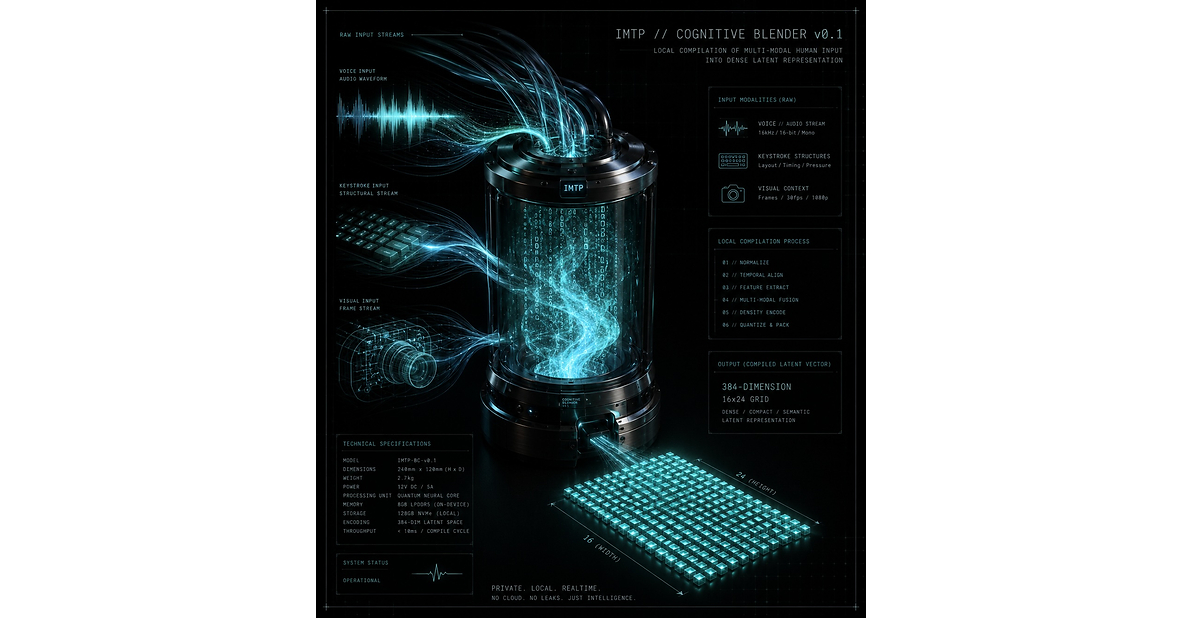
Intersignal released Braid v0.1, a turnkey “local node” desktop app for cloud-free AI state synchronization, packaging sensory inputs into 384-dimension binary latent vectors distributed over a local UDP mesh to enable peer-to-peer alignment without cloud connectivity. The company also announced its Sovereign AI Consulting practice with engagements starting at a $25,000 minimum retainer. Overall, this is a product/innovation step forward with incremental implications for AI privacy and edge deployments rather than a near-term market-moving financial catalyst.
This is more of a sentiment read-through on data sovereignty than a directly monetizable event. The near-term market mechanism is not revenue displacement from cloud AI, but a modest re-rating of “private inference” as a procurement requirement: workloads that are latency-sensitive, regulated, or politically sensitive can migrate to endpoint hardware, local storage, and systems integrators. That creates incremental demand for AI PCs, workstations, SSDs, networking, and security tooling, while putting marginal pressure on cloud inference pricing rather than core cloud demand.
For GOOGL, the first-order impact is likely immaterial, but the second-order risk is margin mix: if enterprise buyers normalize hybrid/local processing, hyperscalers face more competition on the cheapest inference jobs and less control over the workflow layer. The bigger winners are not software vendors here but hardware OEMs and edge-compute suppliers that capture the spend when organizations rebuild around on-prem and air-gapped deployments. TGT is effectively a no-through-line unless this becomes a broader consumer device refresh cycle.
The contrarian view is that the market may overstate decentralization. Most buyers want privacy without operational complexity, which usually means managed private cloud, not truly local meshes. Over 1-3 months the likely catalyst path is small and anecdotal; over 6-18 months the relevant question is whether enterprise IT starts specifying endpoint AI budgets into refresh cycles. If hyperscalers respond with isolated private inference, the cloud-disruption thesis loses force quickly.
AI-powered research, real-time alerts, and portfolio analytics for institutional investors.
Overall Sentiment
mildly positive
Sentiment Score
0.25
Ticker Sentiment
