
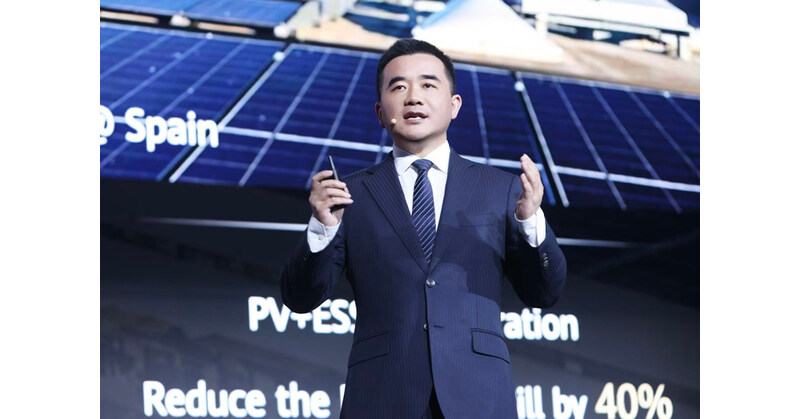
Huawei Digital Power (Steven Zhou) unveiled at The Smarter E 2026 an integrated “network-forming” training strategy aimed at improving grid stability as renewables penetration rises. The article cites Europe’s wind+solar share targeting 64% by 2030 and claims Huawei’s network-forming functions (e.g., autonomous start, inertia support, fault-current withstand) are validated across operating conditions. Commercial examples include a 10% revenue increase in Germany’s AHS after two years and ~40% electricity bill reduction for a Carrefour supermarket in Spain, implying a ~5-year payback.
This is more useful as a signal on European power economics than as a direct equity catalyst for the named retailer. If these integrated solar-plus-storage systems actually reduce power bills by high double digits, the first beneficiaries are capital-light operators with large roof area and long operating hours, but the economic value will likely accrue to the integrator/vendor ecosystem before it shows up in retailer earnings. For CRRFY, the upside is a slow-burn opex tailwind; it is unlikely to move the multiple unless management starts framing energy self-generation as a repeatable margin lever rather than a one-off pilot.
The real second-order winner is grid equipment and BESS infrastructure: grid-forming capability increases the value of inverters, controls, switchgear, and software, while also raising switching costs for utilities once standards are embedded in interconnection codes. That should favor European industrial electrification names such as Schneider Electric and ABB over pure-play module suppliers, because the monetization shifts from commodity hardware to system-level integration, service, and compliance. On the other side, conventional peaker and balancing-asset owners face gradual displacement over 6-18 months if battery installations keep scaling and ancillary-service markets deepen.
The contrarian risk is that this is still mostly vendor marketing until financing, permitting, and utility-code changes catch up. If power prices fall, rates stay elevated, or grid-forming batteries fail to win bankable procurement awards, paybacks could widen and adoption slow sharply. The falsifier is simple: if European C&I battery projects stop landing at sub-6-year paybacks or if regulatory changes delay grid-code adoption into 2027, the thesis on accelerated storage penetration should be faded.
AI-powered research, real-time alerts, and portfolio analytics for institutional investors.
Request TrialOverall Sentiment
mildly positive
Sentiment Score
0.25
Ticker Sentiment
