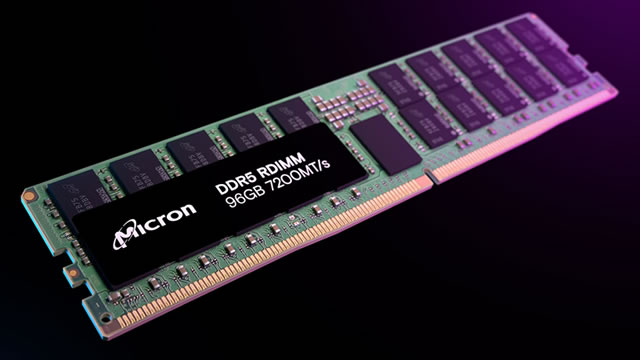
DRAM is expected to stay tighter for longer than NAND, supporting Micron’s DRAM-heavy (76%) portfolio. The article cites faster-than-expected HBM growth alongside tight market conditions and Micron’s strong HBM position as key catalysts, with DRAM tightness extending through 2027+ and HBM TAM projected to surpass $100B in 2027—likely accelerating revenue growth.
The market implication is less about a single earnings beat and more about duration: if DRAM stays structurally tight while HBM remains the scarce node, MU’s earnings power becomes less cyclical than the street typically underwrites. That should support multiple expansion on forward estimates because the mix shift raises visible gross margin durability and lowers the probability of a near-term inventory air pocket. By contrast, NAND-heavy players and lower-value memory assemblers face a weaker pricing backdrop and less ability to re-rate on the same AI demand wave.
Second-order winners are the adjacent bottlenecks. If HBM demand stays ahead of supply, the constraint migrates into advanced packaging, interposer capacity, and memory-qualified server buildouts, which can keep AI hardware lead times long even if GPU silicon availability improves. That favors suppliers with scarce process capacity, but it also means hyperscalers may push harder on design changes and second-source qualification, creating a delayed supply response that could eventually cap pricing power.
Contrarian risk: the consensus may be extrapolating a straight line from tightness to 2027, while memory markets usually normalize when capex and qualification catch up. The key falsifier is not macro but micro: if HBM qualification broadens materially or DRAM contract pricing stops rising, the equity will likely de-rate before demand itself weakens. Near term, the setup looks better over 1-3 months into any estimate revisions; over 6-18 months, the main risk is that the HBM scarcity premium becomes fully reflected and the stock stops outperforming on good news.
AI-powered research, real-time alerts, and portfolio analytics for institutional investors.
Overall Sentiment
moderately positive
Sentiment Score
0.45
Ticker Sentiment
