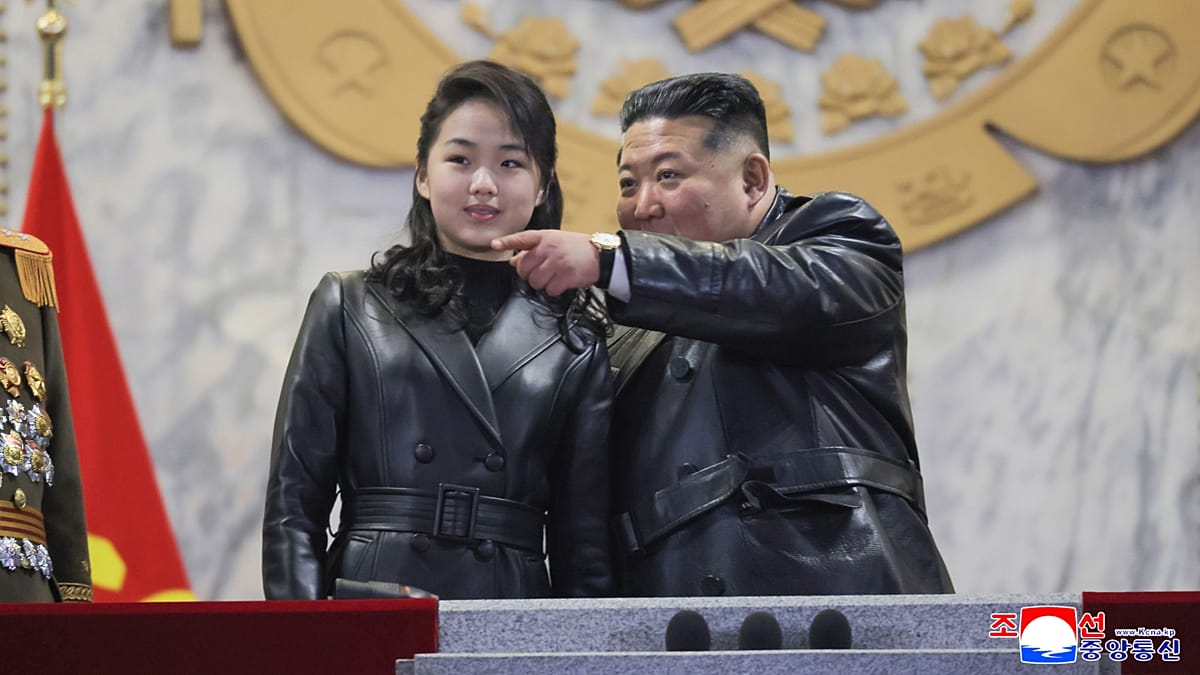
North Korean leader Kim Jong-un used the Workers' Party congress to harden rhetoric toward Seoul, vowing to cut ties with South Korea and threatening its destruction if security is endangered, while calling for expanded nuclear and delivery capabilities including underwater-launched ICBMs and tactical nuclear weapons. He signaled willingness to engage the United States only if Washington recognizes North Korea as a nuclear state, highlighted growing ties with Russia (including reported troop and equipment transfers), and oversaw a military parade — developments that raise regional geopolitical risk and could influence defense and safe-haven asset flows.
Market structure: Escalatory rhetoric strengthens demand for defense, intelligence and ISR suppliers (prime contractors, missile/ASW systems) and safe-haven assets while pressuring South Korea-specific exposure (EWY, KOSPI, Korean banks). Pricing power will increase for firms with classified/dual-use tech (NOC, LMT, RTX, TTWO for cyber) as governments accelerate procurement; commercial travel and Korean exporters face margin compression from currency weakness and risk premia tightening.
Risk assessment: Tail risk is low-probability/high-impact—regional kinetic escalation or attacks on shipping lanes could spike Brent >10% in days and send 2y UST yields down 20–40bps; cyber retaliation could disrupt semiconductor supply for 1–3 months. Near-term (days–weeks) expect volatility spikes; medium-term (3–12 months) depends on diplomacy (Trump–Kim meeting, China posture). Hidden dependencies include Russia/China calibration and US political incentives; sanctions, missile tests, or a high-profile US-NK meeting are primary catalysts.
Trade implications: Favored plays are long primes and ISR suppliers (3–6 month horizon) and long GLD/TLT for 1–3 month risk-off hedges; short Korea equities/currency tactically via options or futures. Use options to size convexity: buy call spreads on LMT/NOC and buy put spreads on EWY or KOSPI; target realized volatility +20–40% vs. prior month for entry signals.
Contrarian angles: Consensus assumes persistent risk premium; this may be overdone if a diplomatic quid-pro-quo emerges after a Trump–Kim meeting, which could compress defense re-rating by 10–20% in 1–3 months. Consider risk-reversal or pair trades (long defense / short Korea equities) to capture asymmetric payoffs and hedge event reversal risk; monitor concrete signals (US delegations, sanctions language) before de-risking.
AI-powered research, real-time alerts, and portfolio analytics for institutional investors.
Request TrialOverall Sentiment
moderately negative
Sentiment Score
-0.45
