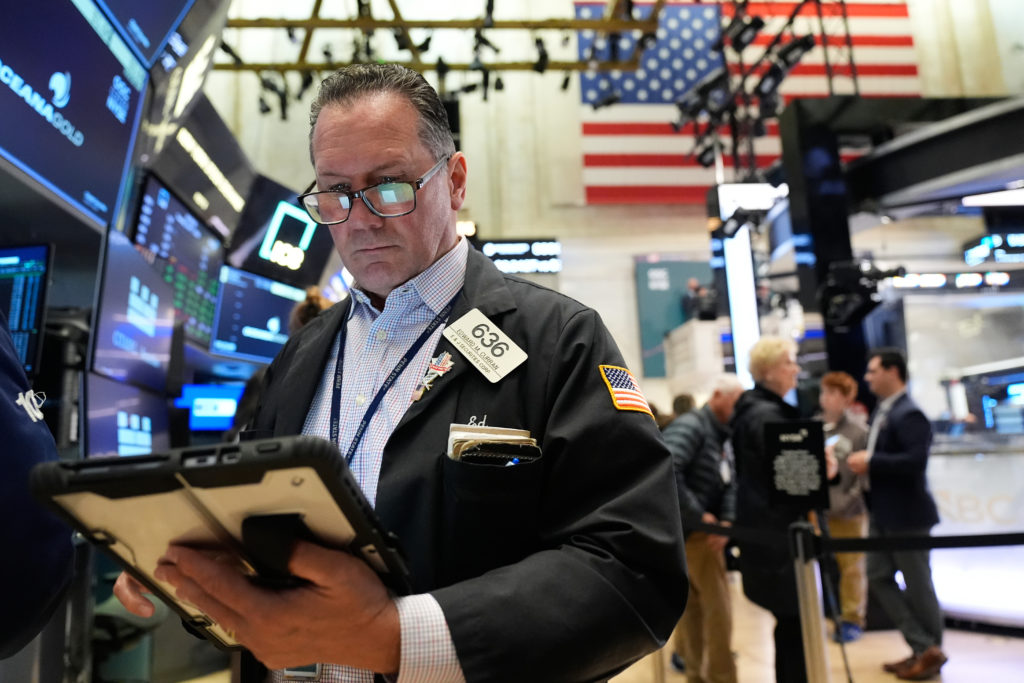
Wall Street rallied modestly as investors hoped the U.S.-Iran conflict could still avoid a worst-case global economic scenario, with the S&P 500 up 0.6%, the Dow up 102 points, and the Nasdaq up 0.8%. Brent crude settled at $99.36 per barrel, up 4.4% but off its nearly $104 intraday high, while the 10-year Treasury yield slipped to 4.29% from 4.31% late Friday. Goldman Sachs reported $5.63 billion in quarterly profit but fell 1.9% on weaker trading revenue, while Sandisk rose 10.6% on Nasdaq 100 inclusion and Oracle gained 11.8% as AI-related volatility continued.
The market is telling us this is still a probabilistic tail-risk event, not a regime change. The key signal is that equities are refusing to price a full energy shock even as headline risk stays elevated, which implies investors still think the disruption path is narrower than a true supply collapse; that keeps downside in cyclicals more contained than many macro models would suggest. The more important second-order effect is that higher crude, even if temporary, is a tax on every non-energy earnings print over the next two quarters through margins, freight, and consumer demand, so the market can hold up while the earnings revisions cycle quietly deteriorates. Financials are the most interesting barometer here. The immediate read-through is not the reported quarter but the forward guide for trading, underwriting, and credit reserves if volatility persists into the bank earnings window; a modest oil spike can actually help loan growth and NII math, but only until funding costs, market-making activity, and recession odds start moving together. Goldman's softer mix versus stronger headline profit is the tell: this environment rewards balance-sheet-heavy franchises with sticky deposits and penalizes capital markets-dependent names that need stable deal flow and low dispersion. On the growth side, the move in names tied to AI spending is more about factor rotation than fundamentals. Investors are starting to reward companies that can monetize capex now, not just promise it later, which is why index mechanics and short-covering matter so much for SNDK, ORCL, NOW, and APP. The contrarian read is that this could be the start of a deeper quality rotation: if yields stay pinned while oil shocks fade, the market may keep paying for cash-flow visibility and punish software vendors where incremental spend is still outrunning proof of ROI.
AI-powered research, real-time alerts, and portfolio analytics for institutional investors.
Request DemoOverall Sentiment
neutral
Sentiment Score
0.05
Ticker Sentiment
