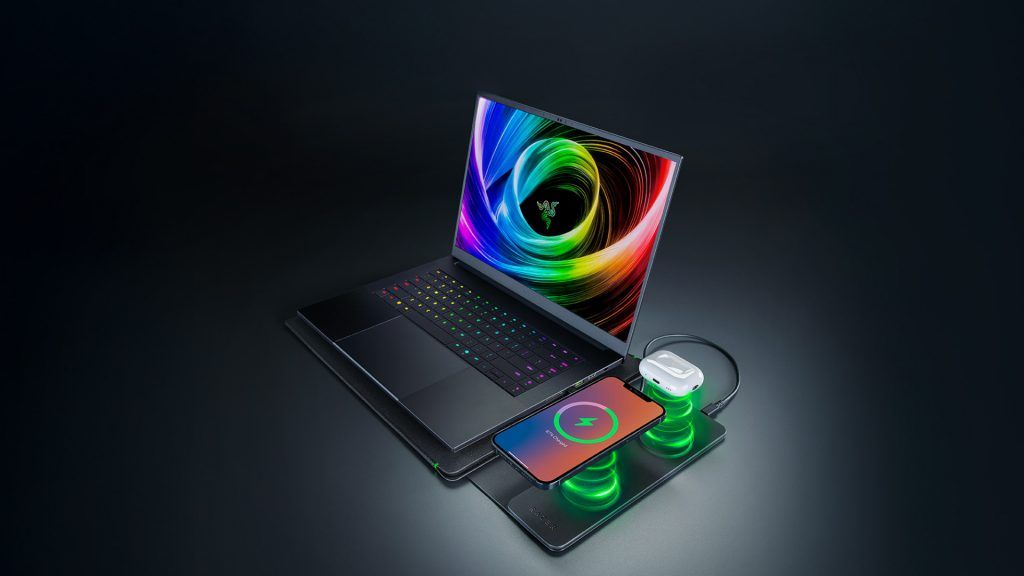
Razer introduced a laptop sleeve for up to 16-inch devices in two SKUs: an $80 basic sleeve and a $130 model whose magnetic flap integrates two wireless charging pads (top pad up to 15W, bottom pad 5W) powered via an included USB-C cable with no internal battery. Available now on Razer's website, the accessory extends the company's premium peripherals lineup and could generate modest incremental accessories revenue and product differentiation, but is unlikely to materially affect near-term financial results or move markets.
Market structure: Razer’s $130 sleeve (vs $80 base) shows willingness among premium consumers to pay a ~62% price premium for integrated wireless charging, which benefits branded peripheral OEMs (Razer 1337.HK, Logitech LOGI) and component suppliers (TXN, QCOM) through higher ASPs and attach rates. Low-cost accessory vendors and standalone power-bank makers may see margin pressure if bundling reduces repeat charger purchases; overall market share shifts will be incremental (low single-digit points) not disruptive to laptop OEMs.
Risk assessment: Tail risks include product safety/recall (wireless coils overheating), IP/regulatory restrictions on wireless emissions, and supplier bottlenecks for power-management ICs; each could knock 5-15% off accessory revenues for affected vendors. Immediate effects are negligible (days), short-term (weeks–months) depends on reviews/holiday season traction, and long-term (quarters) could raise accessory category ASPs by an estimated 1–3% if adopted broadly. Hidden dependencies: USB‑C power sourcing from host/laptop limits standalone utility; positive catalysts are strong holiday sell-through and influencer reviews within 30–90 days.
Trade implications: Direct plays favor small, tactical exposure to premium peripheral winners and component makers rather than hyperscalers: consider concentrated option structures on LOGI and selective equity exposure to Razer (1337.HK) or TXN on better-than-expected guidance. Pair trades can long omni-channel retailers that monetize accessories (BBY) and underweight pure-play online commoditized sellers if same-store accessory mix shifts. Entry should be staged into positive retail sell-through data (3–8 weeks) and exit on a 10–15% move or on holiday sell-through miss.
Contrarian angles: Consensus views will underweight the importance of packaging/bundling — the real lever is recurring accessory attach rates, not one-off sleeve sales; if attach increases by >5% it compounds revenue with low incremental cost. Reaction may be underdone: a successful premium sleeve could validate >$30 incremental ASP per device for 2–3 years, benefiting platform component suppliers. Unintended consequence: normalization of integrated peripherals could accelerate consolidation among small accessory makers, increasing M&A activity (watch for 3–12 month deal flow).
AI-powered research, real-time alerts, and portfolio analytics for institutional investors.
Request TrialOverall Sentiment
mildly positive
Sentiment Score
0.28
