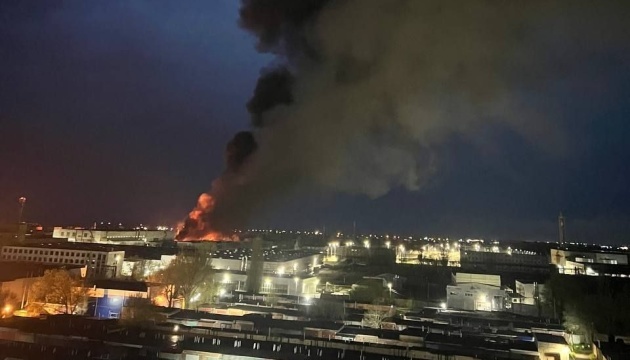
A missile attack hit the ATLANT AERO drone plant in Taganrog, with Russian officials confirming three people sought medical assistance and a warehouse-area fire broke out. OSINT reporting says the facility produces Molniya strike-reconnaissance drones and Orion UAV components, and it had already been attacked in January and March. The event is geopolitically significant and may add near-term disruption to Russian drone production, but it is unlikely to have broad market-wide impact.
Repeated strikes on a specialized drone-production site matter less for the immediate physical damage than for the cumulative friction they impose on a constrained supply chain. Even if the plant is not fully disabled, the more important second-order effect is intermittent loss of assembly, testing, and component finishing capacity, which can push slippage into weeks rather than days and force customers to draw down inventories or substitute lower-spec platforms. That tends to help incumbent larger-system suppliers with deeper redundancy while hurting niche UAV builders whose margins depend on throughput and low working-capital intensity.
The market implication for ORN is not a clean “destroyed capacity, lower earnings” story; it is a higher operational-risk discount on future delivery cadence, export optionality, and component availability. If the ecosystem around this program has to re-route subcontracting, expect a lagged hit to order conversion over 1-2 quarters rather than an instant revenue collapse. The bigger risk is that repeated attacks create a self-reinforcing cycle of capex diversion into hardening, dispersal, and backup tooling, which can permanently reduce margin even if output resumes.
The contrarian read is that investors may overestimate how much of this translates into durable impairment, because defense production often degrades gracefully: critical parts are stockpiled, production can be dispersed, and replacement capacity is prioritized by the state. For ORN specifically, the headline event is negative, but the valuation response could be overdone if the market is already pricing in long-duration supply interruption. What matters is whether this becomes a pattern of attacks on the broader drone manufacturing base; one-off hits are noise, but a sustained campaign can re-rate the whole unmanned-systems complex lower.
Near term, the cleaner expression is event-risk trading around ORN rather than a long-horizon structural short. Any bounce in the name after initial shock is an opportunity to re-establish shorts if there is evidence of repeated strikes, because the downside comes from execution risk compounding across multiple production nodes. A broader geopolitical hedge is to favor firms with exposure to air-defense, electronic warfare, and hardened infrastructure over pure-play UAV manufacturers, as the market usually underprices the defensive spending that follows these incidents.
AI-powered research, real-time alerts, and portfolio analytics for institutional investors.
Request DemoOverall Sentiment
moderately negative
Sentiment Score
-0.45
Ticker Sentiment
