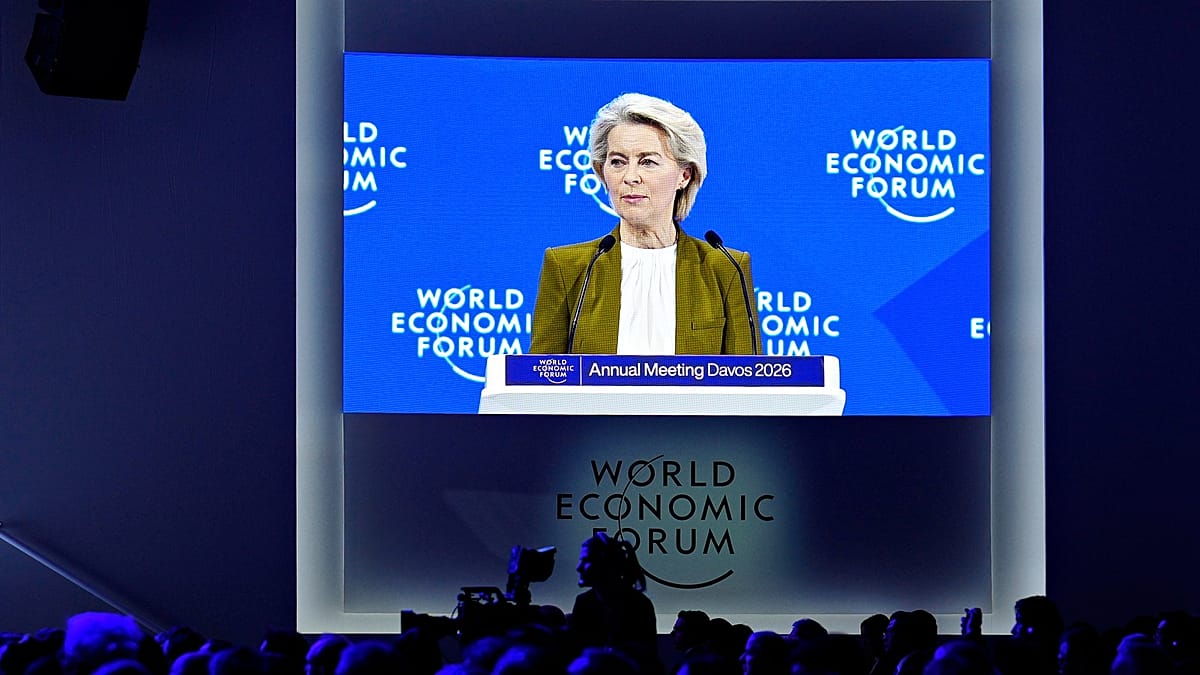
At Davos European Commission President Ursula von der Leyen warned the transatlantic alliance is at risk after US President Donald Trump threatened a 10% tariff on eight NATO-member European countries over a push to acquire Greenland, with tariffs due to start Feb. 1 unless diplomacy succeeds. Von der Leyen promoted a push for 'European independence', highlighted a new Mercosur free-trade deal covering more than 700 million consumers and forthcoming pacts with Australia, India and the UAE, and pledged measures to de-risk supply chains and bolster energy, security and defence autonomy—signaling potential trade realignment and elevated geopolitical risk for investors.
Market structure: A shock to the US–EU security compact accelerates European onshoring and defence re‑investment while increasing political appetite for trade diversification (Mercosur +700m consumers). Direct winners: EU defence primes, cybersecurity and industrial suppliers; losers: US‑centric exporters to Europe if 10% tariffs materialize on Feb 1. Expect higher EU public capex to shift pricing power to domestic suppliers over 12–36 months and push up commodity demand for steel, specialty metals and LNG in the near term. Risk assessment: Tail risks include immediate tariff escalation (10% on eight EU states effective 1 Feb), reciprocal EU tariffs, or a durable NATO rift that triggers deglobalisation scenarios (5–15% downside to trade‑sensitive sectors over 12 months). Near term (days–weeks) expect FX and rate volatility; short/medium term (months) see re‑rating of defence/energy capex; long term (years) structural supply‑chain onshoring alters margins and ROIC across industries. Hidden dependency: European manufacturing still relies on non‑EU semis and rare earths, so “independence” raises input costs unless supplemented by parallel trade partnerships. Trade implications: Tactical long bias to EU defence (6–12 month horizon) and select energy/renewables beneficiaries, paired with hedges against Euro volatility. Use options to express directional views (buy 6–12m calls on defence names; buy 3m put spreads on EURO STOXX 50 if tariffs spike). Rotate out of US‑exposed European autos and some luxury exporters to the US into Mercosur beneficiaries and infrastructure suppliers. Contrarian angles: Consensus underestimates how quickly EU procurement can shift — post‑2014 Crimea saw multi‑year defence budget increases of ~10%+ in several states; similar re‑allocations can compress civilian capex. Reaction may be underdone for defence and overdone for EUR strength in the first 90 days; political risk and trade deal ratification timelines (3–24 months) are the key re‑pricing levers. Unintended consequence: faster onshoring raises CAPEX but likely reduces short‑term margins, creating staging opportunities for active managers.
AI-powered research, real-time alerts, and portfolio analytics for institutional investors.
Request DemoOverall Sentiment
moderately negative
Sentiment Score
-0.25
