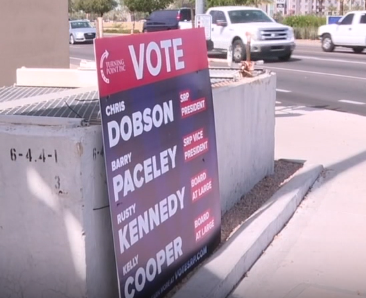
Unofficial Salt River Project election results were announced, with Chris Dobson named President and a mix of incumbents and new members winning board and council seats. Early voting surged with more than 22,000 ballots cast five days before election day versus about 7,500 in the last two elections. SRP will certify official results following a canvass at the SRP Board meeting on April 13. Given the Board and Council set policy, budgets and rates, membership changes could influence future SRP pricing and governance but are unlikely to move broader financial markets immediately.
The contested, high-turnout governance outcome materially raises policymaking risk for Arizona delivery and generation economics: whoever controls Board and Council levers can accelerate large capital projects (transmission, grid hardening) and authorize revenue bonds that shift costs to ratepayers rather than taxpayers. That mechanism favors entities that can accept longer-dated contracted cashflows (large IPPs, muni bond buyers) and penalizes marginal distributed-resource economics where payback is sensitive to tariff design.
A likely second-order effect is a re-pricing of distributed solar and DER investment in Arizona. If the Board leans toward higher fixed charges or demand/peak-based tariffs to curb volumetric recovery, a $5–$15/month increase in fixed bills is sufficient to add ~8–18% to residential electricity spend for an average household — meaning 6–18 month extensions to rooftop-solar payback assumptions used by installers and lenders. That amplifies credit and volume risk for the rooftop supply chain while improving the competitive case for utility-scale PPAs and storage co-located with large renewables.
Near-term catalysts: the April 13 canvass and subsequent Board policy meetings over the next 3–6 months will reveal posture on rate cases and bond issuance, and any early guidance on tariff redesigns will move regional installers and municipal credit spreads. Tail risks include state-level legislative intervention or litigation that can freeze SRP actions for quarters — a high-consequence path that would temporarily favor incumbents in the retail-install ecosystem. Monitor SRP bond docs and any proposed tariff filings as leading indicators of capital-source shifts.
AI-powered research, real-time alerts, and portfolio analytics for institutional investors.
Request DemoOverall Sentiment
neutral
Sentiment Score
0.00
