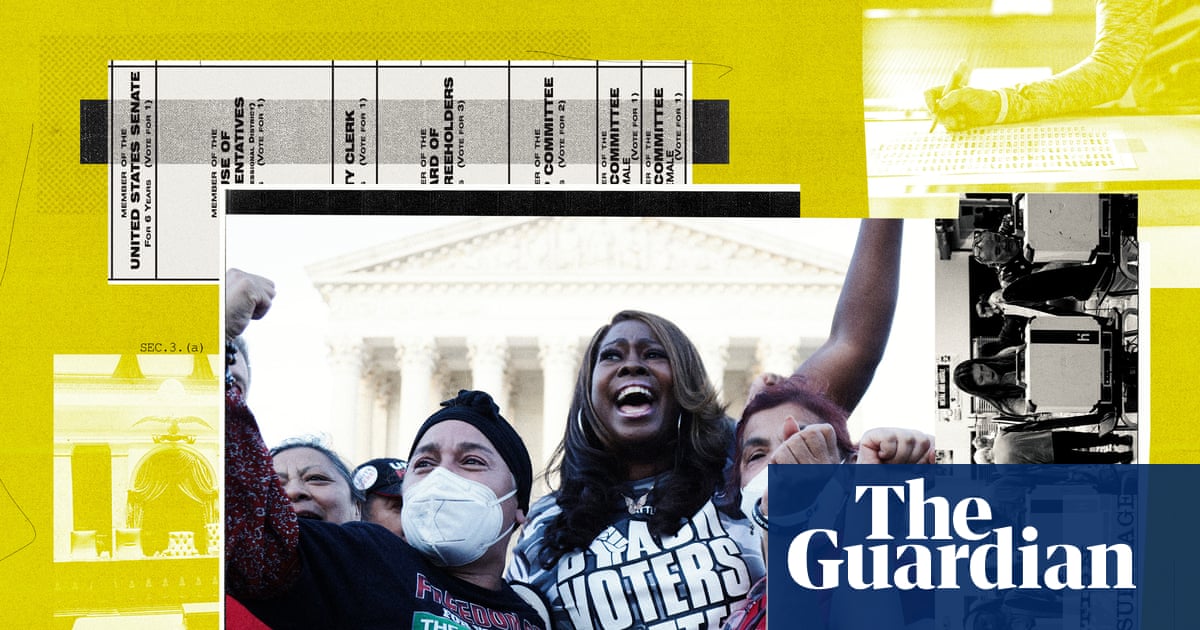
Southern states are rapidly moving to redraw congressional maps after the Louisiana v. Callais decision, with Louisiana, Alabama, Florida, Mississippi, South Carolina and Tennessee all considering or implementing changes that could eliminate multiple Black-majority Democratic seats. The article highlights immediate legal challenges, mid-decade redistricting efforts, and procedural moves that may set aside completed or ongoing elections. The impact is primarily political and legal rather than market-driven, but it raises significant governance and rule-of-law concerns.
The immediate market read is not about ideology; it is about institutional friction. Rapid map changes, special sessions, and attempts to retroactively affect already-advanced election processes imply elevated near-term legal spending, higher injunction risk, and a multi-quarter drip of uncertainty for any issuer with exposure to state procurement, public-sector contracts, or civic-tech/vendor ecosystems tied to election administration. The larger second-order effect is a credibility shock: once legislatures show willingness to rewrite rules midstream, investors should assume a higher probability of election-cycle volatility in bond spreads, utility regulation, and municipal governance decisions in these states.
The clearest loser set is not just the targeted districts; it is any business model reliant on stable local political representation. That includes regulated utilities, regional banks, healthcare systems, universities, and large employers that depend on predictable county-level advocacy and appropriations. The competitive dynamic may also tilt toward national platforms that can absorb compliance and reputational costs better than local incumbents; smaller vendors serving government and nonprofit constituencies face the most headline risk, particularly where activism could become disruptive over the next 1-3 months.
The contrarian view is that markets may underprice judicial backstop risk. The more aggressively states move, the more they create evidentiary records that can be used in expedited injunctions, which could freeze implementation late in the cycle and create a binary reversal trade. That means the best-risk/reward positioning is likely in optionality, not directionality: the event path is messy, but the volatility regime is likely to remain elevated for the rest of the year. If public protest broadens, escalation risk rises, but so does the odds of a court-driven pause that leaves the current maps partially intact.
AI-powered research, real-time alerts, and portfolio analytics for institutional investors.
Request DemoOverall Sentiment
strongly negative
Sentiment Score
-0.80
Ticker Sentiment
