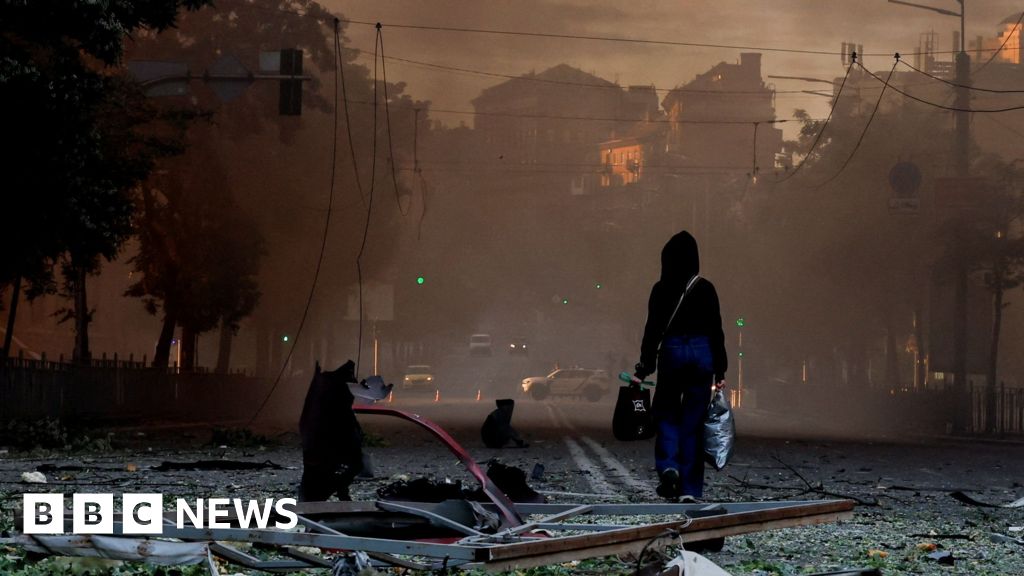
Russia launched a large wave of missile and drone strikes on Kyiv, killing 1 person and injuring 21 others, with damage reported across more than 40 locations. Residential buildings, a school, warehouses, a supermarket and a shopping center were hit, and emergency services are still clearing debris and treating the injured. The escalation raises geopolitical risk and supports a risk-off market tone.
This is less a one-off headline than an escalation in the probability distribution for European energy, defense, and industrial supply chains. The market usually underprices the second-order effect of repeated urban strikes: higher insurance premia, delayed reconstruction schedules, and a rising floor for regional security spending even if frontline dynamics do not materially change. That creates a slow-burn bid for firms exposed to air-defense, counter-drone, electronic warfare, generators, grid hardware, and heavy construction materials, while keeping a lid on Ukraine-adjacent consumer and logistics names.
The key risk catalyst is not the current damage count but the implied shift toward higher-intensity, deeper-strike exchanges over the next 1-3 weeks. If retaliatory cycles continue, volatility in European gas and power becomes a tail risk again through infrastructure interruption rather than direct supply loss, which is typically enough to widen spreads in utilities and industrials that depend on stable baseload pricing. A credible threat to intercept-defying missile deployment would also force NATO governments to accelerate procurement decisions that were already budgeted for 2025-26, pulling demand forward into the next two quarters.
Consensus may be overestimating how much of this is already priced into European defense stocks. The better trade is not simply beta long defense, but long companies with actual bottlenecks in production capacity and multi-year order backlogs; those names can re-rate on revenue visibility rather than sentiment. On the flip side, any near-term ceasefire signal would hit the high-duration defense trade harder than the broader market, because the multiple expansion has already front-run a sustained conflict premium.
The most attractive setup is a relative-value expression: long European aerospace/defense primes with supply-chain leverage, short regional consumer discretionary or logistics names tied to Ukraine/CEE demand. If the conflict intensifies, the long leg benefits from budget acceleration and backlog repricing; if tensions ease, the short leg still has limited upside because reconstruction and security capex remain sticky. For a cleaner hedge, use downside protection in European equities via short-dated index puts rather than outright cash shorts, since headline risk can reverse intraday.
AI-powered research, real-time alerts, and portfolio analytics for institutional investors.
Request DemoOverall Sentiment
strongly negative
Sentiment Score
-0.85
