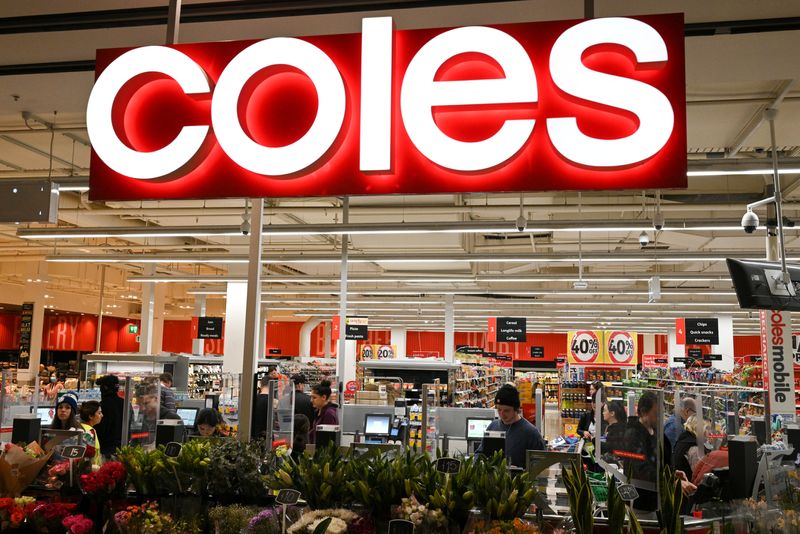
Coles Group reported third-quarter sales revenue up 3.1% to A$10.7 billion, led by a 4.0% increase in supermarkets to A$9.78 billion and 24.8% growth in online sales. Supermarket inflation moderated to 0.8% excluding tobacco, while liquor sales fell 3.9% to A$781 million. Management said early Q4 supermarket trends are in line with Q3, though higher fuel, freight, and packaging costs remain a headwind.
The key signal here is not just resilient grocery spend, but that Coles is converting geopolitical anxiety into pantry-staple pull-forward while still holding price inflation down. That combination suggests the pricing power is currently flowing more through mix and traffic than through outright shelf-price expansion, which is constructive for share retention but caps near-term margin leverage if input-cost pressure re-accelerates.
The more important second-order effect is on competitors and the supply chain. If consumers are trading down in liquor but leaning into staples and convenience, the battleground shifts to basket frequency, fulfillment efficiency, and last-mile economics — a setup that favors the operator with the best store density and e-commerce integration, while pressuring smaller grocers and standalone liquor peers with weaker digital scale. Rising fuel, freight, and packaging costs are a latent tax on these gains, and they tend to hit the smaller-format and less vertically integrated names first.
For the market, the risk is that this becomes a quality-of-demand story rather than a broad retail recovery: the current trend can persist for weeks, but a reversal in household sentiment or a normalization of geopolitical fear could slow the pantry stock-up tailwind quickly. On the other hand, if cost inflation remains contained while e-commerce penetration keeps climbing, the operating leverage arrives with a lag over the next 1-2 quarters, which could make current estimates too conservative.
Contrarian take: the liquor weakness may be more persistent than the market expects because it looks like both demand softness and competitive pressure, not just cyclical noise. If that division remains a drag, investors may be underestimating how much the mix shift toward lower-margin but higher-frequency grocery volumes offsets headline sales growth, limiting upside to earnings despite decent top-line momentum.
AI-powered research, real-time alerts, and portfolio analytics for institutional investors.
Request DemoOverall Sentiment
mildly positive
Sentiment Score
0.35
Ticker Sentiment
