
AllMind vs LSEG
AllMind is an AI research system for institutional investors: agents traverse a financial ontology and hand back a finished model, memo or deck. LSEG Workspace is the multi-asset market-data terminal that succeeded Refinitiv Eikon, now with three AI agents of its own.
The split is what each agent reads: LSEG’s own licensed content, or that plus your firm’s systems.
Joins licensed external content to the firm’s own Snowflake, Databricks, S3 and Data Room through an ontology, runs research for minutes or hours across a coverage list, and produces the finished model, memo or deck with every figure traced to its passage.
Delivers live cross-asset data, exclusive Reuters News, I/B/E/S estimates and aftermarket research, and it now ships three AI agents of its own: AI Search, Company Intelligence and Deep Research, all reading LSEG’s own licensed content.
Keep the direct LSEG surface when the desk depends on exact LSEG fields and history, Reuters exclusivity, an unsupported market or permission, terminal-native analytics, or execution. Choose AllMind when LSEG data should be joined to other licensed providers and firm systems, then turned into a cited model, memo, or deck.
Feature by feature
Agents and analysis
Natural-language search across the corpus
- AllMind
- Supported
- LSEG
- Supported
Answers cited back to source
- AllMind
- Passage level
- LSEG
- LSEG states every claim carries a citation
Long multi-source research runs
- AllMind
- Supported
- LSEG
- Supported
Scheduled or event-triggered research runs
- AllMind
- Supported
- LSEG
- Alerts, not runs
Usage caps on the AI
- AllMind
- Not published
- LSEG
- Monthly fair use
What comes out
Excel model with live formulas
- AllMind
- Supported
- LSEG
- Data export only
Word memo or research note
- AllMind
- Supported
- LSEG
- Supported
PowerPoint deck from a template
- AllMind
- Supported
- LSEG
- Add-in, built by hand
Content the agent reads
Live cross-asset market data
- AllMind
- Equities, options, futures, FX and bonds on supported feeds
- LSEG
- Supported
Estimates and fundamentals
- AllMind
- I/B/E/S, S&P, FactSet
- LSEG
- I/B/E/S, WorldScope
Aftermarket broker research
- AllMind
- Included; provider-specific delay
- LSEG
- 1,900+ contributors
Expert-call transcripts
- AllMind
- Supported
- LSEG
- None published
Global filings inside the agent
- AllMind
- Global filings; EDGAR & SEDAR+ named
- LSEG
- US filings
Private-markets data
- AllMind
- Company profiles, funding and M&A; no fund performance
- LSEG
- Preqin, eVestment
Your firm’s own data
Data room for internal files, models and decks
- AllMind
- Supported
- LSEG
- None published
Warehouse queried in place
- AllMind
- Snowflake, Databricks, S3
- LSEG
- Delivers data out
Per-user entitlements the agents inherit
- AllMind
- Supported
- LSEG
- License level
Reach and infrastructure
Agents inside Microsoft Teams
- AllMind
- Not documented
- LSEG
- AI Search and Deep Research
Excel and PowerPoint add-in
- AllMind
- Generates the files
- LSEG
- Supported
MCP server for other AI tools
- AllMind
- Not documented
- LSEG
- Supported
Python or notebook environment
- AllMind
- Not documented
- LSEG
- CodeBook
Benchmark administration, clearing and listings
- AllMind
- Not supported
- LSEG
- Supported
Trading and execution
- AllMind
- Not supported
- LSEG
- Supported
Commercials and assurance
Published list price
- AllMind
- No published price
- LSEG
- No published price
Third-party security attestation
- AllMind
- SOC 2 Type II
- LSEG
- Not published
Compiled from LSEG’s own product pages, Workspace update notes, data catalogue and press releases, all opened on 30 August 2026, and from AllMind product documentation. LSEG is one of AllMind’s data partners, and “Via data partners” marks estimates and fundamentals AllMind licenses rather than produces. “Not documented” and “None published” report the absence of a published claim by that vendor, not proof the capability is missing; a dash is used only where the vendor’s own scope rules it out.
See AllMind on your own coverage→What AllMind does that a Workspace seat does not
Half the evidence for a call lives inside your own firm
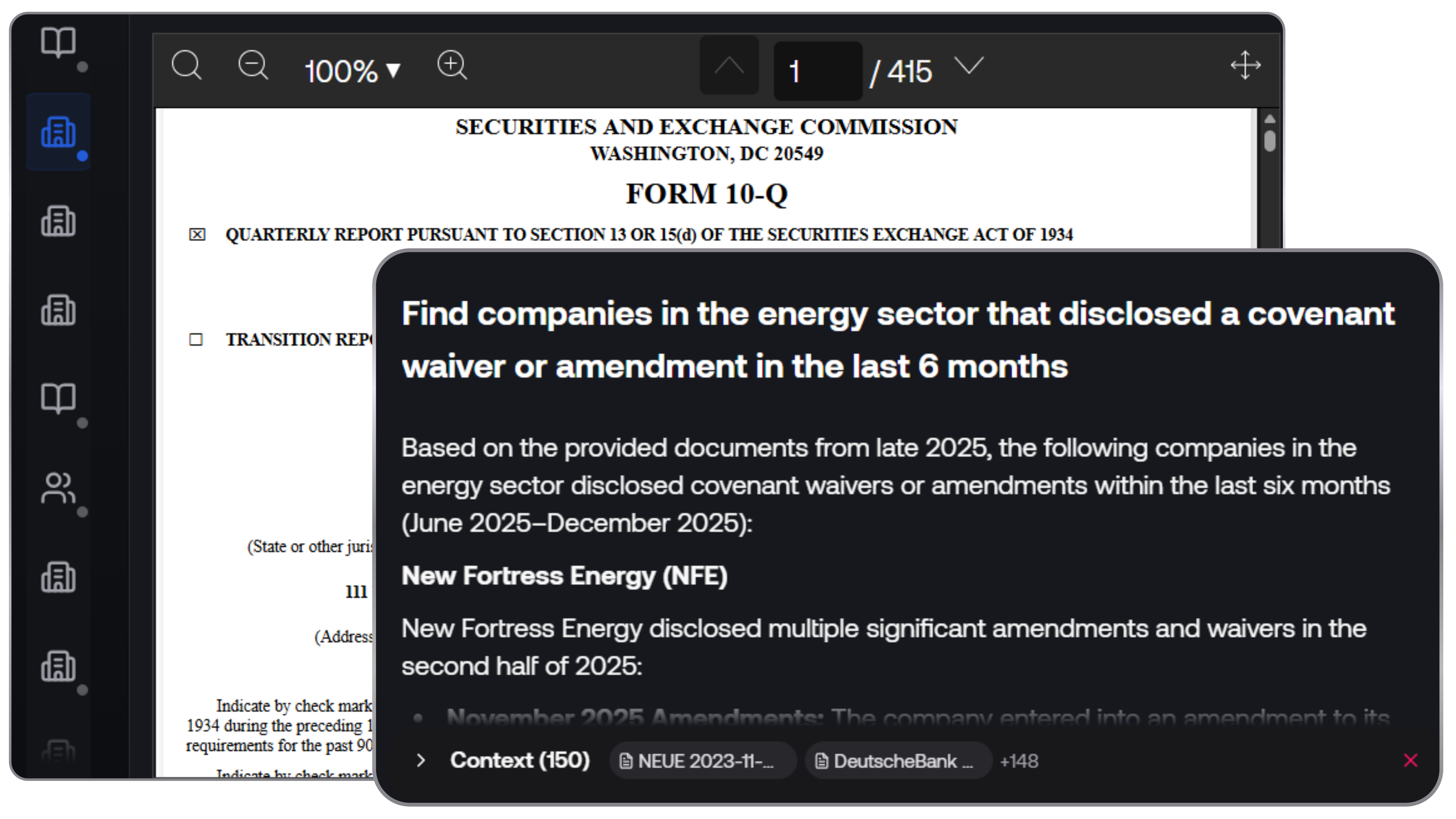
LSEG’s Deep Research agent publishes its own content list, and every item on it is LSEG’s: end-of-day prices, I/B/E/S estimates, key economic time series, Reuters economic polls, WorldScope fundamentals, news from Reuters, Business Wire and PR Newswire, transcripts and US filings. A strong corpus, and a closed one. No LSEG page describes an agent reading files the firm uploads, and LSEG’s direction runs outward: Delta Sharing pushes its data into Databricks, and its MCP server pushes it into Microsoft 365 Copilot, ChatGPT, Gemini Enterprise and Amazon Quick.
AllMind reads in the opposite direction. A scoped IAM role lets it query Snowflake, Databricks and S3 where they already sit, so nothing leaves the firm’s environment, while internal files, models and decks land in a Data Room. The ontology joins the two sides, so an agent can walk from an estimate revision to a supplier to the analyst’s own position note. The cost is honest: that depth starts with a data conversation and IAM scoping rather than a signup.
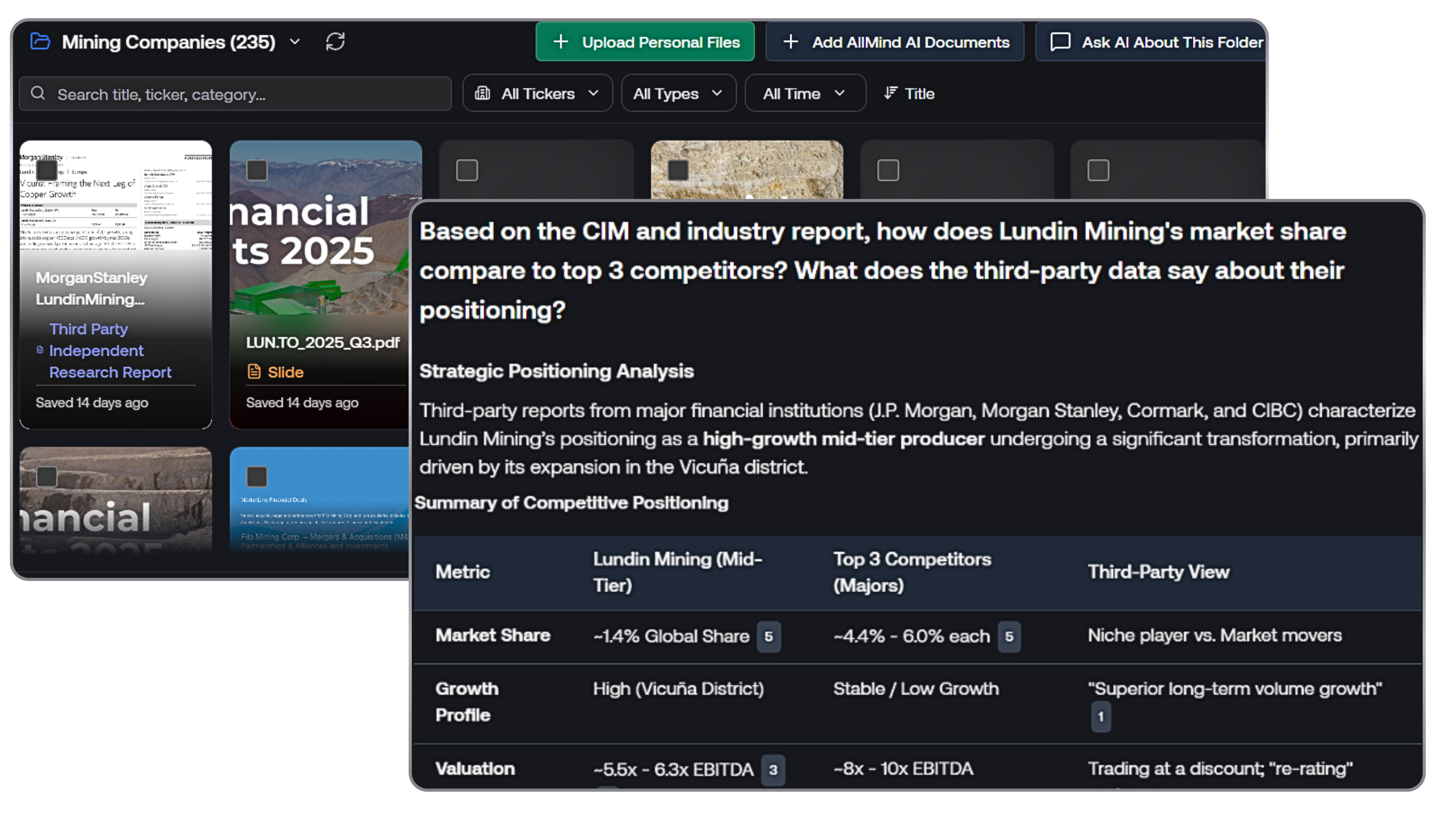
LSEG’s agents stop at the export button
LSEG’s agents hand back an export; AllMind hands back the file. Read LSEG’s own launch pages. Company Intelligence reports “can be exported to PDF or Word for client-ready output, while underlying financial data and tables can be exported to Excel”. AI Search offers “limited outputs such as tables and visuals”. Deep Research “creates charts and graphs” that “can then be exported to Excel, where it can be adapted or overlaid with other proprietary information”. Every one of those sentences ends with an analyst opening another application.
AllMind generates the artifact itself: Excel models covering DCF, LBO and comps with live formulas and standard investment-banking color conventions, Word memos and research notes, PowerPoint decks built from more than twenty investment-bank templates, and edits to existing PPTX, DOCX and XLSX files. The boundary is real. What comes back is built into a supplied template, so a bespoke house format still takes a formatting pass, and the analyst still writes the narrative and sets the rating.

Depth inside one licensed estate, or reach across many classes
LSEG solves entitlement by licensing, and inside its own estate the depth is hard to argue with: 30 million aftermarket research reports from more than 1,900 contributors, exclusive global distribution of Morgan Stanley’s research, exclusive Reuters News, and I/B/E/S estimates from 950 research providers. Step outside that estate and the analyst is back in another tool.
AllMind’s claim is the shape of the corpus rather than the size of any one part: S&P, FactSet, LSEG and MSCI data, broker research, Expert Insights, global investor-relations data, live news from thousands of sources, live earnings and financials within minutes, alternative data, and sector-specific collections. All of it sits behind per-user entitlements the agents inherit and can never widen. Expert Insights is the clearest example, because expert-call transcripts read next to the filings without the desk holding an expert-network contract of its own. Two limits are real: research still under embargo shows only where the firm holds the RMS entitlement, and the aftermarket copy lands on a delay that varies by broker.
Where LSEG is strong
Workspace is what most of the industry means by a terminal, and LSEG dates itself to 1698. It states it serves over 40,000 customers and 400,000 end users across roughly 190 markets. Behind that sit exclusive Reuters News, I/B/E/S estimates covering 22,000-plus companies from 950 research providers with US history to 1976 and international history to 1987, WorldScope fundamentals, StarMine analytics, and 30 million aftermarket research reports from more than 1,900 contributors.
Its AI is no longer a pilot. Deep Research was already in customer use when LSEG reported its first quarter in April 2026, Company Intelligence is datelined July 2026, and AI Search is generally available in Workspace and Microsoft Teams. At the half-year results on 30 July 2026 LSEG put 17,000 users on AI Search and 7,000 on Deep Research, four times its April figure. Against 400,000 end users that adoption is real and still early. On live cross-asset data, estimate tenure and licensed research at scale, LSEG is stronger than AllMind.
Two tools, two different jobs
AllMind
The AI research system for institutional investors
AllMind keeps companies, suppliers, customers, estimates, filings and the firm’s own research as entities with relationships in a financial ontology, and runs its agents over that rather than over an index of documents. One run can travel from a guidance change to the supplier that caused it to the internal note that called it early.
Agents work for minutes, hours or across days on a single question, and the run ends in an artifact: an Excel model with live formulas, a Word memo or a PowerPoint deck.
LSEG Workspace
The multi-asset market-data terminal, now with three agents
LSEG Workspace is the terminal that succeeded Refinitiv Eikon, withdrawn from LSEG’s product line on 30 June 2025; the data business arrived with the Refinitiv acquisition, completed in January 2021. Workspace carries real-time and historical multi-asset market data entitled per named user, exclusive Reuters News, I/B/E/S estimates, WorldScope fundamentals and aftermarket broker research.
It now also ships three AI agents, AI Search, Company Intelligence and Deep Research, which read LSEG’s own licensed content, cite back to source, and run on OpenAI or Anthropic models, per an LSEG product lead.
What each one is good at, and what it costs you
AllMind
- Financial ontology joins companies, suppliers, customers, estimates, filings and the firm’s own research as entities
- Snowflake, Databricks and S3 queried in place through a scoped IAM role, so nothing is copied out
- Data Room takes internal files, models and decks, with Google Drive and OneDrive folder sync
- Generates Excel models with live formulas, Word memos, and decks from 20+ investment-bank templates
- Expert-call transcripts are a built-in content class, with no expert-network contract of the desk’s own
- Scheduled and event-triggered automations across a coverage list; AllMind states up to 200 companies in one automation
- Not a trading or execution terminal; LSEG remains deeper across cross-asset desktop workflows
- No self-serve checkout and no monthly plan, so every deployment starts with a demo and a quote
- Live embargoed broker research needs the firm’s own RMS entitlement; the aftermarket copy arrives on a delay
- Real depth means connecting internal systems, which is a data conversation rather than a signup
LSEG Workspace
- Live cross-asset market data with exchange entitlements, plus exclusive Reuters News
- I/B/E/S estimates from 950 research providers, US history to 1976 and international history to 1987
- 30 million aftermarket research reports from 1,900+ contributors, Morgan Stanley’s distributed exclusively
- Its MCP server carries LSEG data into Microsoft 365 Copilot, ChatGPT, Gemini Enterprise and Amazon Quick
- Company Intelligence alone turned out roughly 3,000 reports a week at the July 2026 half-year results
- FTSE Russell indices, LCH clearing and the exchange itself sit inside the same group
- No LSEG page describes an agent reading documents the firm uploads
- Agents export to Excel, Word or PDF; the model, memo and deck are assembled by hand
- AI Search runs inside monthly fair-use allowances LSEG does not quantify
- LSEG publishes no list price and no third-party security attestation for Workspace
What AllMind and LSEG actually cost
AllMind
Quote-based, no published list price
Every AllMind number comes out of a demo and a quote. There is no self-serve checkout and no monthly plan, so a desk that wants to be live on a card this afternoon should buy something else. What moves the quote is seats, how many internal systems get connected, and which content classes the firm entitles.
- Subscription
- Quote-based
- Self-serve or monthly plan
- None
LSEG Workspace
No published list price
There is no pricing page for Workspace anywhere on lseg.com; the AI capabilities FAQ answers the access question with “Please contact your LSEG representative”. The figure most often quoted online prices Refinitiv Eikon, the predecessor LSEG withdrew on 30 June 2025, not Workspace, and its source never says whether the number is per user. The only transaction-based figures available describe whole contracts rather than seats.
- Workspace subscription
- No published list price
- Refinitiv Eikon, the withdrawn predecessor
- About $3,600 stripped down to about $22,000 a year, unit unstated
- Whole contract, across 35 deals
- $4,752 a year, range $1,161 to $20,190
What changes the quote
LSEG publishes neither a pricing model nor a unit, so read what follows as structure rather than a priced menu; Workspace is generally understood to be sold per named user. Cost moves on entitlements more than headcount: which asset classes, which geographies, real-time versus delayed, and whether exchange fees pass through.
Premium content is licensed separately, so aftermarket research, Datastream, tick history, StarMine, the Preqin and Nasdaq eVestment private-markets data and Dow Jones news each move the number, and enterprise delivery through Datascope, Delta Sharing or the MCP server is priced apart from the desktop. AI Search adds a usage dimension, because its fair-use allowances reset monthly.
The two estimates on the LSEG side measure different things and should never be read together. The Wall Street Prep figures are an education guide’s numbers for a discontinued product, published before Workspace pricing and before any of the agents existed. Vendr’s $4,752 covers whole contracts rather than seats, and the same page labels it both a median and an average while elsewhere describing a 10 to 25 user deployment at $150,000 to $400,000, so it is directional at best. Neither is an LSEG quote.
Which one you want, task by task
“Update the model and write the note by Thursday on eleven names I cover, using our own channel checks alongside the filings.”
The channel checks live in the firm’s Data Room and warehouse, not in any vendor’s corpus, and the run ends in an Excel model with live formulas plus a Word note rather than an export the analyst reassembles by hand.
“I need live FX and rates on the screen, exchange-entitled, next to the blotter.”
This is a market-data entitlement and a trading workflow. AllMind is not a live trading or execution terminal and does not claim to be, and no amount of research tooling substitutes for the entitlement.
“Give me a defensible earnings preview on a company outside my coverage in the next twenty minutes.”
Company Intelligence assembles a structured overview from licensed data, and LSEG says it does so in seconds. AllMind wins the same job once the firm’s own history on the name is in the corpus. If speed on a cold name is the whole test, LSEG is the shorter path.
“Screen 150 portfolio names every morning for supply-chain and filing changes that touch our theses, and file what matters.”
Scheduled and event-triggered automations run across the coverage list and traverse supplier and customer relationships in the ontology. LSEG’s nearest equivalent, Watchlist Pulse, alerts on new research, filings, events and score moves rather than running the research.
AllMind and LSEG reward different edges: licensed multi-provider data joined to firm systems and finished deliverables, or direct LSEG field history, Reuters, terminal analytics and execution.
AllMind licenses LSEG data alongside S&P, FactSet, MSCI and 100+ providers and partners, then joins those datasets to firm systems and produces the cited model, memo or deck.
Keep LSEG Workspace for exact LSEG field and history requirements, Reuters exclusivity, unsupported markets or exchange permissions, terminal-native pre-trade analytics and execution. The decision is direct LSEG terminal depth versus broader multi-provider research production, not external data versus internal data.
AllMind vs LSEG, answered
Sometimes for a research-only seat, but not for a terminal or execution seat. AllMind already licenses LSEG data and supported market feeds, including cross-asset classes, inside its broader provider estate.
Keep Workspace when the job depends on exact LSEG fields and long histories, Reuters exclusivity, a market or entitlement outside the enabled AllMind package, terminal analytics, pre-trade workflows or execution. Consolidation is plausible when the seat is used mainly to read and synthesize information rather than operate the market workflow.
See AllMind on your own coverage
Join leading hedge funds and institutional investors who trust AllMind.Join leading hedge funds and institutional investors who trust AllMind to accelerate their research and analysis.