
AllMind vs AlphaSense
AllMind is an AI research system for institutional investors: entitled external data and the firm’s own systems held in one ontology, with agents running across both.
AlphaSense is a market-intelligence platform, a licensed corpus of 500M+ documents with search, agents and Office add-ins on top.
Both build decks and models now. What differs is the evidence underneath.
Entitled external data and your own warehouse sit in one map of entities and relationships. Agents work across both for minutes, hours or days, and return a memo, a model or a deck with every figure tied to its source passage.
AlphaSense states a licensed library of 500M+ premium documents, roughly 300,000 investor-led expert transcripts, Wall Street Insights broker research, agents, and PowerPoint and Excel add-ins on top, as of August 2026.
If the answer sits in a document your desk cannot reach yet, AlphaSense is the better first call. If it sits in your warehouse and has to be read against a filing, that is the AllMind case.
Feature by feature
Research and agents
Natural-language search across documents
- AllMind
- Supported
- AlphaSense
- Supported
Answers traced to the source passage
- AllMind
- Supported
- AlphaSense
- Supported
Long-running deep research
- AllMind
- Minutes to days
- AlphaSense
- 10 to 30 min
Always-on monitoring agent
- AllMind
- Supported
- AlphaSense
- Rolling out
Scheduled and event-triggered runs
- AllMind
- Agent Studio
- AlphaSense
- Custom agents only
Published concurrency ceiling
- AllMind
- None published
- AlphaSense
- 10 agents
Ontology of entities and relationships
- AllMind
- Supported
- AlphaSense
- Not supported
Deliverables
Excel model built on demand
- AllMind
- Supported
- AlphaSense
- Excel add-in, beta
PowerPoint deck built on demand
- AllMind
- Supported
- AlphaSense
- PPT add-in, beta
Word memos and research notes
- AllMind
- Supported
- AlphaSense
- Not supported
Output in a supplied house template
- AllMind
- 20+ IB templates
- AlphaSense
- Reads your slide master
Edits an existing PPTX, DOCX or XLSX
- AllMind
- Supported
- AlphaSense
- PPT and Excel only
Licensed content
Sell-side broker research
- AllMind
- AMR included; live via RMS
- AlphaSense
- Supported
Expert-call transcript library
- AllMind
- Expert Insights, 100K+ transcripts
- AlphaSense
- 300K+ transcripts
Books a new expert call in-platform
- AllMind
- Not documented
- AlphaSense
- Supported
AI-conducted expert interview
- AllMind
- Not supported
- AlphaSense
- Supported
Pre-built drivable models
- AllMind
- Prebuilt Excel models, count unpublished
- AlphaSense
- 4,100+ Canalyst
Private-company database
- AllMind
- Profiles and funding data; AlphaSense deeper
- AlphaSense
- 1.4M companies
Live market, news and earnings feeds
- AllMind
- Live feeds and news within minutes
- AlphaSense
- Intraday context
Your own data
Queries your warehouse in place
- AllMind
- Snowflake, Databricks, S3
- AlphaSense
- Not documented
Object storage indexed
- AllMind
- Supported
- AlphaSense
- Amazon S3, ingested
SaaS app connectors
- AllMind
- Drive and OneDrive sync
- AlphaSense
- Slack, Salesforce, Zoom
Supplier and customer graph
- AllMind
- Supported
- AlphaSense
- Not documented
Access and commercials
Published developer API and MCP connector
- AllMind
- Not documented
- AlphaSense
- Agent API, MCP beta
Bring your own key or bucket
- AllMind
- Your own S3, GCS or Azure bucket, read in place
- AlphaSense
- Supported
Published list price
- AllMind
- Not supported
- AlphaSense
- Expert calls only
Trading or execution terminal
- AllMind
- Not supported
- AlphaSense
- Not supported
An honest, side-by-side view. Ties are shown as ties, and where AlphaSense leads, it’s marked too. Compiled from public sources on 30 August 2026 and from AllMind product documentation. Cells reading “Not documented” mean the vendor publishes nothing on that capability, not that the capability is absent.
See AllMind on your own coverage→What AllMind does that a licensed library cannot
Work Products closed the deck gap. The evidence underneath still differs.
AlphaSense builds decks and models now, so the old finding-versus-doing split is dead. Work Products launched on 14 July 2026: a PowerPoint add-in that reads the slide master of the deck you already have open, and an Excel add-in that preserves your existing formulas and dependencies. Both are in open beta and included in an active subscription.
What separates the two products is the evidence under the slide. AlphaSense builds against the corpus it licenses plus whatever it has indexed from your file stores and SaaS apps. AllMind builds against that class of external data joined to the firm’s own warehouse, queried where it sits, with every point held as an entity in an ontology rather than a passage in an index. AllMind also writes Word memos and research notes, which the AlphaSense add-ins do not. Neither writes the call: the judgment and the rating stay with the analyst.

AlphaSense can index your documents. It does not query your warehouse.
AlphaSense names no warehouse or lakehouse it queries in place, as of 30 August 2026. Its own connectors article of 22 July 2026 names more than twenty integrations, including Amazon S3, SharePoint, Box, Drive, Egnyte, Dropbox, OneDrive, Slack, Teams, Salesforce, Intralinks and Zoom. It states its own half of the distinction plainly: “Ingested files are structured and enriched alongside AlphaSense content.”
That boundary is where a lot of real work stops, because the numbers a desk argues about, position history, exposure, internal estimates, the risk file, are rows in a warehouse rather than files in a document store. AllMind connects Snowflake, Databricks and S3 through scoped IAM roles, reads them where they live, and joins them to filings, earnings and broker research through a shared entity map. The trade is real: that connection is a data conversation with your engineering team rather than a checkbox in onboarding.
A 400-document grid is a ceiling you hit on a bad Tuesday.
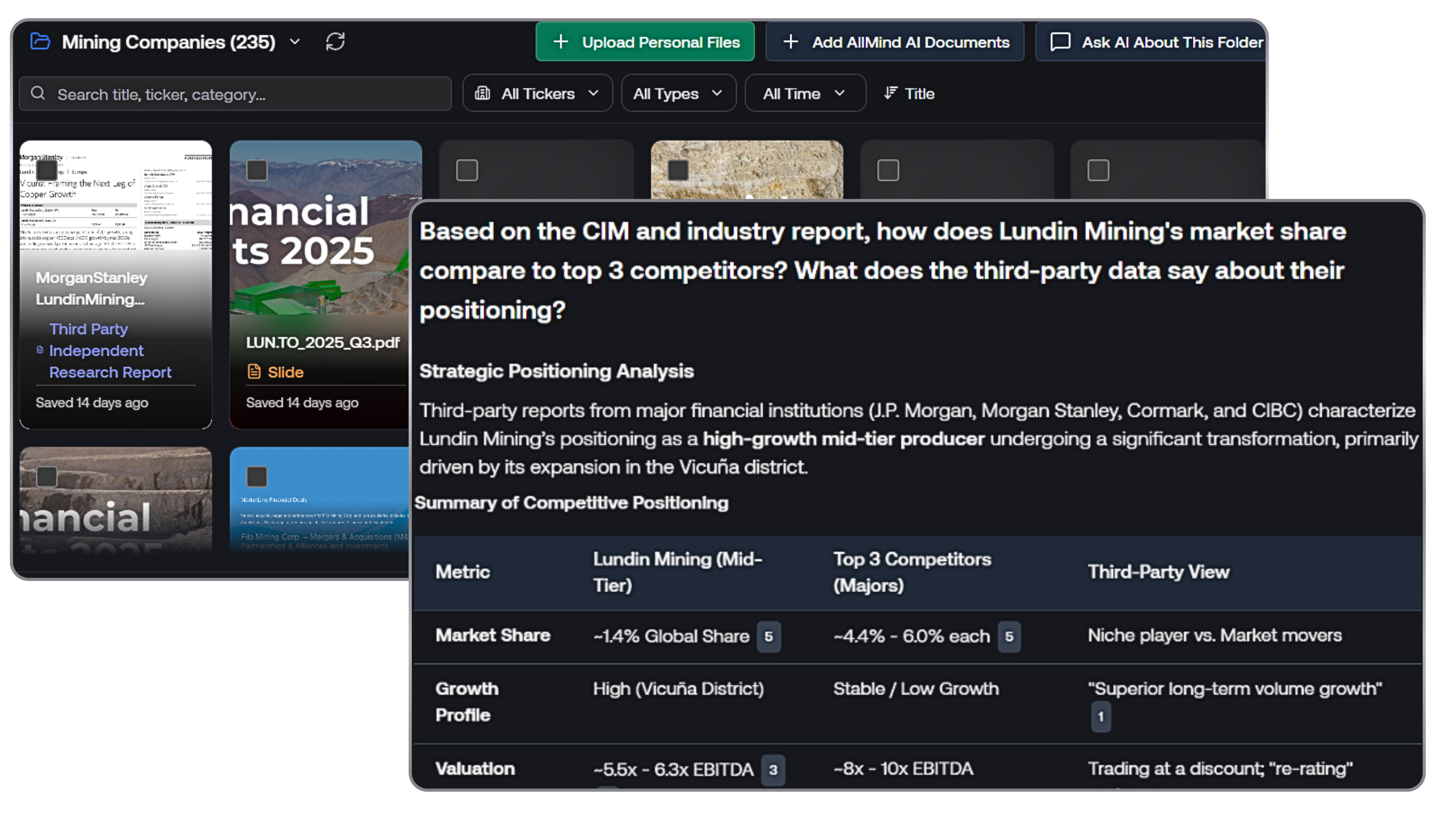
AlphaSense publishes its ceilings, which is to its credit. Generative Grid caps at 400 documents by 12 prompts per grid, per a help article updated 21 August 2026. Workflow Agents run up to 10 at a time and only Custom agents can be scheduled, per one updated 9 April 2026. Deep Research is documented at 10 to 30 minutes on a complex question, in a product article from 13 June 2025.
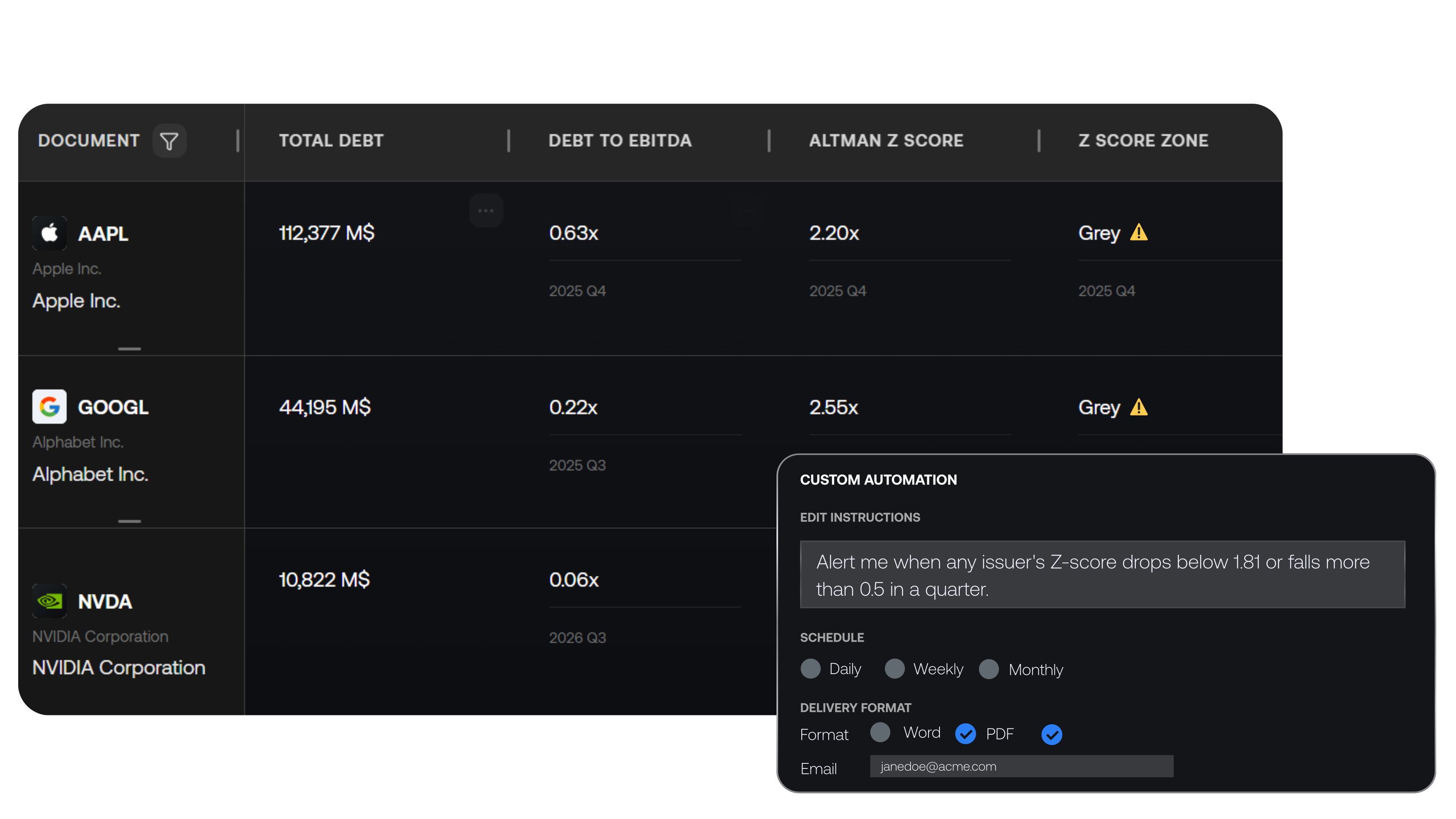
SuperAnalyst, announced on 3 June 2026 as the always-on layer above all of this, went to select enterprise customers in early access, picked up help-center documentation on 29 July 2026, and its product page still read “Coming Soon” on 30 August 2026. AllMind is bought for the opposite shape of work: an agent that runs for minutes, hours or across days over many data points, built in Agent Studio, with AllMind’s compare pages putting one automation at up to 200 companies. For one fast lookup, the shorter run is the better tool.
Where AlphaSense is strong
AlphaSense earns its reputation. Founded in 2011, it has assembled the library the subscription is bought for: 500M+ premium documents, Wall Street Insights broker research from 1,000+ sell-side and independent firms, data on 1.4 million private companies, 4,100+ drivable Canalyst models, and, through Tegus, roughly 300,000 investor-led expert transcripts across 29,000+ companies with 8,000+ added a month. All of that is company-stated as of August 2026.
It will also sell you a new call at a published rate, the expert’s rate plus a flat $75 transcription fee, or send its AI Interviewer to conduct one for you, and AllMind matches neither. It publishes a developer portal with an Agent API and a hosted MCP connector it labels beta, and in August 2026 Forrester named it the only Leader in its Market and Competitive Intelligence Platforms Wave for Q3 2026, a market-intelligence evaluation rather than a financial-research one. If your bottleneck is reaching evidence your desk does not have yet, AlphaSense is the better first call.
One owns the library. The other joins your own systems to it.
AllMind
The AI research system for institutional investors
One maintained map of companies, suppliers, customers, estimates and filings, holding entitled external data and the firm’s own systems side by side, with agents running over the whole of it.
The corpus behind it runs to 750M+ documents across 6,800+ premium data sources: S&P, FactSet, LSEG and MSCI data, broker research, Expert Insights, live news from thousands of sources worldwide, global investor-relations data, live earnings and financials within minutes, alternative data, and sector-specific datasets. Snowflake, Databricks and S3 are read in place under a scoped IAM role.
AlphaSense
The market-intelligence search and content library
A licensed corpus with finance-tuned search, agents and Office add-ins layered on top. The company states 500M+ premium documents spanning filings, transcripts, news, broker research and, through its 2024 acquisition of Tegus, roughly 300,000 investor-led expert transcripts.
Enterprise Intelligence indexes internal content through more than twenty named connectors, and since 14 July 2026 PowerPoint and Excel add-ins draft decks and models against all of it.
What each one is good at, and what it costs you
AllMind
- Agents that run for minutes, hours or across days over many data points
- Warehouse rows joined to filings, earnings and broker research through one entity map
- Every figure traces to its source passage, with a verification pass before a report ships
- Agents inherit a user’s entitlements and can never widen them, and every access is logged
- AllMind’s compare pages state up to 200 companies in a single automation
- Word memos and research notes as well as decks and models
- Not a live trading or execution terminal
- No in-platform expert-call booking and no published rate card
- Live embargoed broker research needs the firm’s own RMS entitlement
- Connecting internal systems is a data conversation with engineering, not a signup
AlphaSense
- Data on 1.4 million private companies and KPIs across 115+ industries
- Wall Street Insights broker research from 1,000+ sell-side and independent firms
- More than twenty named connectors, from SharePoint and Box to Slack, Salesforce and Zoom
- A published expert-call rate: the expert’s rate plus a flat $75 transcription fee
- Only Leader in Forrester’s Market and Competitive Intelligence Platforms Wave, Q3 2026
- $700M+ ARR in Q2 2026, and a $7.5B valuation from a round announced 3 June 2026
- No Snowflake or Databricks connector appears anywhere it publishes
- Connected sources are ingested and indexed rather than queried where they sit
- The PowerPoint and Excel add-ins are in open beta, and there is no Word assistant
- SuperAnalyst is still rolling out; its product page read “Coming Soon” on 30 August 2026
What AllMind and AlphaSense actually cost
AllMind
Quote-based, nothing published
Nothing here is bought on a card: no self-serve checkout, no monthly plan, so anyone outside an institution is better off with a self-serve tool. A quote turns on seat count, on how deep the internal connections go, and on whether live embargoed broker research rides on an RMS entitlement the firm already holds.
- Platform subscription
- No published price, quote-based
- Self-serve or monthly plan
- None offered
- Expert Insights
- Built-in content class, no rate card published
AlphaSense
Quote-based, except for expert calls
The pricing page names two tiers, Market Intelligence and Enterprise Intelligence, and no dollar figure: it asks you to “Connect with our sales team for scalable pricing” and offers “flexible subscription options, from enterprise-wide solutions to per-seat pricing”. Expert calls and Canalyst models sit under product add-ons, the clearest published signal that both are metered or entitled on top of the base subscription.
- Expert calls
- A flat $75 transcription fee on top of the expert’s own rate
- Typical expert rate
- About $450 on average, with no distribution published
- Median contract
- $17,500 a year, range $9,250 to $51,000, 38 purchases
- Per seat
- $10,000 to $20,000, enterprise deals $50,000 to $100,000+
- Average annual spend
- $12,210 under 1,000 employees, $123,760 above, across 160 customers
What changes the quote
Seats first on both sides, then entitlements. On AlphaSense the step from Market Intelligence to Enterprise Intelligence buys the internal-content connectors, broker research through Wall Street Insights is an entitlement layer above that, and expert calls are metered per call, so a diligence-heavy quarter moves the invoice without anyone adding a seat.
On AllMind the same two levers apply, seats and how much internal plumbing the deployment covers. Whether a desk sees live embargoed broker research depends on an entitlement it holds with its own RMS, and anything aftermarket lands on a delay that varies by broker.
These estimates measure different things: Vendr’s $17,500 is a whole contract, not a seat, and SpendHound is actual spend by company size. Expert calls are metered on top of the subscription. The ~$450 expert rate is an average with no distribution published, so a call can land either side of it. Expert-network rates are publicly reported at roughly $700 to $1,500 an hour, and Inex One put a typical hour at $1,000 to $1,400 in February 2026, so $450 plus the $75 fee sits under that band. AlphaSense says the calls save 70% on average against traditional networks, with no baseline published. No AllMind figure appears here: AllMind publishes none.
Which one you want, task by task
We need six primary calls on a niche industrial supplier, and we hold no expert-network contract.
AlphaSense books and runs the calls inside the product at a published rate, a flat $75 transcription fee on top of the expert’s own rate, with an AI Interviewer option. AllMind reads expert transcripts through Expert Insights, entitled to the firm or arranged through AllMind, but publishes no booking flow and no rate card.
Refresh the model for 180 covered names the week after earnings, flag anything that moved guidance, then hand me a memo per name.
Depth and duration of the run. AllMind is built for an agent working across days over many data points, with its compare pages stating up to 200 companies per automation and Word memos as an output. AlphaSense caps a Generative Grid at 400 documents by 12 prompts and runs 10 Workflow Agents at once.
Read our position history out of Snowflake against the last four 10-Qs and show me where our estimate diverges from the Street.
Half of this question lives in Snowflake. AllMind reads it there under a scoped IAM role and lines it up against the filings through the ontology, while AlphaSense names no Snowflake or Databricks connector as of August 2026, so that half never reaches its index at all.
Track competitive and regulatory chatter across a therapeutic area, pull the broker views, and build the strategy deck for the board.
Both platforms carry broker research, expert content and private-company data. AlphaSense wins for its exact 1,000+ firm archive, Tegus depth or PowerPoint add-in; AllMind wins when those classes need joining to the firm’s pipeline and cost data, other licensed providers and an ontology before the cited deck ships. Test provider-level coverage on both sides.
AllMind and AlphaSense reward different edges: joining your own systems to entitled external data, or the size and reach of the library it owns.
Choose AllMind when the slow work spans 6,800+ premium data sources and the firm’s systems, follows supplier and customer relationships, and ends in a cited memo, model or deck. AllMind already carries broker research and Expert Insights as content classes.
Choose AlphaSense when the requirement is its exact broker-provider archive, Tegus transcript depth, Canalyst model library, or commissioning a new expert call at a published rate. Those specific services, not broker and expert content as whole classes, are the parts that require a coverage test or a retained AlphaSense seat.
AllMind vs AlphaSense, answered
Yes for licensed research and expert-content synthesis; not as a replacement for commissioning new calls or for every AlphaSense-specific archive.
AllMind carries broker research and Expert Insights across 6,800+ premium data sources, adds the firm’s systems, and joins everything through an ontology. AlphaSense holds a documented broker archive, roughly 300,000 Tegus transcripts, Canalyst models and a marketplace that books new calls at a published rate. A switch should test exact provider and transcript coverage; teams that need new-call commissioning should retain that service.
See AllMind on your own coverage
Join leading hedge funds and institutional investors who trust AllMind.Join leading hedge funds and institutional investors who trust AllMind to accelerate their research and analysis.