
AllMind vs Bloomberg AskB
AllMind is a standalone AI research system for institutional investors: agents read a firm’s warehouse tables alongside filings, transcripts, broker research and expert calls, then return the model, memo or deck as a file.
ASKB is Bloomberg’s agentic AI interface, in beta since February 2026, and it ships inside a Terminal seat. The split: the deliverable against the tape.
A standalone platform built on a financial ontology, so agents follow the links between a company, its suppliers, its estimates and its filings instead of pulling documents one at a time. The run ends in a file, and every number traces to its source passage.
A coordinated network of AI agents inside the Terminal, in beta since February 2026 and on mobile since August 2026. It answers over data, news, research and analytics the user already holds, attributes each answer to source, and hands over the BQL behind it.
If the seat sends orders, marks cross-asset positions or lives on Instant Bloomberg, the Terminal is unmatched and ASKB comes with it. If the seat reads and writes for a living, AllMind is built for that work and needs no Terminal.
Feature by feature
How the AI is bought
Standalone product, no terminal seat required
- AllMind
- Supported
- Bloomberg AskB
- Not supported
Assistant priced separately from the platform
- AllMind
- Supported
- Bloomberg AskB
- Not supported
Assistant generally available
- AllMind
- Supported
- Bloomberg AskB
- Beta since Feb 2026
Assistant on mobile
- AllMind
- Not published
- Bloomberg AskB
- Supported
Research output
Excel models (DCF, LBO, comps) as files
- AllMind
- Supported
- Bloomberg AskB
- BQL you extend
Word memos and IC decks as files
- AllMind
- Supported
- Bloomberg AskB
- Reports and briefs
Investment-bank deck templates
- AllMind
- 20+ templates
- Bloomberg AskB
- Not documented
Edits existing PPTX, DOCX and XLSX
- AllMind
- Supported
- Bloomberg AskB
- Not documented
Scheduled recurring report
- AllMind
- Supported
- Bloomberg AskB
- Morning Report
Event-triggered research runs
- AllMind
- Supported
- Bloomberg AskB
- Apr 2026 roadmap
Many companies in one automated run
- AllMind
- Up to 200 (stated)
- Bloomberg AskB
- Not documented
Content and entitlements
Broker research inside the platform
- AllMind
- AMR included; live via RMS
- Bloomberg AskB
- Supported
Expert-call transcripts
- AllMind
- Expert Insights
- Bloomberg AskB
- GLG / Third Bridge
Alternative data
- AllMind
- Supported
- Bloomberg AskB
- Second Measure
Live news and newswires
- AllMind
- Supported
- Bloomberg AskB
- Bloomberg News
Private-markets fund documents
- AllMind
- Data Rooms
- Bloomberg AskB
- Canoe deal pending
Your own data
Warehouse queried in place
- AllMind
- Snowflake, Databricks, S3
- Bloomberg AskB
- Not documented
Persistent internal document store
- AllMind
- Supported
- Bloomberg AskB
- RMS notes only
Per-user entitlements the assistant inherits
- AllMind
- Supported
- Bloomberg AskB
- Supported
Market data and execution
Bloomberg/BVAL-equivalent evaluated pricing and reference-field breadth
- AllMind
- Not supported
- Bloomberg AskB
- Supported
Order and execution management
- AllMind
- Not supported
- Bloomberg AskB
- EMSX / AIM / TOMS
Institutional messaging network
- AllMind
- Not supported
- Bloomberg AskB
- Instant Bloomberg
Commercial and governance
Published list price
- AllMind
- Not supported
- Bloomberg AskB
- Not supported
SOC 2 Type II
- AllMind
- Certified Nov 2025
- Bloomberg AskB
- Not published
No training on customer data
- AllMind
- Supported
- Bloomberg AskB
- Not published
Compiled from public sources and AllMind product documentation, verified August 30, 2026. Cells reading “Not documented” or “Not published” mean the capability is not publicly documented, not that it is absent. bloomberg.com blocks automated verification, so every Bloomberg fact here comes from independent reporting, from professional.bloomberg.com, or from a Bloomberg release reproduced on a third-party wire. “Apr 2026 roadmap” means Bloomberg has announced the capability without confirming it shipped. ASKB has been in beta since February 2026 and we could find no general-availability announcement.
See AllMind on your own coverage→Three things a Terminal seat does not do
An attributed answer is not a finished deliverable
An attributed answer is where the analyst’s work restarts. Bloomberg’s own August 2026 description of ASKB is user-entitled data, news, research and analytics with transparent attribution back to source, plus the BQL behind any structured analysis so an analyst can extend it in Excel or BQuant. That is a good answer and a real audit trail. It is also a table to work from, because somebody still opens Excel and still writes the note.
AllMind carries the same run through to the file. Ask for the comps and it returns an Excel model with live formulas. Ask for the write-up and it produces a Word note or a deck on one of 20+ investment-bank templates, citations intact, each number linked to the passage it came from, with a verification pass across the figures before anything leaves. The limit worth naming is the template: a firm that insists on its own house layout still reformats at the end, and the judgment and the rating stay with the analyst.

Half the research already sits inside your own systems
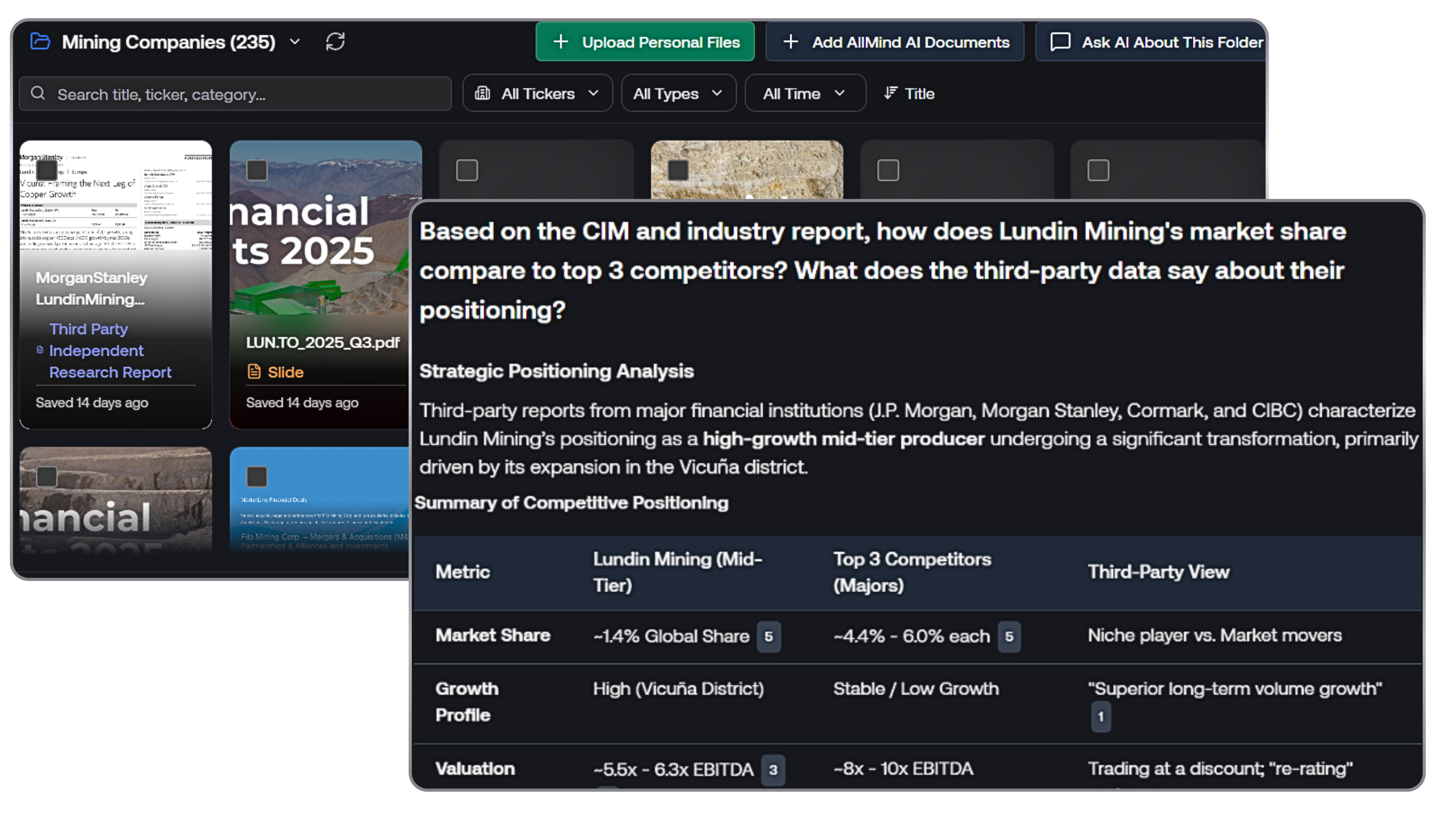
Half the research a firm needs sits inside its own systems, and ASKB does not reach it. ASKB grounds on Bloomberg’s universe, and the April 2026 roadmap extends that to a firm’s own material through RMS Enterprise, which surfaces internal research notes held inside Bloomberg (A-Team Insight, April 2026). That is your notes, in Bloomberg’s system. Bloomberg publishes no warehouse connector for ASKB.
AllMind starts from the other end. Scoped IAM roles reach Snowflake, Databricks and S3, queried where they sit so nothing is copied out, and Google Drive or OneDrive folders sync into a Data Room. What matters is less the connector list than the join: a position sizing file, a proprietary supplier dataset and a broker note get read in one run, held together by the ontology as entities and relationships rather than three searches. A user’s entitlements carry into that run, no agent widens them, and every access is logged. The caveat: reaching that depth takes a data conversation and an IAM scope review, not a signup.
A morning brief and an unattended multi-day run are different products
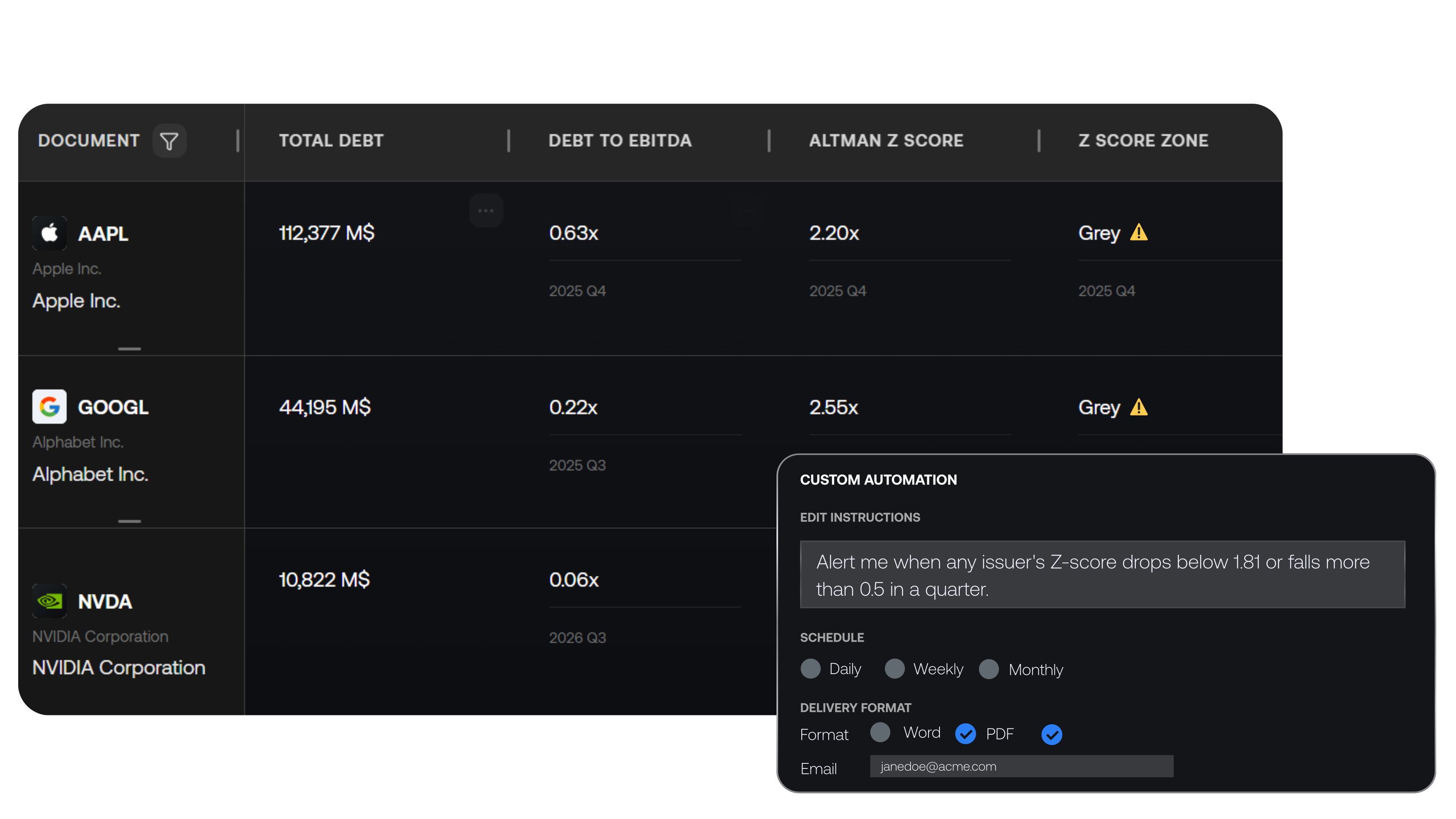
A morning brief and an unattended multi-day run are different products. Bloomberg shipped scheduling in August 2026, a Morning Report that follows the user across desktop and mobile. Its April 2026 roadmap goes further, describing an ASKB Workflows layer with “scheduled or trigger-based execution” (A-Team Insight), so triggered runs sit on Bloomberg’s stated path with only the Morning Report confirmed shipped. Either way the unit of output is a brief.
AllMind is built for the other shape, an agent that stays on one job for minutes, hours or days across many data points, and AllMind states a single automation can follow up to 200 companies, delivered as Word or PDF. The difference shows during earnings season. A brief tells you what happened this morning. A run reads forty transcripts against the prior four quarters, pulls the guidance language, checks it against consensus and your own model file, and returns a table plus the exceptions worth an hour. That 200-company figure comes from AllMind’s compare pages, and /platform/agent-studio publishes no cap.
Where Bloomberg AskB is strong
Bloomberg is the incumbent for good reason, and this is not a close call in its home categories. Its cross-asset pricing is what other systems mark against, and a valuation committee cares about that more than any research feature. The Terminal is a full decision-to-execution system through EMSX, AIM and TOMS, a category AllMind deliberately does not enter: it is not an OMS, an EMS or a trading system. Instant Bloomberg is the messaging fabric of institutional finance, and no research product replicates a network.
ASKB ships with an explicit accuracy check rather than a promise: Bloomberg says post-processing confirms a returned number “actually came from an attributed source, down to a particular bullet point” (A-Team Insight, April 2026), and it arrives entitled to everything the user has, with no procurement or data conversation. Expert-call content sits on both sides now, through Third Bridge in April 2026 and GLG in May 2026, so that is an honest tie. Bloomberg’s security posture is not ours to characterize; ask them for it.
What you are actually buying in each case
AllMind
AI research system for institutional investors
A standalone platform built around a financial ontology: a maintained map linking companies, their suppliers and customers, estimates, filings and a firm’s own research, so agents follow those links rather than retrieving documents.
It reads across a company-stated 6,800+ premium data sources: S&P, FactSet, LSEG and MSCI data, broker research, Expert Insights, live news from thousands of sources worldwide, global investor-relations data, live earnings and financials within minutes, alternative data and sector-specific datasets. Those join the firm’s Snowflake, Databricks or S3 tables, queried in place. Work leaves as an Excel model, a Word memo or a deck.
Bloomberg AskB
Agentic AI inside a Bloomberg Terminal seat
A coordinated network of AI agents built into the Bloomberg Terminal, introduced on February 23, 2026 and extended to the mobile app on August 18, 2026 for enabled Bloomberg Anywhere subscribers.
It answers over data, news, research and analytics the user is already entitled to, attributes answers back to source, and exposes the BQL behind structured analysis so an analyst can extend it in Excel or BQuant. ASKB is a feature of the seat, not a product of its own.
What each one is good at, and what it costs you
AllMind
- No Terminal seat required; the AI is the product, not a feature of one
- Deliverables ship as files: Excel models with live formulas, Word memos, PowerPoint decks
- Edits existing PPTX, DOCX and XLSX, not only newly generated files
- Warehouse tables are queried in place, so internal data joins the external corpus uncopied
- Expert Insights is built in, so a desk reads expert calls without its own network contract
- One automation can follow up to 200 companies, by AllMind’s own account
- Not a trading or execution terminal, and no cross-asset reference pricing
- Live embargoed broker research needs the firm’s own RMS entitlement; aftermarket arrives on a delay
- Real depth means connecting internal systems, which is a data conversation rather than a signup
- ISO 27001 is targeted for Q1 2027; SOC 2 Type II is certified as of November 2025
Bloomberg Terminal
- Cross-asset reference pricing across equities, fixed income, FX, rates, commodities and derivatives
- Order and execution management on the same seat through EMSX, AIM and TOMS
- Instant Bloomberg, the messaging network the Street runs on
- 1,200+ permissioned research providers and 59,000+ listed companies covered, by Bloomberg’s own count
- Four decades of Terminal history, plus Bloomberg News and Bloomberg Intelligence
- ASKB arrives already entitled to the user’s data, with nothing to procure or connect
- ASKB has been in beta since February 2026, with no general-availability announcement
- Cannot be bought without a Terminal seat, and Bloomberg publishes no price for one
- No warehouse connector is documented; internal content means research notes inside Bloomberg
- Private-markets document automation is a pending Canoe Intelligence acquisition, announced July 2026
What AllMind and Bloomberg AskB actually cost
AllMind
No published price, quoted per firm
The pricing page offers enterprise-wide and per-seat subscriptions and publishes no figure, no tier names and no trial terms. That cuts both ways: we are not going to claim to be cheaper per seat than a Terminal without a number to show, because a comparison between two unpublished prices is a comparison between two quotes. The structural difference is that reaching AllMind does not require a Terminal seat.
- Terminal seat required
- No
Bloomberg Terminal
No published price, and ASKB has none of its own
Bloomberg publishes no price page, no rate card and no tier, and its own Terminal page carried no figure when we checked it on August 30, 2026. What is public is a dated series rather than a band, taken from two Bloomberg client letters reported by NeuGroup and set out below. ASKB adds nothing to that bill and cannot be bought without the seat.
- Published list price
- None
- Single terminal, per year
- Roughly $30,000 to $32,000
- Level from Jan 1, 2023
- $30,000 single, $26,580 multi
- Level from Jan 1, 2025
- $31,980 single, $28,320 multi
- Subscription term
- Two years
- Per terminal on volume deployments
- $18,000 to $25,000
- Per user per year, 2022 level
- About $24,000 to $27,000
- ASKB, priced on its own
- Not sold separately
What changes the quote
On the Bloomberg side the unit is the seat, and the seat is close to all-inclusive: data, news, analytics, Bloomberg Intelligence research, Instant Bloomberg and ASKB on one login, with volume discounting past a handful of terminals. The real drivers sit outside the seat: enterprise data licenses (B-PIPE, Data License), which took the same 6.5% increase in January 2025, plus execution modules and hardware.
On the AllMind side, what moves a quote is which dataset classes a firm entitles, how many internal systems connect, and how much automated agent work runs. Live embargoed broker research needs the firm’s own RMS entitlement either way, a license the firm already pays for.
Read the Bloomberg figures as a dated series rather than a range to pick from, on a two-year cycle Bloomberg ties to weighted global inflation. The older public numbers nearer $24,000 describe 2022 or carry no price year at all, and Vendr’s lower tiers are volume-discount estimates for multi-terminal deployments, which is a different unit from one seat. Ask which year and which unit any number refers to, on both sides. Our 2026 AI research tools pricing guide works through what the rest of the category charges.
Which one you want, task by task
I cover 25 names and need every guidance change flagged before the morning meeting.
The deciding mechanism is an automation that runs the whole coverage list and traces each change to the passage it came from, against a Morning Report that is a scheduled brief rather than a per-name diff. Fair warning: Bloomberg’s April 2026 roadmap describes trigger-based workflows including pre- and post-earnings reports, so this gap may close.
I am marking a distressed credit book and need a price my valuation committee will accept.
The deciding mechanism is Bloomberg’s evaluated pricing and BVAL-grade cross-asset reference depth, which valuation committees already accept. AllMind carries licensed market data and 40+ exchange and venue feeds, but does not claim Bloomberg/BVAL-equivalent evaluated marks or field parity.
I have to produce an initiation note and a comps model on a name the PM asked about yesterday.
The deciding mechanism is document generation: an Excel model with live formulas and a Word note built on a supplied template, against BQL you extend in Excel or BQuant yourself. The template is the limit, so an in-house layout means a reformat at the end.
We run a two-Terminal desk and are hiring a third analyst who will never trade.
Keep the Terminals for the tape and the orders, and put a reader and writer on the system built for reading and writing. A Terminal seat is publicly reported at roughly $30,000 to $32,000 a year, while AllMind quotes rather than publishes, so get both numbers before either vendor tells you which is cheaper.
AllMind and Bloomberg AskB reward different edges: the finished deliverable built over your own data, or the incumbent data, execution and messaging stack.
If your edge is what comes out the other end, choose AllMind: agents traversing an ontology over filings, transcripts, broker research, Expert Insights and the warehouse tables you already own, working for minutes or hours rather than one shot, and returning the model, the memo or the deck as a file.
If your edge is the tape, the marks, Instant Bloomberg and an order that leaves the same screen, keep the Terminal; ASKB comes with the seat. Most desks run both; the only genuine swap is the marginal research-only seat.
AllMind vs Bloomberg AskB, answered
For a research-only seat, often yes; for a trading seat, no, and AllMind does not claim otherwise.
The Terminal is a decision-to-execution system: cross-asset pricing, EMSX, AIM and TOMS for orders, Instant Bloomberg for messaging. AllMind is not an OMS, an EMS or a trading system. What it replaces is the research-to-deliverable path: filings, transcripts, broker research, expert calls and your own warehouse read together, then the model, the memo or the deck as a file.
The test: does the person holding the seat ever send an order? If they do, keep the Terminal. If they read and write for a living, the seat buys a tape they never touch.
See AllMind on your own coverage
Join leading hedge funds and institutional investors who trust AllMind.Join leading hedge funds and institutional investors who trust AllMind to accelerate their research and analysis.