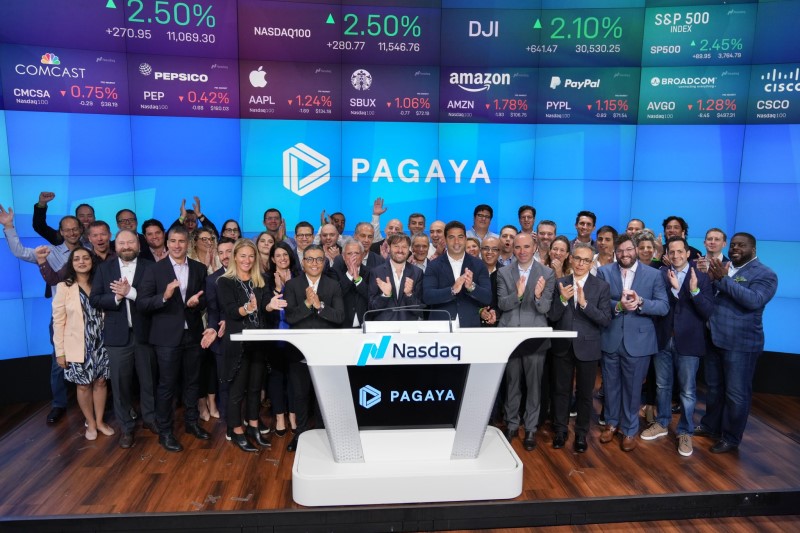
Pagaya Technologies posted its fifth consecutive quarter of GAAP profitability in Q1 2026, with EPS of $0.73 versus $0.20 expected, a 265% surprise, even as revenue of $318 million came in slightly below the $323.63 million consensus. Management raised the lower end of full-year 2026 adjusted EBITDA guidance and lifted the upper end of GAAP net income guidance. Benchmark reiterated a Buy rating and $33 price target, citing stronger fundamentals despite tighter credit-box settings that are reducing near-term volume.
Pagaya’s setup is less about a one-quarter earnings beat and more about a proof point that its model can still monetize through the credit cycle after deliberately shrinking its own risk appetite. That matters because the market has been treating AI-enabled credit originators as highly levered beta to benign lending conditions; sustained profitability while the company is tighter on the credit box suggests operating leverage may be more durable than feared. The real second-order implication is that funding partners are likely to value the platform more for risk-adjusted throughput than raw volume, which can support better economics per deal even if headline originations stay muted.
The near-term tension is that the market may initially reward the guide raise, but the stock can still be vulnerable if investors conclude earnings quality is coming from mix and discipline rather than re-accelerating growth. In the next 1-2 quarters, the key catalyst is whether the tighter underwriting regime preserves loss performance while funding network expansion offsets lower unit volume; if both hold, multiple expansion is justified, but if volumes stall again the “quality over quantity” story loses momentum quickly. Because the valuation is anchored to growth expectations, any sign of normalization in consumer credit or partner caution could compress the multiple faster than the business fundamentals deteriorate.
The contrarian angle is that consensus may be underestimating how much of Pagaya’s upside is already pulled forward by the rerating to profitability. A company trading as a growth-fintech with a low apparent PEG can look cheap until the market asks whether this is a structurally better business or just a temporarily safer one; those are very different terminal value cases. If management keeps choosing margin and credit quality over volume, upside becomes steadier but likely slower than the market’s most aggressive AI-fintech narrative implies.
AI-powered research, real-time alerts, and portfolio analytics for institutional investors.
Request DemoOverall Sentiment
moderately positive
Sentiment Score
0.62
Ticker Sentiment
