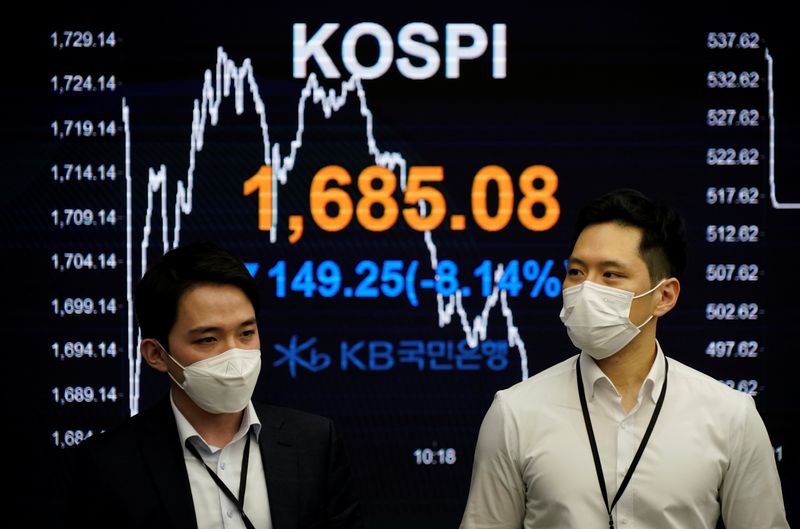
BCA Research downgraded Korean equities to neutral from overweight after the KOSPI surged more than 50% in three months, 173% over the past year, and roughly 4.5% in the last month, warning that the market has become the most stretched expression of the global risk-on trade. The firm cited speculative excess in semiconductor stocks, heavy retail buying, weak breadth, and historically low cash balances as signs of late-cycle vulnerability. It remains constructive on the Korean won versus the U.S. dollar and Korean 10-year government bonds, but recommended taking profits on its long Asian semiconductor/short U.S. hyperscalers trade, which has returned about 140% since November 2025.
This is a classic late-stage liquidity-led tape where one market becomes the marginal expression of global risk appetite. Korea is not just overextended on valuation; it is vulnerable because its rally is unusually dependent on a narrow cluster of semiconductor leaders and crowded retail participation, which means small disappointments can trigger outsized de-grossing. That concentration also creates second-order pressure on suppliers, equipment vendors, and momentum-sensitive regional ETFs, while less-loved domestic cyclicals could underperform simply from factor rotation rather than any change in fundamentals.
The more interesting setup is that the market is now carrying less cash and weaker breadth at the same time, which removes the usual cushion that allows dips to be bought. In this regime, the first drawdown is often mechanical: systematic trend followers and retail flows can reverse over days, not months, if the KOSPI loses key moving averages. The risk is not a single earnings miss; it is a regime shift from “AI scarcity premium” to “crowded beta unwind,” which can compress the index faster than consensus expects.
The contrarian angle is that the strongest signal may not be to short Korea outright, but to fade the most reflexive winners while staying constructive on the balance-sheet assets that benefit from a risk-off correction. A stronger won and resilient Korean duration are consistent with a market that is pricing cyclical excess but not outright macro stress. If equity momentum breaks, local bond yields can fall even as equities de-rate, creating a cleaner relative-value expression than a directional equity short alone.
For SMCI and APP specifically, the article’s implication is not that these names are broken, but that high-duration AI-adjacent winners are becoming more sensitive to crowding and factor de-risking. Their beta to sentiment is likely rising faster than their beta to fundamentals, so any disappointment in AI capex digestion or growth normalization could force sharp multiple compression over a 1-3 month horizon. In that sense, they are better viewed as tactical momentum trades than durable core longs at current positioning extremes.
AI-powered research, real-time alerts, and portfolio analytics for institutional investors.
Request DemoOverall Sentiment
mildly negative
Sentiment Score
-0.25
Ticker Sentiment
