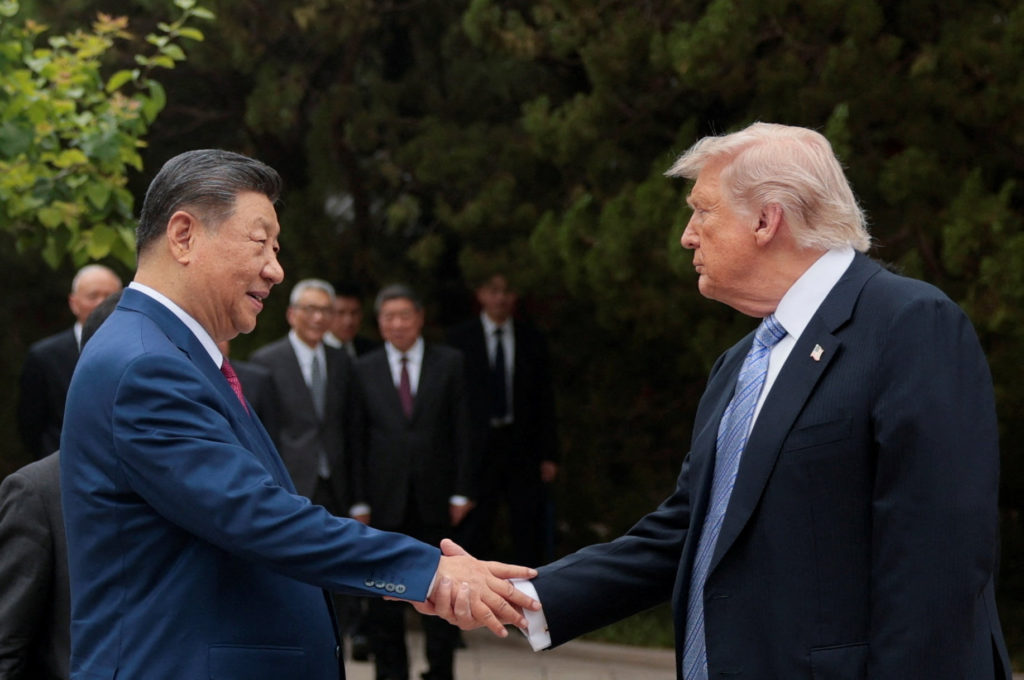
President Trump and Xi Jinping pledged "strategic stability" and agreed to launch a board on trade and investment, but the summit produced few concrete details. The most material unresolved issue was Taiwan, including U.S. arms sales that Trump did not commit to approve, while China signaled continued leverage via rare earths and trade pressure. The article also highlighted broader U.S.-China rivalry across EVs, AI, and access to each other's markets.
The market implication is not “progress” but a temporary de-risking of the most sanctions-sensitive tail risks: Taiwan language, export controls, and rare-earth retaliation. That lowers headline volatility in the near term, but it does not materially change the bargaining structure; both sides appear to be using strategic ambiguity to buy time while preserving leverage. For equities, that usually favors a short-duration relief trade in global cyclicals and industrials, while leaving the medium-term China decoupling premium intact.
BA is the cleaner second-order beneficiary than the news flow suggests. Even if aircraft orders are politically useful, the more important read-through is that Beijing is signaling it can selectively relax pressure when it wants concessions elsewhere; that improves the odds of incremental civil aviation normalization and reduces cancellation risk for already-scheduled deliveries over the next 6-12 months. The risk is that any Taiwan escalation quickly re-politicizes the backlog, so this is best treated as a tactical sentiment trade, not a structural re-rating.
XPEV is more nuanced: the article reinforces that Chinese EV makers are gaining domestic confidence and product credibility, but the U.S. remains an unlikely near-term destination. The investment case is less about U.S. sales and more about global competitive pressure: if Chinese EVs remain locked out of the U.S., they will intensify pricing pressure in Europe, Southeast Asia, and Latin America, which can compress margins for incumbent OEMs and suppliers over 12-24 months. For XPEV specifically, the upside comes from domestic scale and software differentiation; the downside is that any export bottlenecks or tariffs abroad can keep the stock in a valuation trap despite product strength.
The contrarian miss is that “strategic stability” may actually be bearish for the most levered geopolitical hedges: defense and domestic reshoring beneficiaries can underperform if the summit reduces probability of near-term crisis, even if only marginally. The right framing is asymmetric: near-term peace premium compression is tradable, but the structural China-risk premium remains because the core unresolved issue is Taiwan, not trade volumes.
AI-powered research, real-time alerts, and portfolio analytics for institutional investors.
Request DemoOverall Sentiment
neutral
Sentiment Score
0.00
Ticker Sentiment
